


Introduction : Key Questions That Will Transform How You Understand Polarimeters
Are you working in pharmaceuticals, chemical manufacturing, food science, or research labs? If so, you’re likely familiar with the importance of analyzing optically active compounds. A polarimeter is one of the most reliable instruments for measuring optical rotation, concentration, and purity.
In this in-depth Q&A guide, we address 14 frequently questions about polarimeters—how they work, where they’re used, and how to choose the best model for your needs.
1. What is a polarimeter, and how does it work?
A polarimeter is a scientific instrument used to measure the angle of rotation caused when plane-polarized light passes through an optically active substance. It typically employs a light source—such as a sodium or LED lamp—to produce polarized light, which then travels through the sample. The chiral molecules in the sample rotate the plane of this light, and an analyzer measures the resulting angle of rotation. This measurement provides critical information about the compound’s purity, concentration, and chirality, and can also be used to calculate specific rotation.
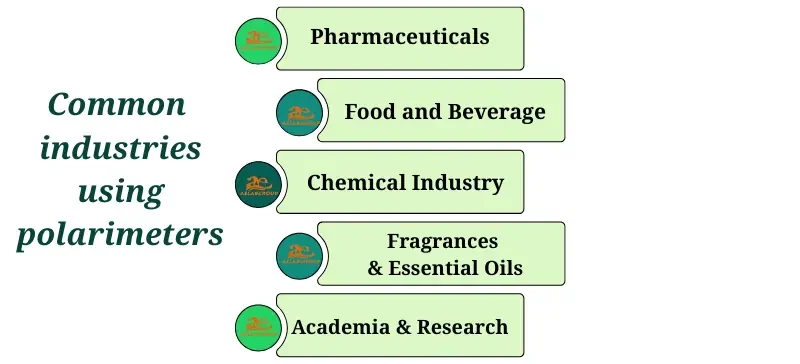
2. In which industries are polarimeters commonly used?
– Pharmaceuticals – For enantiomeric purity and quality control
– Food and Beverage – Sugar and sweetener analysis
– Chemical Industry – Monitoring chiral synthesis
– Fragrances & Essential Oils – Verifying composition
– Academia & Research – Studying molecular structures
3. What types of light sources are used?
| Feature | Sodium Lamp | LED Lamp |
|---|---|---|
| Wavelength | 589.3 nm | 589.3 nm (with filter) |
| Lifespan | 50–200 hours | 5,000+ hours |
| Cost | Higher | Lower |
| Trend | Traditional | Modern standard |
Recommendation: LED sources are more efficient, cost-effective, and long-lasting—ideal for modern labs.
4. Why is temperature control important in polarimetry?
Temperature affects molecular interactions and optical rotation. For high-accuracy results, especially in pharmaceutical applications, polarimeters should feature built-in temperature control or use water baths.
5. Do all polarimeters offer temperature control?
No. Some basic models don’t. However, models with automatic temperature control are recommended for:
Regulatory compliance (e.g., USP <781>)
High-precision measurements
Repeatability and reproducibility
6. What features should I look for when buying a polarimeter?
Accuracy & repeatability
Digital interface & auto-calibration
Temperature control
Sample transmittance sensitivity
Multiple measurement modes
Tip: Always check if the instrument meets GMP or pharmacopeial standards if you’re in a regulated environment.
7. What measurement modes are available in modern polarimeters?
Most advanced digital polarimeters support:
Optical Rotation (OR)
Specific Rotation (SOR)
Concentration
Sugar Content (°Z)
8. How often should a polarimeter be calibrated?
Heavy use: Weekly
Standard lab use: Monthly
High-precision labs: Daily, using quartz calibration standards
Maintaining a calibration log helps ensure ongoing accuracy.
9. Can polarimeters be used in real-time monitoring?
Yes. Digital polarimeters support real-time reaction monitoring and kinetic studies, ideal for research and development environments.
10. Can I use a polarimeter for solid samples?
Primarily, polarimeters are used for liquids. However, certain models allow analysis of solids via:
Dissolution in a suitable solvent
Solid-state holders or flow-through cells

11. How should I fill a polarimeter tube correctly?
Tilt the tube slightly to avoid air bubbles, fill it evenly, and ensure no leaks. Cleanliness is crucial to avoid contamination.
12. How does turbidity affect polarimetric readings?
Turbid or colored samples may scatter light and affect accuracy. Use filtered or clarified samples when possible, or choose models with compensation algorithms.
13. What’s the difference between manual and digital polarimeters?
| Feature | Manual | Digital |
|---|---|---|
| Ease of Use | Requires training | Plug-and-play |
| Output | Analog | Digital |
| Calibration | Manual | Automatic |
| Best For | Education | Industry & research |
Digital polarimeters are recommended for professional labs due to precision, speed, and data logging.
14. What environmental factors affect polarimeter accuracy?
Room Temperature: Ideal between 15–25°C
Humidity: Can affect electronics
Vibration/Lighting: Should be minimized for stable readings
Final Thoughts
Understanding how polarimeters work—and knowing what to look for when buying one—can greatly enhance lab productivity and compliance. Whether you’re testing sugar concentration, monitoring drug purity, or studying chiral molecules, the right polarimeter is key.
Next Step: Explore AELAB’s full line of digital polarimeters for reliable, accurate, and user-friendly solutions tailored to your industry.