Overview
Differential scanning calorimetry (heat-flow type DSC) is a classical thermal analysis technique used to study thermal effects under controlled programmed temperatures. It is widely applied in research and development, process optimization, quality control, and failure analysis across materials science and chemistry. Using DSC, the phase transition of inorganic materials, melting of polymers, crystallization behavior, polycrystalline drug transitions, and solid–liquid ratios in food such as oil can be accurately characterized.
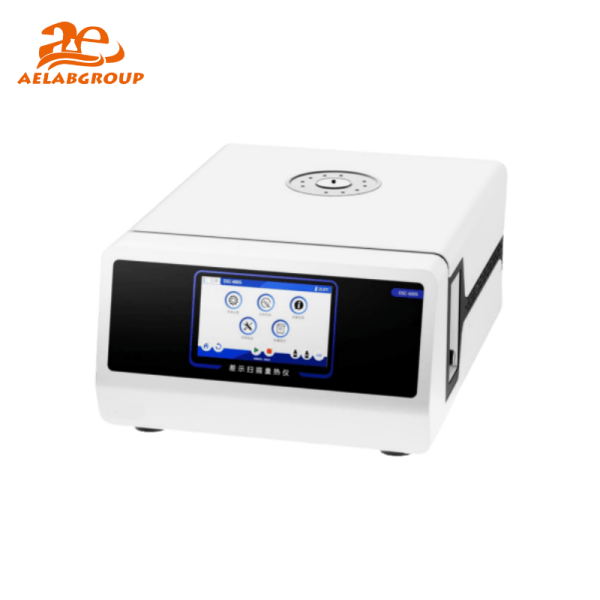
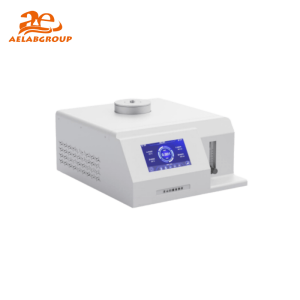
The AELAB AE-DSC600S Differential Scanning Calorimeter measures physical and chemical changes related to heat, including glass transition temperature, melting point, melting temperature, crystallization temperature, crystallization heat, reaction heat, thermal stability, curing and crosslinking, oxidation induction period, and more.
⚙️ Design & Construction
The AE-DSC600S integrates a whole-machine design that minimizes signal loss and interference, improving DSC sensitivity and baseline stability. The system incorporates a high-frequency kernel control processor for fast computing and high-efficiency temperature regulation. An imported high-sensitivity DSC sensor increases accuracy for low-level thermal events. Dual independent atmosphere pathways enable intelligent switching and controlled purge conditions. A 24-bit 7-inch LCD touchscreen provides a clear and intuitive interface for thermal method setup and monitoring.
🔬 Working Principle / Testing Method
The instrument uses heat-flow DSC measurement to quantify the energy difference between the sample and reference during controlled heating, cooling, or isothermal scanning. With FTC and STC temperature modes and a 12-order programmable temperature control system, the AE-DSC600S ensures precise thermal profiling across complex applications. The optimized adaptive dynamic PID algorithm enhances temperature stability while preventing overshoot. Signal sampling is programmable from 1–10 Hz, enabling accurate acquisition of fast or slow thermal transitions. Multi-point temperature correction ensures robust calibration across the entire range up to ~600 °C.
💡 Key Advantages
- High-resolution thermal measurement with 0.001 °C temperature resolution and 0.001 mW sensitivity
- Dual-mode FTC/STC temperature control for flexible experimental design
- Rapid heating capability up to 100 °C/min for high-throughput thermal screening
- Intelligent dual-path atmosphere control with automatic gas switching
- Programmable sampling (1–10 Hz) for enhanced control of signal acquisition
- Advanced PID control minimizing manual adjustments and reducing analysis deviation
- USB-based data export and software communication for GLP-compliant documentation
🔗 Connectivity & Integration
The AE-DSC600S supports USB two-way communication for data upload, method control, and firmware upgrades. Integrated software provides baseline deduction, automatic drawing, advanced data processing, enthalpy and glass transition calculation, oxidation induction temperature analysis, and multi-point calibration functions suitable for regulated laboratory workflows.
🧠 Model Insight
| Model |
Specifications |
| AE-DSC600S |
0~±2000 mW range; Room temperature ~600 °C; 0.001 °C resolution; 0.1~100 °C/min heating rate; 1~10 Hz sampling |
🧪 Testing Applications
The AE-DSC600S is suitable for polymer analysis, pharmaceutical crystallinity studies, material phase transition evaluation, food science testing, oxidation induction time measurement, curing and crosslinking research, and quality assurance in industrial production. It supports R&D laboratories, academic institutions, chemical manufacturing, and materials engineering applications.
Compliance & Quality Assurance
The instrument complies with GB/T 19466.2-2004 / ISO 11357-2:1999 (glass transition), GB/T 19466.3-2004 / ISO 11357-3:1999 (melting and crystallization), and GB/T 19466.6-2009 / ISO 11357-6:1999 (oxidation induction temperature). All AELAB systems undergo rigorous quality control for accuracy, stability, and long-term reliability.