

1. Determine Your Assay Requirements
Start by identifying the types of assays your lab performs most often:
Absorbance: Ideal for ELISAs and turbidimetric assays
Fluorescence: Great for nucleic acid quantification and protein interactions
Luminescence: Common in ATP assays and cell viability studies
If your lab uses multiple assay types, consider a multimode reader to maximize flexibility.
2. Detection Wavelength and Compatibility
Detection wavelength directly impacts assay compatibility:
Common wavelengths include 450 nm, 492 nm, and 630 nm
Dual-wavelength measurements reduce background noise and improve accuracy
Opt for systems that support both single and dual-wavelength detection
Filter vs. Monochromator:
Filter-based systems offer higher sensitivity for fixed assays
Monochromator-based systems allow tunable wavelengths without additional filters
Hybrid systems combine both benefits for versatility and performance
3. Absorbance Range
Choose a Microplate Reader with an adequate absorbance range to ensure accurate and reproducible results:
Standard Microplate Readers typically offer a range of 0.0 to 2.5 OD, which is sufficient for most ELISA applications.
Advanced Microplate Reader models provide up to 3.5 OD or more, delivering better linearity for high-concentration samples.
A wider dynamic range in your Microplate Reader allows consistent performance across various assay types, from routine diagnostics to high-sensitivity analyses.
A wider dynamic range ensures consistent, accurate results across diverse assay types.
4. Detection Speed and Throughput
Speed matters, especially for kinetic assays or high-throughput environments:
Faster read times minimize time-related variation between wells
Batch reading and robotic automation options significantly increase throughput
Balance speed and precision to ensure reliable data
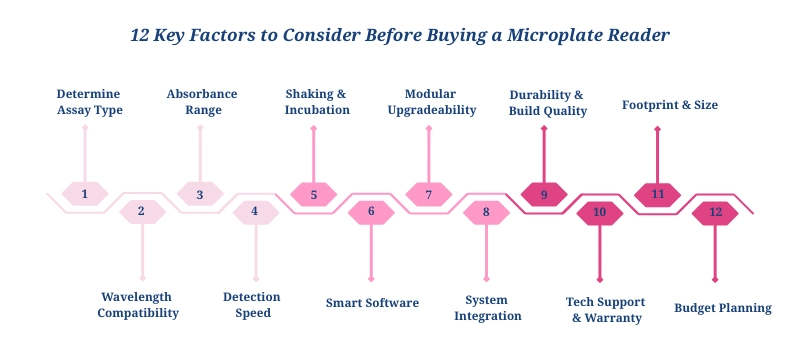
5. Shaking and Incubation Capabilities
Consistency is key in assay development, and a Microplate Reader with built-in shaking and incubation features enhances both accuracy and efficiency:
Shake Function: Ensures uniform color distribution across all wells after reagent addition, improving assay consistency.
Integrated Incubation: Keeps reactions at a precise and stable temperature, essential for temperature-sensitive assays.
By choosing a Microplate Reader with these capabilities, you reduce dependency on external mixers or incubators—saving time, space, and streamlining your workflow.
6. Software & Data Analysis Features
Software often makes or breaks the user experience. Essential features include:
User-friendly, customizable interface
Built-in protocols for ELISA and other common assays
Curve fitting, regression analysis, statistical tools
Real-time visualization and multi-format export (CSV, XML, etc.)
LIMS compatibility for regulated environments
Tip: Always request a demo to test usability and functionality before purchase.
7. Upgradeability and Modular Design
Future-proof your investment with a modular system:
Add detection modes as your research evolves (e.g., add luminescence or fluorescence later)
Include optional modules such as injectors, shakers, or environmental controls
Ensure upgrades can be performed on-site, not just at the factory
8. Integration with Existing Systems
Ensure compatibility with your lab’s infrastructure:
Integration with LIMS and ELNs
Robotic arms or liquid handling systems
Cloud storage or secure local data environments
Seamless software-hardware connectivity increases efficiency and traceability
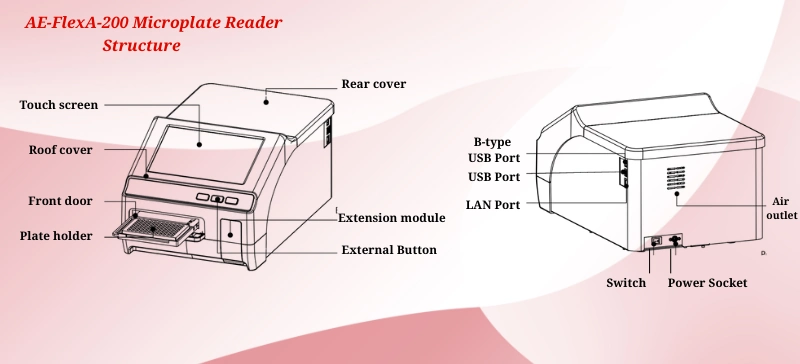
9. Build Quality and Long-Term Reliability
Durability and reliability matter, especially in demanding lab settings:
Look for high-quality materials resistant to corrosion and chemical exposure
Devices proven to perform under high-frequency use, heat, and vibrations
Ask vendors for case studies or long-term performance documentation
10. Technical Support and Warranty
Reliable support ensures minimal downtime:
Is support direct from the manufacturer or third-party?
What’s the average response time?
Are software updates included?
Understand the length and scope of the warranty
Vendors offering both technical and application support are ideal.
11. Space and Footprint Considerations
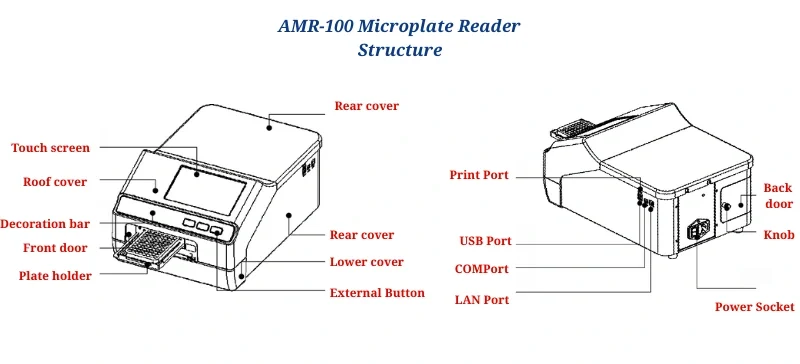
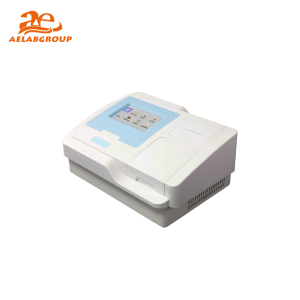
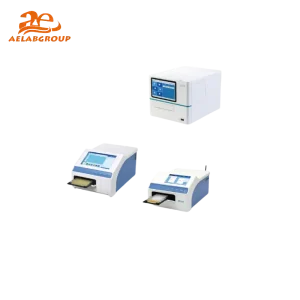
When selecting a Microplate Reader, it’s important to consider your lab’s available space and layout:
Compact readers are great for small or mobile labs
Larger models are suited for core facilities with dedicated bench space
Modular systems often offer better scalability without needing more space
12. Budget and Total Cost of Ownership
Don’t base your decision solely on initial price:
Factor in maintenance, calibration, software licensing, and upgrade costs
Consider consumables and accessory requirements
A slightly higher upfront investment may save thousands in future operating costs