
info@aelabgroup.com
QR Code 1
QR Code 2

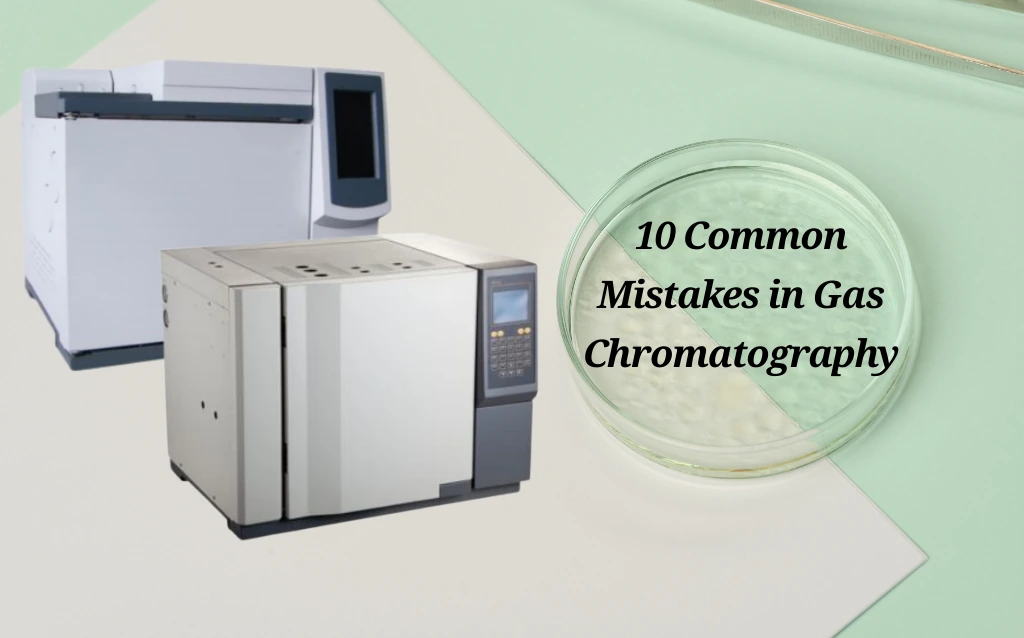
10 Common Mistakes in Gas Chromatography

10 Common Mistakes in Gas Chromatography AELAB

10 Common Mistakes in Gas Chromatography

Introduction

Gas Chromatography (GC) is one of the most powerful and widely used analytical techniques for separating and analyzing volatile compounds. It plays a vital role in pharmaceuticals, food safety, environmental monitoring, and forensic science. However, despite its accuracy and versatility, the technique is highly sensitive to errors. Even small issues can lead to common mistakes in gas chromatography, compromising data quality, reducing reproducibility, and damaging expensive equipment.

In this article, we explore these frequent errors in GC and provide practical, expert-backed tips on how to avoid them—helping laboratories achieve reliable, reproducible, and accurate results.

What is Gas Chromatography?

Gas Chromatography works by vaporizing a sample and transporting it through a column with the help of a carrier gas (such as helium, nitrogen, or hydrogen). As the compounds interact with the stationary phase inside the column, they separate based on their volatility and polarity. The separated compounds are then detected and quantified.

Its major advantages include:

  • High sensitivity and selectivity

  • Quantitative and qualitative analysis

  • Wide application across multiple industries

However, GC’s reliability depends heavily on correct sample preparation, method execution, and instrument maintenance.

Common Mistakes in Gas Chromatography (and How to Avoid Them)

1.Poor Sample Preparation and Handling

One of the most common mistakes in gas chromatography is improper sample preparation. Issues such as contamination, incorrect dilutions, or the use of incompatible solvents can create ghost peaks or even mask target analytes.

✅ Solution:

  • Use clean containers and high-purity solvents.

  • Filter and dilute samples properly.

  • Match solvents with analytes and system requirements.

2. Inconsistent or Incorrect Injection

Fast injections, oversized volumes, or the wrong syringe can cause inlet flooding, backflash, and distorted peaks.

✅ Solution:

  • Use the correct syringe and inject consistently.

  • Control inlet temperature carefully.

  • Rely on autosamplers for reproducibility.

3. Using a New Column Without Conditioning

New GC columns often contain oxygen or contaminants. Direct use without conditioning can shorten their lifespan and degrade separation quality.

✅ Solution:

  • Purge new columns with carrier gas.

  • Condition them at recommended maximum temperatures.

  • Always ensure carrier gas flow before heating.
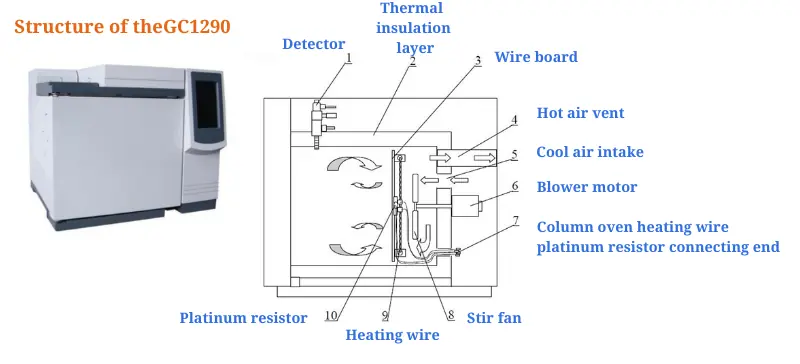
Gas Chromatography (GC) : 6 Key Components You Must Know AELAB

4. Incorrect Carrier Gas Flow and Pressure

Carrier gas flow determines efficiency and resolution. Wrong settings cause broad peaks and poor separation.

✅ Solution:

  • Adjust flow based on column diameter and gas type (e.g., helium ~35 cm/sec, hydrogen ~40–50 cm/sec).

  • Check EPC (electronic pneumatic control) settings routinely.

5. Equipment Leaks

Leaks around septa, inlet seals, or fittings cause unstable pressure and contamination.

✅ Solution:

  • Replace septa regularly.

  • Perform leak checks with detectors.

  • Use only manufacturer-approved consumables (e.g., AELAB-compatible parts).

6. Temperature Control Issues

GC is highly temperature-sensitive. Even small fluctuations can distort retention times and peak shapes.

✅ Solution:

  • Calibrate oven and detectors.

  • Avoid environmental fluctuations.

  • Allow equilibration before starting analysis.
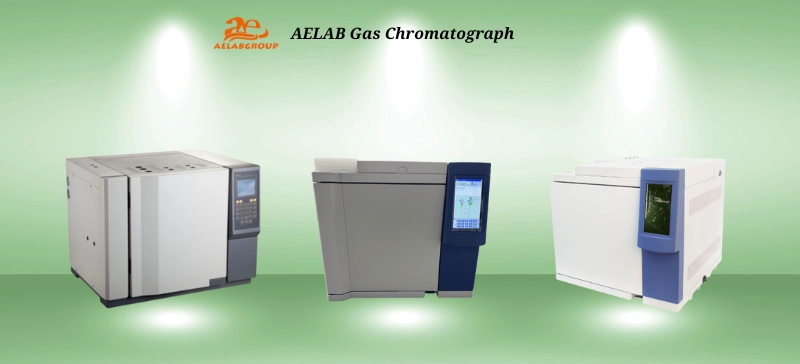
AELAB Gas Chromatograph

7. Running Out of Gas

Among the common mistakes in gas chromatography is running out of carrier or detector gases, which can interrupt the analysis and increase the risk of system contamination.

✅ Solution:

  • Monitor cylinder levels closely.

  • Establish a gas management plan.

  • Replace cylinders before depletion.

8. Detector Instability and Miscalibration

Whether using an FID or MS, incorrect calibration or unstable baselines reduce accuracy.

✅ Solution:

  • Follow manufacturer flow ratios (e.g., 10:1 air to hydrogen in FID).

  • Calibrate detectors regularly.

  • Verify baseline stability before analysis.

9. Neglecting Preventive Maintenance

Skipping regular maintenance is one of the common mistakes in gas chromatography, often leading to residue buildup, contamination, and costly downtime.

✅ Solution:

  • Schedule preventive maintenance.

  • Replace septa, trim columns, and clean detectors routinely.

  • Keep maintenance logs for traceability.

10. Errors in Data Analysis

Even with perfect instrumentation, human error in data analysis can invalidate results.

✅ Solution:

  • Use validated chromatography software.

  • Double-check peak integration and baseline corrections.

  • Provide analyst training in GC interpretation.
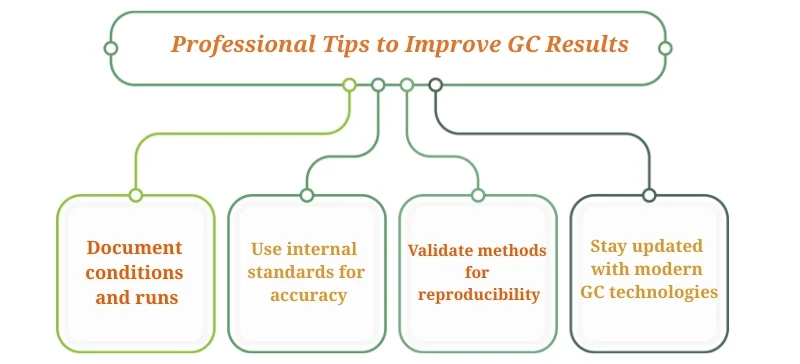
Professional Tips to Improve GC Results

  • Document everything: Keep detailed logs of conditions and runs.

  • Use internal standards: Increase accuracy in quantitative analysis.

  • Validate methods: Test reproducibility before production.

  • Stay updated: Invest in modern GC technologies (e.g., AELAB systems).

Professional Tips to Improve GC Results AELAB

Conclusion

Gas Chromatography is a powerful and precise technique, but only if errors are minimized and best practices followed. By recognizing and avoiding common mistakes in gas chromatography—such as poor sample preparation, incorrect injections, improper column handling, and neglected maintenance—laboratories can achieve high-quality, reproducible, and reliable results.

👉 Call to Action:
Want to ensure peak performance in your lab? Download our GC troubleshooting checklist and explore AELAB’s advanced GC solutions to optimize accuracy, save costs, and extend instrument lifespan.

Frequently Asked Questions

1What is Gas Chromatography (GC)?
Gas Chromatography is an analytical technique used to separate and analyze volatile compounds. It works by vaporizing a sample and transporting it through a column with a carrier gas, where compounds separate based on their volatility and polarity
2Why is sample preparation important in Gas Chromatography?
Poor sample preparation, like contamination or incompatible solvents, can lead to ghost peaks or hide target analytes, affecting the accuracy of results. Proper filtering, dilution, and solvent matching are key to accurate analysis.
3How can improper carrier gas flow and pressure affect GC results?
Incorrect gas flow settings can cause broad peaks and poor separation. It is essential to adjust flow based on the column's diameter and the gas type to maintain efficient separation and resolution.
4What is a common challenge in Gas Chromatography related to maintenance?
Neglecting regular preventive maintenance can lead to residue buildup, contamination, and system downtime. Scheduling routine maintenance and replacing key components like septa ensures reliable performance.
5What are some professional tips to improve GC results?
Keep detailed logs, use internal standards for accuracy, validate methods before production, and stay updated with modern GC technologies to enhance reproducibility, accuracy, and efficiency.
Share:

Categories

Laboratory and Science Knowledge

Leave a Reply

Leave a Reply

Your email address will not be published. Required fields are marked *