

Introduction:
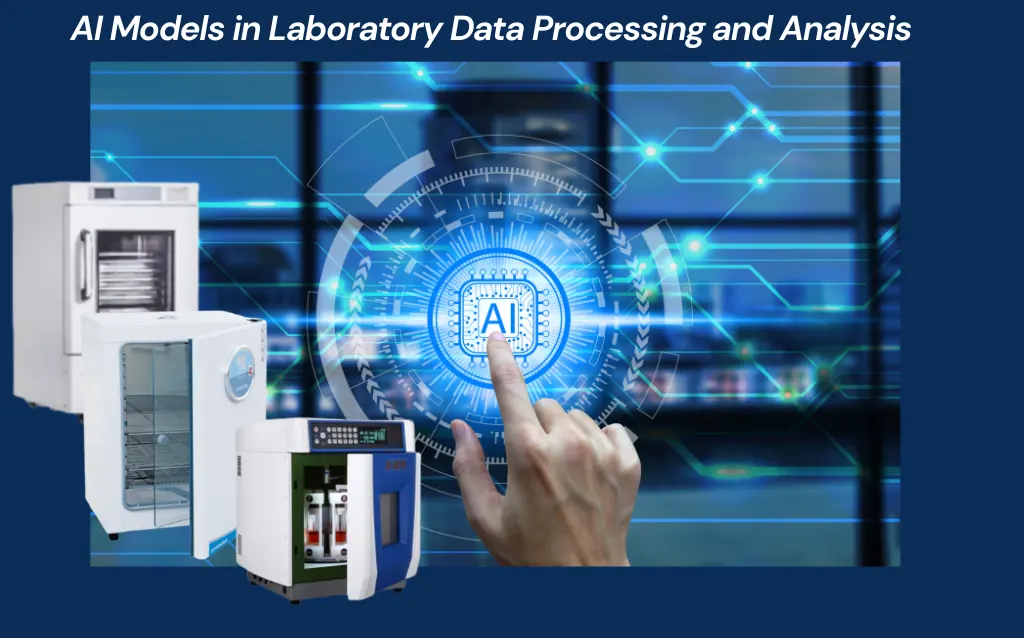
In today’s data-driven laboratories, AI models in laboratory data processing are revolutionizing how scientists collect, interpret, and utilize experimental information.
From chemistry to biotechnology, these intelligent systems enable labs to handle massive datasets with speed, accuracy, and insight that were previously impossible with traditional methods.
By integrating machine learning (ML), deep learning (DL), and natural language processing (NLP) into laboratory workflows, researchers can automate repetitive tasks, reduce errors, and extract meaningful insights from complex experimental data.
This article explores how AI models in laboratory data processing are reshaping research, improving efficiency, and unlocking new opportunities for scientific discovery.
Understanding AI Models in Laboratory Data Processing
These systems are designed to analyze large volumes of structured and unstructured data, identify patterns, and make predictive, data-driven decisions.
These models function as intelligent assistants, enhancing analytical accuracy and streamlining workflow automation.
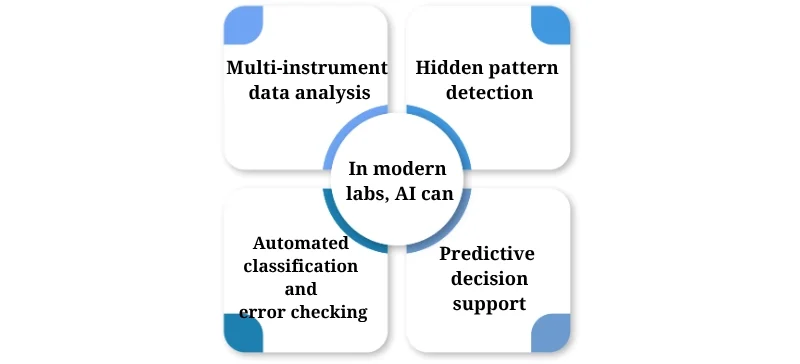
In modern laboratories, AI models can:
Analyze data from multiple instruments simultaneously
Detect hidden trends and relationships in large datasets
Automate classification, quantification, and error detection
Enable predictive analysis to support informed decision-making
As a result, AI-powered laboratories achieve higher consistency, reproducibility, and efficiency across every stage of research.
Types of AI Models Used in Laboratory Data Processing
1. Machine Learning (ML) Models
Machine learning models form the foundation for advanced systems that analyze and interpret laboratory data.
They learn from historical data to recognize patterns and make predictions without explicit programming.
Applications include:
Predicting experimental outcomes
Classifying chemical compounds or biological samples
Detecting instrument errors or anomalous results
This approach enables laboratories to transform raw data into reliable, actionable insights, enhancing both productivity and scientific accuracy.
2. Deep Learning (DL) Models
Deep learning models, including Convolutional Neural Networks (CNNs) and Recurrent Neural Networks (RNNs), specialize in analyzing large and complex datasets, such as images or time-series data.
Examples of use:
Interpreting microscopy images to detect cellular abnormalities
Analyzing molecular structures or protein formations
Processing spectroscopic or chromatographic outputs
DL enhances the depth and precision of data interpretation, making it a critical component of AI-driven research workflows.
3. Natural Language Processing (NLP) Models
NLP models extend the functionality of AI models in laboratory data processing by managing unstructured textual data, such as lab notes, protocols, and scientific publications.
Use cases include:
Extracting structured information from unformatted lab reports
Summarizing research literature automatically
Translating complex findings into readable summaries for research teams
By connecting textual and experimental data, NLP models accelerate knowledge discovery and improve information accessibility.
Step-by-Step Implementation of AI Models in Laboratory Data Processing
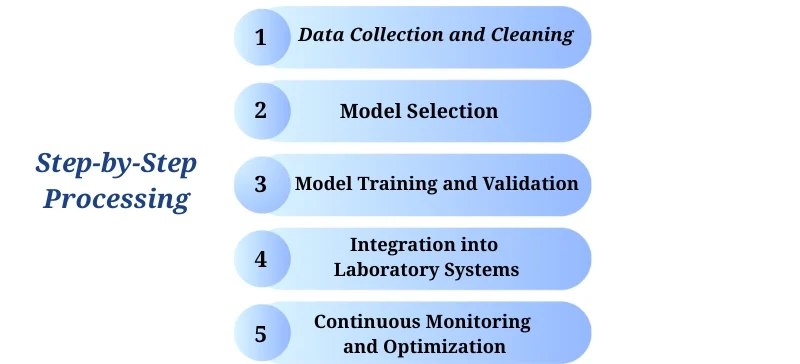
1: Data Collection and Cleaning
Gather consistent, labeled data from instruments and sensors.
Remove errors, duplicates, and outliers.
Normalize formats to ensure compatibility with AI systems.
2: Model Selection
Select the AI model based on your data type and analysis goals:
ML: Structured numerical or categorical data
DL: Images, spectra, or complex signals
NLP: Textual and unstructured information
3: Model Training and Validation
Train models on historical datasets.
Test and validate performance on new data to ensure accuracy.
Fine-tune hyperparameters for optimal results.
4: Integration into Laboratory Systems
Deploy trained AI models within LIMS or analytical platforms.
Ensure seamless data flow and interoperability across instruments.
5: Continuous Monitoring and Optimization
Monitor performance metrics regularly.
Retrain models with updated datasets.
Adjust algorithms for sustained accuracy and reliability.
Tip: Collaborating with AI specialists or data scientists can accelerate successful implementation.
Benefits of Using AI Models in Laboratory Data Processing
Increased Accuracy: Reduced manual errors and improved reproducibility
Faster Analysis: Process large datasets in minutes instead of hours
Predictive Insights: Forecast experimental outcomes and trends
Cost Efficiency: Optimize workflow and resource usage
Scalability: Handle growing datasets without additional staff
Studies show that integrating AI models can reduce chemical analysis time by up to 70%, significantly accelerating research cycles.
Real-World Applications of AI Models in Laboratories
Chemical Analysis
AI models process spectroscopic and chromatographic data to identify compounds and predict chemical properties — cutting analysis time dramatically.
Biological and Medical Research
Deep learning models analyze genomic and proteomic data, accelerating drug discovery and personalized medicine.
Environmental and Industrial Applications
Environmental pollutants are detected, manufacturing processes optimized, and quality control ensured across industrial laboratories using AI models.
Conclusion: The Future of Laboratory Science Is AI-Driven
AI models in laboratory data processing are transforming laboratories into intelligent, data-driven ecosystems.
By combining automation, predictive analytics, and intelligent modeling, these systems turn raw experimental data into actionable insights with unprecedented efficiency and accuracy.
Whether you are a researcher, technician, or data scientist, leveraging AI models ensures your laboratory remains innovative, competitive, and ready for the future of scientific discovery.