

Advanced Applications of Photocell Technology in Reflectometry: Exploring the RM-206M Device
Reflectometry is a fundamental technique in quality control across diverse industries, such as coatings, optics, and materials science. Its precise measurement of surface reflection ensures product consistency and performance. This article examines the integration of Photocell Technology in Reflectometry, with a focus on the RM-206M device, which redefines precision and efficiency standards.
Photocell Technology in Reflectometry
Structure and Functionality of Photocells
Photocells, or photoelectric sensors, operate based on the photoelectric effect. When light reflects off a surface and interacts with the sensor material, photons release electrons, generating an electric current proportional to the light intensity. Photocell Technology in Reflectometry enables highly accurate measurements due to its advanced design.

Figure: A schematic representation of a reflectometry system featuring a detector arm for positioning the detector, an incident table for beam control, and a sample table for versatile sample placement and alignment.
Key components of a photocell:
-
Light-sensitive Material:
Converts light into electrical signals.
-
Electrodes:
Transmit the electrical output.
-
Amplification Circuitry:
Strengthens signals for accurate readings.
Signal Conversion: From Reflected Light to Electrical Output
Photocells precisely convert reflected light intensity into electrical signals. Advanced versions of Photocell Technology in Reflectometry incorporate filtering mechanisms to eliminate noise, enabling accurate detection of even subtle variations in reflectance.
Advantages of Using Photocells in Reflectometry
- High Sensitivity: Detects minute differences in surface reflectance.
- Durability: Performs reliably under challenging industrial conditions.
- Compact Design: Ideal for portable instruments like the RM-206M.
- Energy Efficiency: Low power consumption compared to traditional systems.
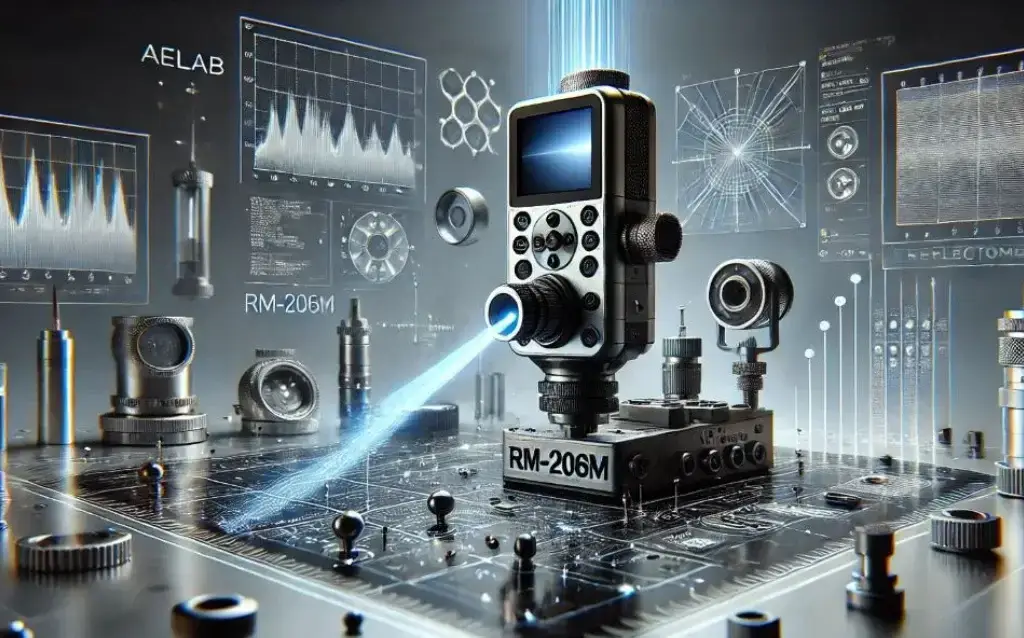
Mirror Reflectance Meter RM-206M
- Measurement Range: 0% to 100%
- Accuracy: ±1%
- Repeatability: 0.3%
- Measuring Area: 7×14 mm
- Portable and lightweight design
Key features include advanced photocell integration for precision, versatility for various materials, and compliance with ISO and GB standards. Its cutting-edge signal processing sets it apart from older models, ensuring superior performance.

Mirror Reflectance Meter RM-206M
Industrial Applications of RM-206M
The RM-206M leverages Photocell Technology in Reflectometry across various industries, ensuring precision in the following sectors:
Key Sectors
-
Coatings and Pigments
Maintains uniform surface quality and reflectance.
-
Printing and Dyeing
Ensures consistent and vibrant finishes.
-
Optics and Films
Evaluates surface reflection for enhanced performance.
-
Plastics and Leather
Analyzes finishes for tailored applications.
Value in Industrial Processes
By leveraging photocell technology, the RM-206M provides real-time, precise insights, optimizing production and reducing waste.
Economic and Operational Impacts
By integrating Photocell Technology in Reflectometry, the RM-206M achieves:
-
Cost Efficiency
Reduces material waste and rework costs.
-
Productivity Gains
Accelerates quality control with rapid measurement.
-
Environmental Sustainability
Conserves resources through precise assessments.
Challenges and Recommendations
Despite its advantages, Photocell Technology in Reflectometry faces challenges such as:
Current Limitations
- Sensitivity to Environmental Factors: Interference from ambient light or dust.
- Material Constraints: Difficulties in handling highly reflective or specific surfaces.
Proposed Improvements
- Enhanced Filtering Technology: Reduces noise and external interference.
- AI Integration: Enables real-time data analysis for predictive quality control.
- Robust Design: Improves durability in challenging conditions.
Conclusion
Photocell technology has revolutionized reflectometry by delivering precision and adaptability. Instruments like the RM-206M exemplify the transformative potential of modern sensors in portable designs. Despite current challenges, advancements in AI algorithms, robust engineering, and material compatibility promise significant progress.
As industries demand greater precision and efficiency, photocell-based reflectometers like the RM-206M are set to remain at the forefront of quality control innovations, ensuring their pivotal role in industrial advancements.