

Introduction
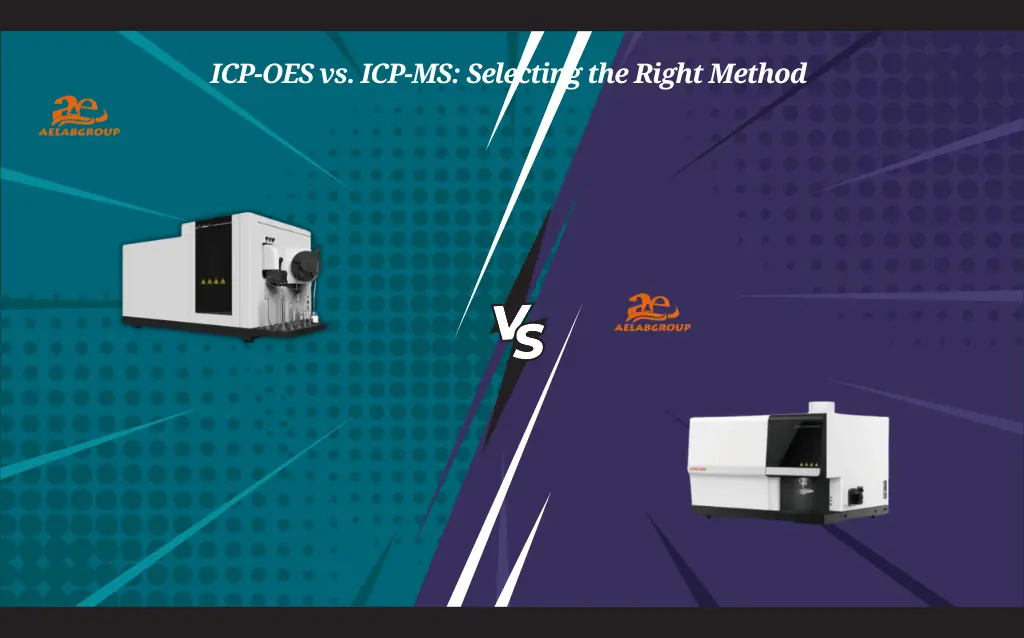
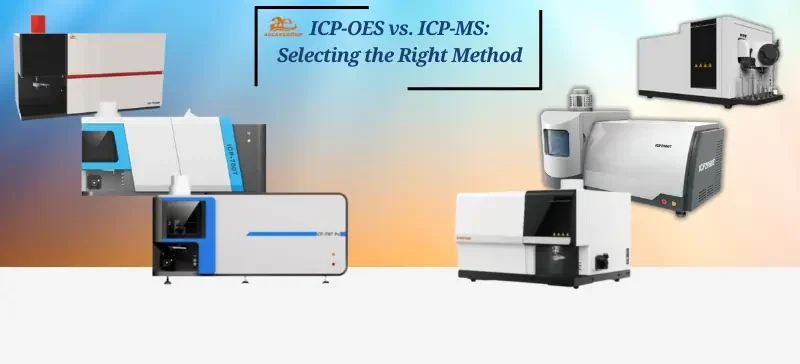
Inductively Coupled Plasma Optical Emission Spectroscopy (ICP-OES) and Inductively Coupled Plasma Mass Spectrometry (ICP-MS) are two of the most widely used techniques for elemental analysis in various scientific, industrial, and regulatory fields. While both provide precise elemental data, they operate on distinct principles and have unique strengths and limitations. Choosing the right technique depends on your analytical needs, including sensitivity, sample matrix, budget, and desired results.
This article outlines the key differences between ICP-OES and ICP-MS, helping you make an informed decision when selecting the best method for your laboratory.
What Are ICP-OES and ICP-MS?
ICP-OES works by exciting atoms in a sample with an inductively coupled plasma source. These excited atoms emit light at specific wavelengths, which is then detected and quantified to determine the elemental composition.
ICP-MS uses the same plasma to ionize sample atoms, but instead of detecting emitted light, it separates the resulting ions by their mass-to-charge ratios using a mass spectrometer, providing more precise elemental quantification and isotopic analysis.
Principle of Operation
ICP-OES: Measures emitted light from excited atoms returning to their ground state, using an optical spectrometer to quantify elemental concentrations.
ICP-MS: Ionizes atoms and measures ions separated by mass-to-charge ratio. It provides high precision, including isotopic analysis.
Sensitivity and Detection Limits
ICP-OES: Detection limits range from parts per million (ppm) to parts per billion (ppb), suitable for routine analyses. The technique can detect a broad range of elements but with less sensitivity compared to ICP-MS.
ICP-MS: Capable of detecting ultra-trace elements as low as parts per trillion (ppt), making it ideal for ultra-trace elemental analysis and isotopic studies. It has a much wider dynamic range (up to 10^8) compared to ICP-OES.
Sample Requirements and Preparation
ICP-OES: More tolerant of high dissolved solids, allowing for simpler sample preparation. It can analyze up to 60 elements simultaneously with a higher throughput and larger sample volumes.
ICP-MS: Requires strict sample preparation, with samples needing to be free of high dissolved solids (typically below 0.2%). It is more sensitive to clogging and matrix effects.
Interferences and Matrix Effects
ICP-OES: Prone to spectral interferences due to overlapping emission lines. Background correction and other optimization techniques help mitigate these effects.
ICP-MS: Susceptible to isobaric interferences, where ions with the same mass overlap. High-resolution mass spectrometry and collision/reaction cells are used to minimize these interferences.
Cost and Maintenance
| Aspect | ICP-OES | ICP-MS |
|---|---|---|
| Initial Cost | Lower | 2–3 times higher than ICP-OES |
| Operating Cost | Moderate (higher argon use) | Higher (requires ultra-pure reagents, cleanroom) |
| Maintenance | Simpler, fewer consumables | More complex, requiring maintenance of cones, detectors, and vacuum systems |
| Operator Expertise | Easier to operate | Requires highly skilled personnel |
Typical Applications
ICP-OES: Commonly used for routine multi-element analysis in industries like environmental monitoring, food safety, agriculture, and pharmaceuticals where moderate sensitivity is sufficient.
ICP-MS: Essential for trace and ultra-trace element analysis, as well as isotopic studies in fields such as pharmaceuticals, clinical research, geology, toxicology, and forensic science.

How to Choose Between ICP-OES and ICP-MS?
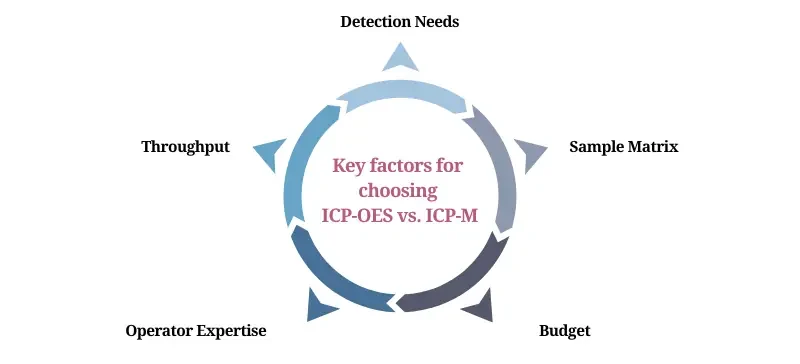
When deciding between ICP-OES and ICP-MS, consider the following factors:
Detection Needs: Choose ICP-MS for ultra-trace detection or isotopic analysis, and ICP-OES for multi-element analysis at moderate sensitivity levels.
Sample Matrix: ICP-OES handles complex sample matrices with higher dissolved solids more efficiently, while ICP-MS requires cleaner, less complex samples.
Throughput: If you need higher throughput, ICP-OES is faster and more suitable for high-volume labs.
Budget: ICP-OES offers a more cost-effective solution with lower initial and operating costs, while ICP-MS requires more investment and specialized maintenance.
Operator Expertise: ICP-MS requires skilled personnel to manage its complexity, whereas ICP-OES is simpler to operate and maintain.
Conclusion
Both ICP-OES and ICP-MS are valuable tools for elemental analysis, each with its strengths and ideal use cases. ICP-OES excels in routine, high-throughput analysis and is more affordable, while ICP-MS offers unmatched sensitivity and precision for ultra-trace and isotopic analysis. Understanding the key differences between the two methods ensures that you select the best technology suited to your specific laboratory needs, optimizing accuracy, efficiency, and data quality.
Ready to elevate your laboratory’s elemental analysis? Contact AELAB today to explore our advanced ICP-OES and ICP-MS systems. Our experts are available to guide you in selecting the perfect solution for your analytical requirements.