

Low-Speed Centrifuges VS High-Speed Centrifuges:
Centrifuges are essential tools in laboratories, used for separating particles from solutions based on their size, shape, density, and viscosity. While various types of centrifuges exist, two of the most common are low-speed and high-speed centrifuges. This article explores the differences between these two types, highlighting their applications, benefits, and considerations.
Low-Speed Centrifuges
Speed and RPM: Low-speed centrifuges typically operate at speeds below 10,000 RPM. Their gentle spinning action is ideal for applications that do not require high g-forces.
Applications: These centrifuges are commonly used in clinical laboratories for processing blood and urine samples. They are also used in cell culture labs for separating cells from media, in microbiology for yeast and bacteria sedimentation, and in general laboratories for routine sample preparation.
Capacity: Low-speed centrifuges often have larger rotor capacities, allowing for the processing of multiple large-volume samples simultaneously. This makes them suitable for high-throughput environments.
Cost and Maintenance: Generally, low-speed centrifuges are more affordable and require less maintenance than high-speed models. They are durable and have straightforward maintenance requirements, making them a cost-effective choice for many labs.
Operation: They are user-friendly, with simple controls and fewer technical complexities. This makes them ideal for routine tasks and for use by personnel with varying levels of expertise.

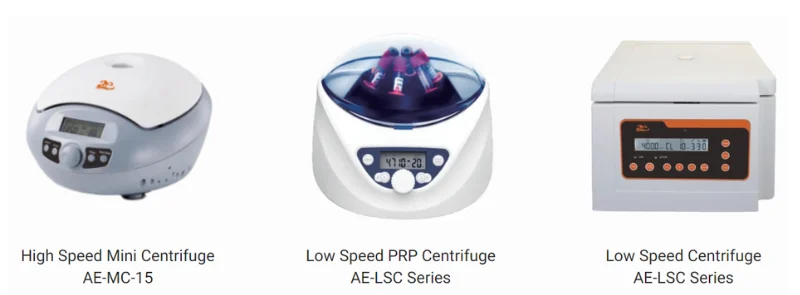
Low Speed Centrifuge AE-LSC Series
High-Speed Centrifuges
Speed and RPM: High-speed centrifuges can reach speeds of up to 30,000 RPM or more, generating higher g-forces necessary for separating smaller particles and achieving faster sedimentation.
Applications: These centrifuges are suited for more complex and precise laboratory applications. They are essential in molecular biology for DNA and RNA purification, in biochemistry for protein separation, and in cell biology for isolating subcellular components like mitochondria and lysosomes.
Capacity: High-speed centrifuges typically have lower rotor capacities compared to low-speed models. They focus on processing smaller sample volumes with higher precision, making them suitable for specialized tasks.
Cost and Maintenance: Due to their advanced technology and precision, high-speed centrifuges are more expensive. They also require regular maintenance and calibration to ensure accurate performance, adding to the overall cost of ownership.
Operation: Operating high-speed centrifuges often requires more technical expertise. Users need to be trained in handling these sophisticated machines to avoid potential issues and to maximize their performance.

High Speed Mini Centrifuge AE-MC-15
Choosing the Right Centrifuge
When deciding between low-speed and high-speed centrifuges, consider the following factors:
- Application Needs: Determine the primary use of the centrifuge. For routine tasks and larger volumes, a low-speed centrifuge is ideal. For specialized, high-precision tasks involving smaller sample volumes, a high-speed centrifuge is necessary.
- Budget: Assess the available budget for purchasing and maintaining the centrifuge. Low-speed centrifuges are more cost-effective, while high-speed models, although more expensive, provide advanced capabilities.
- Technical Expertise: Consider the level of expertise of the laboratory personnel. Low-speed centrifuges are easier to operate, while high-speed centrifuges require more specialized knowledge.
Conclusion
Both low-speed and high-speed centrifuges play crucial roles in laboratory settings, each offering unique advantages depending on the application. Low-speed centrifuges are perfect for routine, high-throughput tasks, while high-speed centrifuges are indispensable for detailed, precision-driven applications. Understanding the differences and aligning them with your laboratory’s needs ensures efficient and effective use of these powerful tools.