

Examining the Performance and Applications of Distillation Apparatus in Laboratories
Distillation is a critical separation technique used in laboratories for purifying and separating components of liquid mixtures. This process utilizes differences in boiling points to effectively purify chemicals, water, and other substances. This article explores the vital role of distillation apparatus in laboratory settings, examines various distillation system configurations, and highlights their applications across different scientific fields.
Types of Distillation Apparatus
Laboratory distillation apparatus come in various configurations, each suited for specific applications. These systems vary in complexity and cater to different needs:
-
Simple Distillation Apparatus
Used for separating liquids with significantly different boiling points (typically above a 25°C difference). This setup works effectively for purifying relatively pure substances.
-
Fractional Distillation Apparatus
Applied to separate mixtures with close boiling points. The system includes multiple distillation columns, which increase the efficiency of the separation process.
-
Vacuum Distillation Apparatus
Suitable for substances with high boiling points. This system reduces ambient pressure, allowing distillation to occur at lower temperatures, which helps prevent thermal degradation of sensitive compounds.
-
Short Path Distillation Apparatus
Often used for small quantities of highly sensitive materials. This system minimizes the distance that vapors travel, reducing losses and degradation.
Key Components of Distillation Apparatus
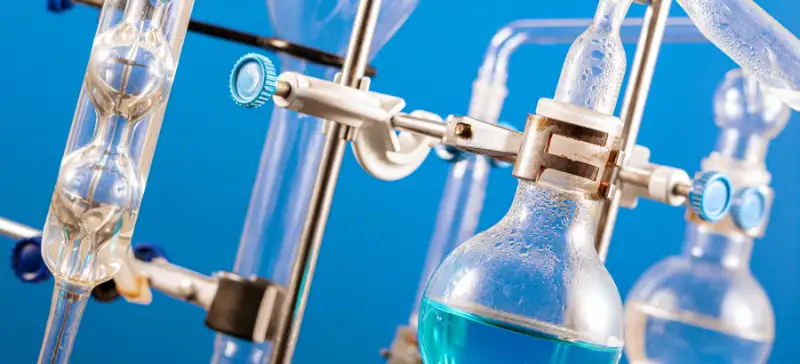
A basic distillation apparatus consists of several key components that work in tandem to carry out the distillation process effectively:
-
Boiling Flask
This container holds the liquid mixture to be distilled and is heated to vaporize the components.
-
Condenser
This component cools and condenses the vapor back into a liquid form. Common types of condensers include the Liebig and Graham condensers.
-
Distillation Head
The distillation head connects the boiling flask to the condenser and directs the vapor flow.
-
Receiving Flask
This vessel collects the distilled liquid.
-
Additional Components
These include supports, clamps, thermometers, and other fittings that ensure the apparatus is stable and allows temperature monitoring during the distillation process.
Applications of Distillation Apparatus in Laboratories
This device serves various purposes in laboratory settings, each requiring a distinct type of apparatus:
- Chemical Purification: Distillation is essential for purifying solvents, chemicals, and oils. In organic chemistry, it plays a key role in isolating pure compounds from mixtures.
- Water Distillation: Distillation is the standard method for producing distilled water, which is crucial for experiments requiring high purity.
- Pharmaceutical and Chemical Industries: Laboratories in the pharmaceutical industry frequently use distillation to purify drugs and chemicals. Fractional distillation systems are particularly important for separating complex mixtures.
- Extraction of Flavors and Essential Oils: Distillation also plays a significant role in the food industry, where it is used to extract essential oils and flavors from plants and other natural sources. This process is crucial in perfume and flavor production.
Advanced Distillation Apparatus for Specialized Laboratory Applications
For more specialized applications, laboratories often use advanced distillation systems that offer greater precision in controlling temperature and pressure:
-
Vacuum Distillation Systems
These are ideal for substances that have high boiling points, as they allow distillation at lower temperatures by reducing pressure. This helps avoid thermal degradation.
-
Short Path Distillation Systems
These systems are typically used for sensitive materials that require a short vapor path to prevent loss or decomposition. They ensure that delicate compounds remain intact during the distillation process.
By using high-quality materials and modern designs, distillation apparatus has evolved to meet the demanding needs of scientific research. AELab manufactures distillation systems that offer researchers the reliability and accuracy required for high-precision laboratory work.
All-Glass Distillation Apparatus Optima-R6
Safety and Best Practices in Distillation
Safety is critical when operating distillation apparatus. Laboratories must follow strict protocols to ensure that equipment functions properly and experiments remain safe:
- Glassware Integrity: Inspect glassware for cracks or defects before use. Replace any damaged glassware immediately to prevent accidents during high-temperature operations.
- Temperature Control: Avoid overfilling the boiling flask. It is advisable to keep the flask half full to prevent foaming or splashing, which could damage the apparatus or lead to incorrect results.
- Cooling Systems: Connect the condenser to a reliable source of cold water to maintain optimal temperature conditions during distillation.

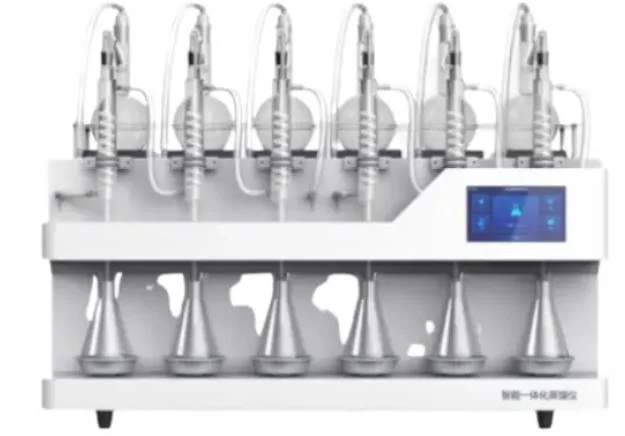
Integrated Distillation Apparatus Optima-6+
Conclusion
Distillation apparatus are essential tools in laboratory environments, providing precise purification and separation of substances. Whether used for simple distillation or more advanced methods like vacuum or fractional distillation, these systems play a crucial role in obtaining high-purity substances. In order to achieve accurate results, proper setup, operation, and safety measures are necessary. Moreover, continuous advancements in distillation technology ensure that scientists and researchers can perform their work with greater accuracy and reliability. Consequently, the use of modern distillation equipment enhances the overall efficiency and effectiveness of laboratory processes.