

How Is Quick Heating and Cooling Achieved in Water Baths?
1. Rapid Heating and Cooling Mechanisms
Water baths provide controlled temperature environments crucial for various scientific and industrial applications. Rapid heating and cooling are essential in processes that require precise temperature control within short timeframes.
-
Laser and Electron Beam Technology
The use of scanned or pulsed laser or electron beams allows for rapid quenching in thermal processing. These technologies enable the material to reach desired temperatures quickly and then cool down just as fast, ensuring precision in the process.
-
Heat Transfer Efficiency
The efficiency of heat transfer in water baths plays a significant role. Water’s high thermal conductivity ensures even heat distribution, making it ideal for uniform heating and cooling of samples.
Learn more:Using Vortex Mixers for Sensitive Sample Handling in Biochemistry and Molecular Biology
2. Temperature Control Precision
Accurate temperature control is crucial in a wide range of applications, from molecular biology to industrial testing. Water baths excel in maintaining consistent temperatures, even when external factors like ambient temperature change.
-
Thermostatic Regulation
Advanced water baths come with thermostatic control that regulates the water temperature with high precision. This feature prevents temperature fluctuations, making them reliable for sensitive experiments like enzyme reactions or cell culture incubations.
-
Real-Time Monitoring
Many modern water baths have digital interfaces, enabling users to monitor and adjust temperatures in real-time, ensuring optimal conditions for their experiments.
3. Types of Water Baths for Diverse Applications
Water baths come in several designs to meet the diverse needs of laboratories and industries. Whether it’s for heating, cooling, or both, each type offers specific benefits.
-
Circulating Water Baths
These use a pump to circulate the water, ensuring uniform temperature distribution. They are ideal for applications requiring tight temperature control, such as biochemical assays or chemical reactions.
-
Refrigerated Water Baths
These maintain lower-than-ambient temperatures, which is necessary for cooling sensitive biological or chemical samples quickly and efficiently.

Learn more: water bath in laboratory principle
4. Innovations Enhancing Performance
Continuous innovations improve the performance of water baths, making them more energy-efficient, precise, and user-friendly.
-
Digital Controls and Automation
Modern water baths feature digital interfaces that allow for the programming of heating cycles. This automation ensures greater accuracy, reproducibility, and time efficiency in experiments.
-
Energy-Efficient Designs
New water bath models incorporate insulation and heating technologies that reduce energy consumption without compromising on heating performance.
-
Safety Features
Enhanced safety features, such as over-temperature alarms and low-water level sensors, ensure that the equipment operates without risk, enhancing safety for users and extending the life of the equipment.
5. Water Bath WB-T Series Overview
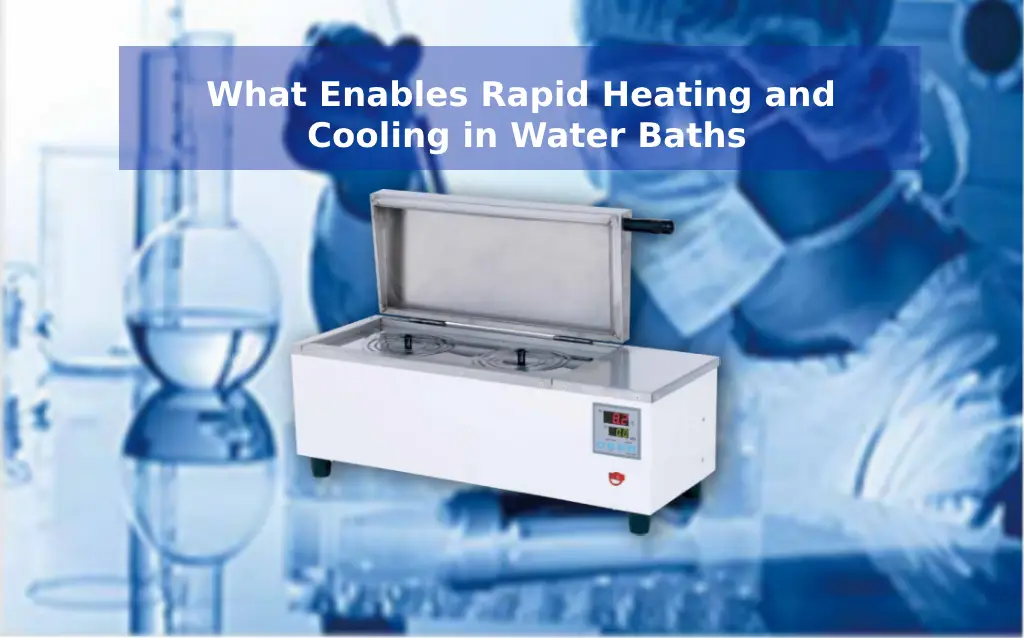
The Water Bath WB-T Series is specifically designed for applications such as distilling, drying, concentrating, and thermostatic heating of chemicals and biological products. It is also ideal for checking serum, conducting biochemical experiments, and sterilizing injectors and small surgical equipment. These water baths are constructed with high-quality cold-rolled steel, and the working space is made of durable imported stainless steel plates. They feature microcomputer-controlled temperature regulation, ensuring precision and stability for sensitive processes.
Product Specifications for WB-T Series:
- WB-T1 & WB-T2 Models: These are designed with 2 to 3 holes and power ranging from 500 to 750W. The temperature range is from (RT) +10°C to 65°C or 100°C, respectively, with a temperature deviation of ±1°C. They are perfect for general thermostatic heating tasks.
- WB-T3 & WB-T4 Models: These models provide higher power outputs of 1000W and 2000W, with an expanded range of applications for larger volumes or more demanding tasks. They can operate in environments requiring a higher temperature range and more significant heating capacities.
The intelligent temperature control ensures ease of use and reliable performance in various laboratory and medical applications.

6. Applications Across Various Fields
Water baths are versatile and are used across different fields, ranging from research laboratories to industrial production processes.
-
Molecular Biology and Biochemistry
In molecular biology, water baths are indispensable for processes like DNA/RNA extraction and protein denaturation. Precise heating is critical in these applications to ensure accuracy and efficiency.
-
Clinical and Pharmaceutical Laboratories
Water baths are used for sample thawing, reagent preparation, and diagnostic tests, providing the consistent heating necessary for clinical analyses.
-
Food and Environmental Testing
Water baths are used in the food industry for quality control and pasteurization. Similarly, environmental testing uses water baths to prepare soil and water samples for pollution analysis, demonstrating their broad industrial relevance.
Conclusion:
In conclusion, water bath systems are essential tools in laboratories and various industries, offering high precision in temperature control along with the ability for rapid heating and cooling. These features are particularly crucial in sensitive processes such as biological, chemical, and medical experiments. Recent advancements in digital temperature control, energy efficiency, and enhanced safety features have improved the performance of these devices, making them versatile for a wide range of applications. Choosing the appropriate model based on the specific needs of each process can significantly enhance accuracy, efficiency, and safety in experiments and industrial productions.