AELAB | Petroleum Testing Equipment | Distillation Tester
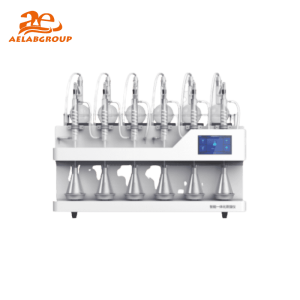
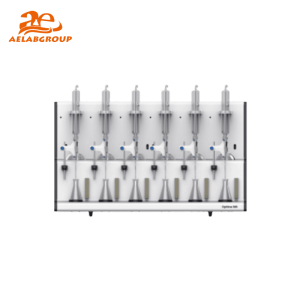
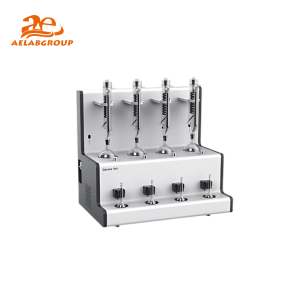
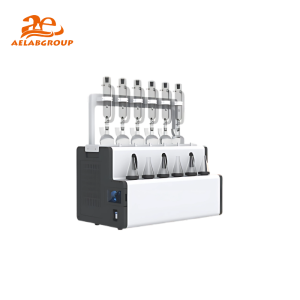
A Distillation Tester determines the boiling range of petroleum products under standardized conditions. It is essential for assessing volatility, performance, and compliance of fuels and solvents in quality-control labs. This guide explains what a Distillation Tester is, how it works, and how to select the right model.
A distillation tester is a laboratory instrument that simulates fractional distillation to measure initial and final boiling points and the temperatures at specified distillate volume percentages (e.g., 10%, 50%, 90%). It is widely used in refineries, fuel-testing labs, and chemical QC facilities to generate a distillation curve that reflects product composition and volatility. Results support regulatory compliance with methods such as ASTM D86 and ISO 3405.
| Feature | Details |
|---|---|
| Measurement Outputs | IBP, FBP, and temperatures at 10%, 50%, 90% distillate; total recovery and residue |
| Sample Volume | Typically 100 mL per ASTM D86 |
| Temperature Range | 0–400 °C (or higher, model-dependent) |
| Temperature Accuracy | ±0.1 °C typical |
| Automation Levels | Manual, semi-automatic, fully automatic |
| Compliance | ASTM D86, ISO 3405, EN ISO 918 |
| Cooling Method | Air-cooled or water-cooled condenser |
| Data Interface | USB, RS-232, or Ethernet; software for curve plotting and reports |
| Safety | Over-temperature cutoffs, flame protection, enclosed test area |
| Aspect | Distillation Tester | Flash Point Tester |
|---|---|---|
| Primary Measure | Boiling range/volatility (IBP, FBP, % recovery) | Lowest temp at which vapors ignite |
| Use Case | Fuel composition and performance profiling | Safety classification and handling risk |
| Standards | ASTM D86, ISO 3405 | ASTM D93, ISO 2719 |
| Automation | Manual to fully automatic systems | Manual to fully automatic (closed/open cup) |
| Outcome | Distillation curve for formulation and QC | Single flash point value for safety compliance |
Q: What does a distillation tester measure?
A: It measures the boiling range of petroleum products, including initial and final boiling points and temperatures at specified recovery percentages.
Q: Which standard applies to fuel distillation testing?
A: ASTM D86 is the most widely used method globally, with ISO 3405 providing equivalent requirements.
Q: Are automated distillation testers worth the cost?
A: For moderate to high throughput, fully automated systems improve repeatability, reduce operator time, and streamline data reporting—often offsetting the higher upfront investment.
Q: Do I need water cooling?
A: Many systems support either air- or water-cooled condensers; choose based on available utilities, expected sample volatility, and compliance with the specified method conditions.