

1.Poor Sample Preparation and Handling
One of the most common mistakes in gas chromatography is improper sample preparation. Issues such as contamination, incorrect dilutions, or the use of incompatible solvents can create ghost peaks or even mask target analytes.
✅ Solution:
Use clean containers and high-purity solvents.
Filter and dilute samples properly.
Match solvents with analytes and system requirements.
2. Inconsistent or Incorrect Injection
Fast injections, oversized volumes, or the wrong syringe can cause inlet flooding, backflash, and distorted peaks.
✅ Solution:
Use the correct syringe and inject consistently.
Control inlet temperature carefully.
Rely on autosamplers for reproducibility.
3. Using a New Column Without Conditioning
New GC columns often contain oxygen or contaminants. Direct use without conditioning can shorten their lifespan and degrade separation quality.
✅ Solution:
Purge new columns with carrier gas.
Condition them at recommended maximum temperatures.
Always ensure carrier gas flow before heating.
4. Incorrect Carrier Gas Flow and Pressure
Carrier gas flow determines efficiency and resolution. Wrong settings cause broad peaks and poor separation.
✅ Solution:
Adjust flow based on column diameter and gas type (e.g., helium ~35 cm/sec, hydrogen ~40–50 cm/sec).
Check EPC (electronic pneumatic control) settings routinely.
5. Equipment Leaks
Leaks around septa, inlet seals, or fittings cause unstable pressure and contamination.
✅ Solution:
Replace septa regularly.
Perform leak checks with detectors.
Use only manufacturer-approved consumables (e.g., AELAB-compatible parts).
6. Temperature Control Issues
GC is highly temperature-sensitive. Even small fluctuations can distort retention times and peak shapes.
✅ Solution:
Calibrate oven and detectors.
Avoid environmental fluctuations.
Allow equilibration before starting analysis.
7. Running Out of Gas
Among the common mistakes in gas chromatography is running out of carrier or detector gases, which can interrupt the analysis and increase the risk of system contamination.
✅ Solution:
Monitor cylinder levels closely.
Establish a gas management plan.
Replace cylinders before depletion.
8. Detector Instability and Miscalibration
Whether using an FID or MS, incorrect calibration or unstable baselines reduce accuracy.
✅ Solution:
Follow manufacturer flow ratios (e.g., 10:1 air to hydrogen in FID).
Calibrate detectors regularly.
Verify baseline stability before analysis.
9. Neglecting Preventive Maintenance
Skipping regular maintenance is one of the common mistakes in gas chromatography, often leading to residue buildup, contamination, and costly downtime.
✅ Solution:
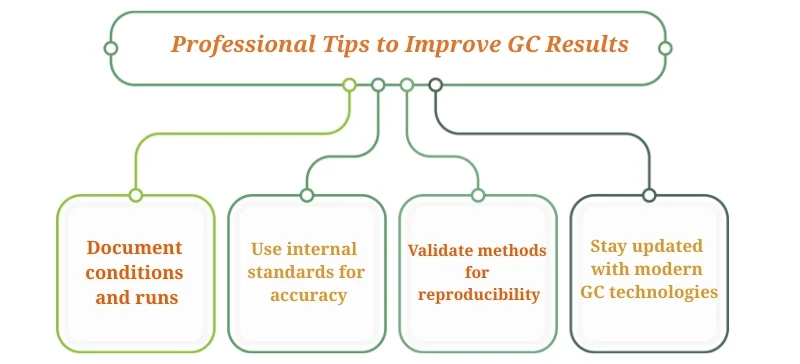
Schedule preventive maintenance.
Replace septa, trim columns, and clean detectors routinely.
Keep maintenance logs for traceability.
10. Errors in Data Analysis
Even with perfect instrumentation, human error in data analysis can invalidate results.
✅ Solution:
Use validated chromatography software.
Double-check peak integration and baseline corrections.
Provide analyst training in GC interpretation.