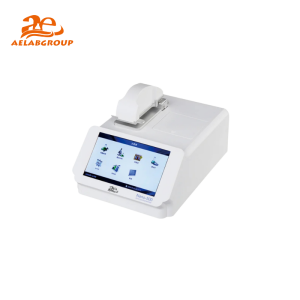
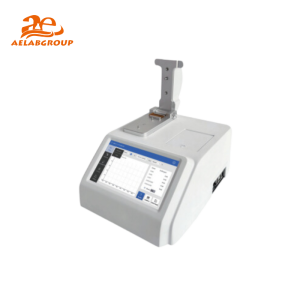
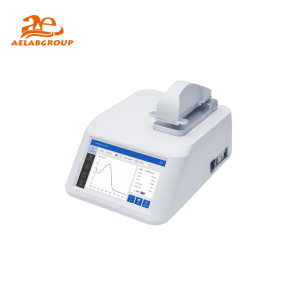
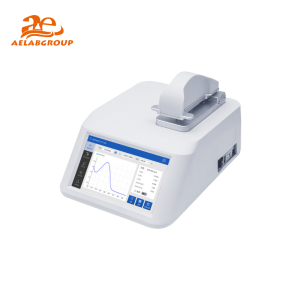
Micro Volume Spectrophotometer (Nano)
Introduction
A Micro Volume Spectrophotometer (Nano) enables highly accurate UV-Vis measurements from ultra-small samples (≈0.5–2 µL) without cuvettes. It preserves precious DNA, RNA, and protein materials while speeding up quantification and purity checks in modern life-science workflows.
What Is a Micro Volume Spectrophotometer?
A microvolume (nano) spectrophotometer is a compact UV-Vis instrument that measures absorbance directly from a small drop placed on an optical pedestal. Light traverses a controlled micro-pathlength, absorbance is captured across ~190–850 nm, and concentration is computed via Beer–Lambert Law—ideal for nucleic acid and protein quantification without cuvettes.
Devices in This Category
- Pedestal microvolume UV-Vis spectrophotometer (single-sample)
- Microvolume spectrophotometer with touchscreen & onboard software
- Nano spectrophotometer with optional cuvette port/long-path adapter
- Multi-sample microvolume system with automated wiping/positioning
- Microvolume accessories: calibration standards, hydrophobic tips, cleaning tools
Technical Features and Specifications
| Feature |
Details |
| Sample Volume |
0.5–2.0 µL (typical) |
| Wavelength Range |
UV-Vis 190–850 nm (supports 260 nm for nucleic acids, 280 nm for proteins) |
| Detection Limits |
dsDNA to ~2 ng/µL; protein sensitivity assay-dependent |
| Measurement Time |
<10 seconds per sample (typical) |
| Pathlength Control |
Fixed or auto-ranging micro-pathlength for extended dynamic range |
| Purity Metrics |
A260/A280, A260/A230 ratios with pass/fail thresholds |
| Calibration & QA |
Quick blanking; minimal calibration; supports verification standards |
| Data & Connectivity |
USB/export to CSV; cloud/LIMS sync; built-in touchscreen UI (model-dependent) |
Benefits
- Ultra-low sample consumption with cuvette-free workflow.
- Fast, accurate quantification and purity assessment in seconds.
- Reduced contamination risk and consumable costs.
- Compact, portable footprint for any biotech or academic lab bench.
- User-friendly operation with reproducible results across users.
Applications and Tests
🔬 Molecular Biology
- DNA/RNA quantification for PCR, cloning, and NGS library prep
- Purity checks (A260/A280, A260/A230) to detect carryover contaminants
- Enzyme kinetics and small-volume absorbance assays
🧪 Clinical Diagnostics
- Protein concentration (Bradford, BCA) in micro-scale workflows
- QC checks for nucleic-acid extraction kits and workflows
- Method verification and small-volume reference testing
🏭 Industrial & Food Testing
- Fast protein/nucleic-acid checks in process development
- Formulation verification with minimal sample use
- Small-volume spectral scans for additives or enzymes
🌱 Environmental & Agricultural Labs
- Nucleic-acid assessment in field-limited or rare specimens
- Protein/biomolecule measurements in micro-extractions
- Rapid purity screening prior to downstream analyses
Micro Volume Spectrophotometer vs. Traditional UV-Vis
| Aspect |
Micro Volume Spectrophotometer (Nano) |
Traditional UV-Vis Spectrophotometer |
| Sample Volume |
0.5–2.0 µL |
500–3000 µL (cuvette) |
| Cuvettes Needed |
No (pedestal measurement) |
Yes |
| Throughput Speed |
High (seconds/sample) |
Moderate |
| Sample Preservation |
Excellent |
Moderate |
| Suitability for DNA/RNA |
Excellent |
Good; best with larger volumes |
| Cost & Consumables |
Higher upfront; minimal consumables |
Lower upfront; ongoing cuvette costs |
Expert Tips for Choosing the Right Micro Volume Spectrophotometer
- Match detection limits and dynamic range to your lowest dsDNA/RNA concentrations.
- Prioritize auto-pathlength and robust purity ratio calculations for consistency.
- Check software features for LIMS/export, user management, and audit trails.
- Evaluate measurement speed, reproducibility, and cleaning ergonomics.
- Confirm warranty, local support, and availability of verification standards.
Maintenance Best Practices
- Clean the optical surfaces before/after each run with lint-free wipes and 70% ethanol.
- Use the correct blanking solution and verify zero baseline routinely.
- Prevent bubbles and particulate matter; spin down samples when needed.
- Store the device dust-free; keep the arm closed when idle to protect optics.
- Update firmware periodically and document performance checks.
FAQ
Q: What is the typical wavelength range for a Micro Volume Spectrophotometer?
A: Most nano spectrophotometers scan ~190–850 nm, covering nucleic acids at 260 nm and proteins at 280 nm.
Q: How little sample do I need?
A: Typically 0.5–2.0 µL per measurement, making it ideal for scarce or precious samples.
Q: Do I still need cuvettes?
A: No, measurements are performed directly on a pedestal; some models offer optional cuvette ports for longer pathlengths or kinetics.
Q: Can it assess sample purity?
A: Yes, common purity ratios (A260/A280, A260/A230) are calculated automatically with pass/fail guidance.