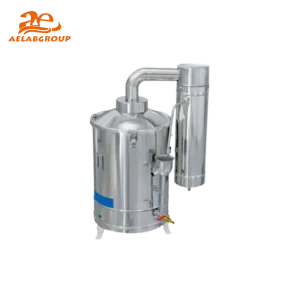
AELAB | Laboratory Equipment | Water Distiller
Water distillers are reliable devices for producing ultra-pure water by removing impurities, minerals, and microbes through distillation. Whether for home, laboratory, or medical use, a water distiller ensures consistent water quality. This guide explains how water distillers work, their advantages, and how to choose the best one for your needs.
A water distiller purifies water by heating it into steam, separating impurities, and condensing the steam back into clean liquid. This process removes up to 99.9% of contaminants—including heavy metals, chemicals, and microbes—resulting in safe, distilled water for drinking, medical, and laboratory use.
| Feature | Details |
|---|---|
| Purification Method | Thermal distillation (boil–evaporate–condense cycle) |
| Contaminant Removal | Eliminates up to 99.9% of bacteria, viruses, heavy metals, and dissolved solids |
| Material Construction | Stainless steel body with glass or BPA-free container |
| Production Capacity | 1–12 gallons per day (varies by model) |
| Power Consumption | Approximately 500–750 W per gallon |
| Cooling System | Air- or water-cooled condenser coil |
| Safety Features | Automatic shut-off, overheat protection, sealed steam path |
| Optional Enhancements | Post-carbon filter for taste improvement, automatic refill systems |
| Feature | Water Distiller | Reverse Osmosis | Carbon Filter |
|---|---|---|---|
| Removes Viruses | ✅ Yes | ❌ No | ❌ No |
| Removes Heavy Metals | ✅ Excellent | ✅ Good | ❌ Limited |
| Removes Fluoride | ✅ Yes | ✅ Some | ❌ No |
| Filter Replacement Cost | ❌ None | ✅ Ongoing | ✅ Ongoing |
| Wastewater Produced | ✅ Minimal | ❌ High | ✅ Low |
Q: Is distilled water safe to drink every day?
A: Yes, distilled water is completely safe for daily use, though it lacks minerals found in tap water, which may affect taste.
Q: Does a water distiller remove fluoride?
A: Absolutely. Distillation effectively removes fluoride, unlike carbon filters or most standard filtration systems.
Q: How long does it take to produce distilled water?
A: Most countertop units take about 4–6 hours to produce one gallon of distilled water, depending on power and ambient temperature.
Q: Can distilled water be used for cooking?
A: Yes, distilled water enhances flavor in tea, coffee, soups, and baby food, as it’s free from chlorine and minerals that alter taste.