


Introduction
In laboratory environments where contamination control is critical, laminar flow cabinets are vital in protecting samples, equipment, and personnel. Depending on the direction of airflow, laminar flow cabinets are categorized into two main types: vertical and horizontal. Each has its own advantages and limitations, making them suitable for different applications. This guide combines technical insights and expert recommendations to help you choose between vertical and horizontal laminar flow cabinets, optimized for performance and compliance.
Understanding Laminar Flow Cabinets
Laminar flow cabinets, also known as clean benches, are specialized equipment designed to provide a clean, particle-free environment by directing filtered air over the workspace in a unidirectional flow. This ensures that contaminants are continuously removed from the working area, protecting sensitive samples, processes, and instruments.
There are two main types:
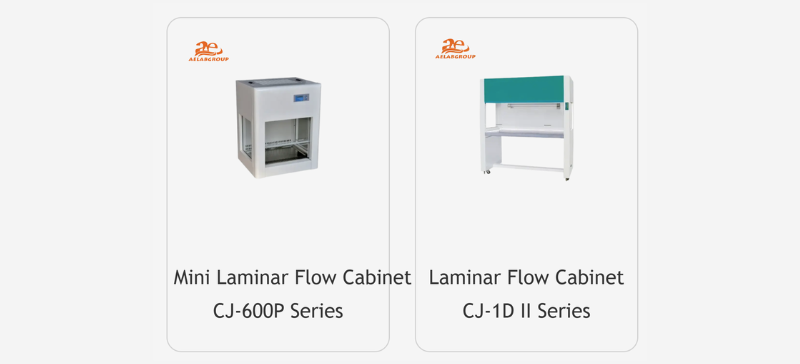
Vertical Laminar Flow Cabinet
Horizontal Laminar Flow Cabinet
How Laminar Flow Works
Laminar flow refers to airflow in parallel layers with minimal disruption between them. These cabinets use HEPA filters to remove at least 99.99% of airborne particles as small as 0.3 microns. The unidirectional flow reduces turbulence, helping ensure cleanliness.
Vertical Laminar Flow Cabinets
How They Work
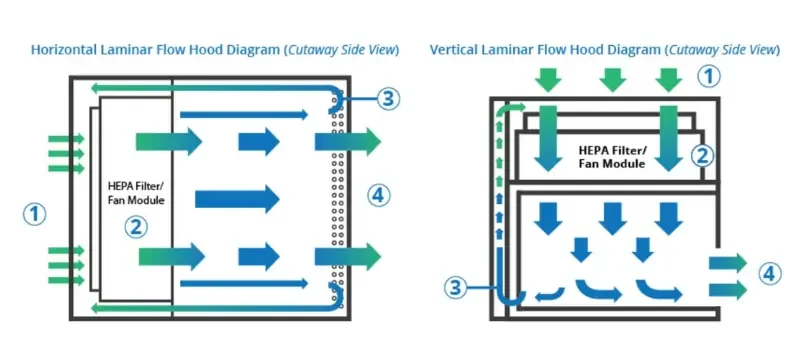
Ambient air is drawn into the cabinet, passed through a pre-filter, and then through a HEPA filter located at the top. The filtered air flows downward across the work surface and exits through front or bottom vents, flushing contaminants away.
Advantages
Enhanced Product Protection: The top-to-bottom airflow ensures contaminants are continuously flushed out.
Improved User Safety: Air flows downward and away from the operator’s face.
Space Efficiency: Compact footprint and greater vertical clearance for tall equipment.
Reduced Cross-Contamination Risk: Vertical flow minimizes lateral particle spread.
Limitations
Airflow Obstruction: Large equipment can block vertical flow and create turbulence.
No Hazardous Material Use: Not suitable for biohazards or toxic chemicals.
Limited Operator Protection: Offers minimal protection from aerosols or splashes.
Maintenance Needs: Requires regular upkeep to maintain HEPA performance.
Horizontal Laminar Flow Cabinets
How They Work
Air is drawn from the lab environment, filtered through a rear-mounted HEPA filter, and directed forward across the work surface toward the operator. The horizontal flow pushes contaminants away from the samples and provides a clean zone.
Advantages
Uniform Airflow: Consistent air coverage across the entire surface.
Lower Obstruction Risk: Rear-to-front flow is less affected by tools or equipment.
Operator Comfort: Enhanced visibility and workspace access.
Ideal for Sensitive Operations: Electronics assembly, plate pouring, media prep.
Limitations
No Operator Protection: Airflow is directed at the user, posing exposure risks.
Environmental Contamination Risk: Spills or aerosols can escape toward the operator.
Larger Footprint: More space needed due to rear-mounted components.
Airflow Disruption: Careful positioning of items is necessary.
Comparison Table
| Feature | Vertical Laminar Flow Cabinet | Horizontal Laminar Flow Cabinet |
|---|---|---|
| Airflow Direction | Top to Bottom | Back to Front |
| HEPA Filter Location | Top of Cabinet | Rear of Cabinet |
| Workspace Clearance | More Vertical Space | Better Horizontal Access |
| Risk of Obstruction | Higher | Lower |
| Operator Protection | Moderate | Minimal |
| Product Protection | Excellent | Excellent |
| Applications | Media Prep, Tissue Culture | Electronic Assembly, Plate Pouring |
| Footprint | More Compact | Requires More Depth |
| Noise Level | Often Quieter | Can Be Slightly Louder |
| Visibility & Access | Moderate | High |
Choosing Between Vertical vs. Horizontal Laminar Flow Cabinets
Nature of the Work
If your tasks involve handling non-hazardous materials requiring a sterile environment (e.g., plating, component assembly), either type is suitable. Vertical cabinets offer better clearance for tall items, while horizontal units are better for tasks requiring precision and operator visibility.
Safety Requirements
Neither cabinet is suitable for hazardous or infectious agents. Vertical cabinets provide slightly better user protection by directing airflow downward, reducing particle exposure. If user or environmental protection is needed, a biosafety cabinet is essential.
Lab Space & Layout
Vertical cabinets are ideal for smaller spaces with limited bench depth. Their compact design and taller workspace accommodate varied instruments. Horizontal units require more space but offer improved ergonomics and lighting.
Equipment Placement & Air Dynamics
Vertical airflow can be obstructed by large tools, creating turbulence. Horizontal airflow is more uniform, ideal for setups with multiple samples or instruments.
Maintenance & Operation
Both types require filter replacement and regular airflow checks. Horizontal units may allow easier filter access. Vertical cabinets may operate more quietly and have less dust accumulation.
Cost & Long-Term Value
Vertical cabinets are often more space-efficient and economical in compact labs. Horizontal units may offer long-term ergonomic benefits and ease of multitasking.
Conclusion
Both vertical and horizontal laminar flow cabinets are essential tools for ensuring sample protection in controlled environments. AELAB offers a full line of high-performance cabinets tailored to your laboratory needs. By understanding airflow direction, workspace requirements, and safety considerations, you can make the right choice for your lab.