

Comprehensive Overview of Gas Chromatography: Techniques, Applications, and Key Concepts
Introduction
Gas chromatography (GC) is a widely used analytical technique in both scientific research and industry for separating and analyzing compounds that can be vaporized without decomposition. It is particularly effective for analyzing volatile and semi-volatile organic compounds. The technique plays a pivotal role in numerous fields such as environmental analysis, pharmaceutical research, food safety, and petrochemical industries.
GC is based on the principle of separation of different components of a sample mixture by passing it through a stationary phase, which interacts differently with each component. This process results in the differential retention times of the various components as they travel through the column.
This article will focus on the key techniques used in gas chromatography, delve into its various applications, and explore essential concepts that make GC a powerful tool for modern chemical analysis.
Learn more: Gas Chromatography vs Liquid Chromatography: Comparative Analysis and Use Cases
Techniques and Working Principles of Gas Chromatography
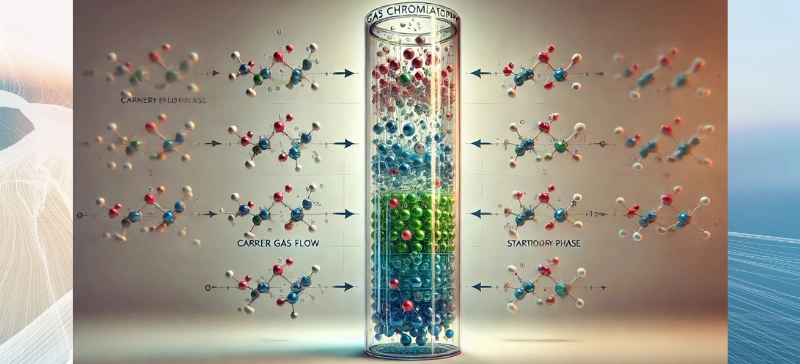
Gas chromatography (GC) separates the components of a sample mixture by passing it through a stationary phase within the column while an inert carrier gas, such as helium or nitrogen, transports the sample. The process starts when the system vaporizes the sample and the carrier gas moves it through the column. Components interact differently with the stationary phase, which causes each to travel at a unique speed. This difference in interaction times enables the system to perform precise separations, forming the foundation for both qualitative and quantitative analysis in GC.
Core Components of a Gas Chromatography System
- Columns:
Columns in GC can be of two types: packed columns and capillary (open tubular) columns. The choice of column depends on the type of sample being analyzed and the required resolution.- Packed Columns: These contain solid particles coated with a stationary phase, offering higher sample capacity but lower resolution.
- Capillary Columns: These have a smaller internal diameter and offer higher resolution but lower sample capacity.
The table below provides a detailed comparison of column types and carrier gases, highlighting their respective advantages and limitations. This comparison is intended to assist in selecting the optimal configuration based on sample type and analytical needs.
- Detectors:
Various detectors are used in GC systems, each providing specific advantages depending on the nature of the analytes.- Flame Ionization Detector (FID): Widely used for detecting organic compounds, especially hydrocarbons. FID measures ions produced during combustion of the sample in a hydrogen flame, offering high sensitivity and low detection limits.
- Mass Spectrometry (GC-MS): A powerful combination of gas chromatography with mass spectrometry. It provides not only the separation of compounds but also their identification based on mass spectra, making it an essential tool for complex sample analysis.
- Temperature Control Systems:
These systems control the temperature of the oven, column, and detector to ensure optimal separation of the components. Temperature programming is often used to improve separation for more complex samples.
Table: Comparison of Column Types and Carrier Gases
| Feature | Packed Column | Capillary Column |
| Internal Diameter | Larger (2-4 mm) | Smaller (0.1-0.5 mm) |
| Resolution | Moderate | High |
| Sample Capacity | High | Low |
| Efficiency | Moderate | High |
| Carrier Gas Flow Rate | Higher flow rates | Lower flow rates |
| Suitable Carrier Gases | Helium, Nitrogen, Argon | Helium, Hydrogen, Nitrogen |
| Applications | Suitable for large sample quantities | Suitable for high-resolution separations |
This table demonstrates the trade-offs between packed and capillary columns as well as the choice of carrier gases, helping analysts determine the best configuration for their specific applications.
Working Principles
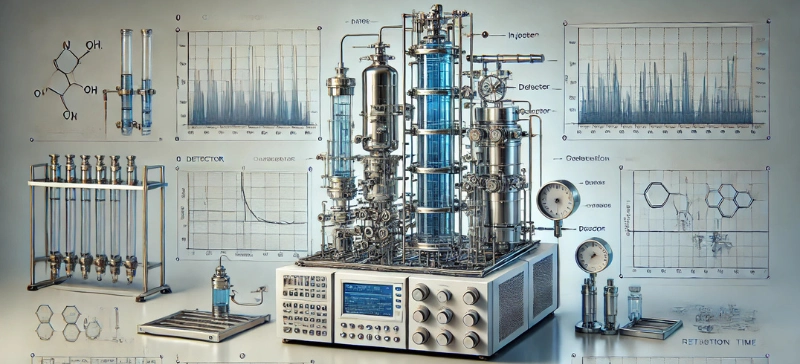
- The sample is injected into the system, where it is vaporized and carried through the column by the mobile phase.
- Components of the sample interact differently with the stationary phase, leading to their separation over time.
- As the separated compounds exit the column, they are detected and recorded based on their unique retention times, producing a chromatogram that allows for qualitative and quantitative analysis.

figure 1:This image illustrates the fundamental principles of gas chromatography, including how the carrier gas transports the sample through the column to the detector.
Applications of Gas Chromatography
Gas chromatography has vast applications in multiple industries and scientific disciplines. Some of the most significant areas include:
1. Petrochemical and Oil Industry
GC is extensively used to analyze natural gas, gasoline, and petrochemical products. It is used to separate and quantify hydrocarbons, including alkanes, aromatics, and other volatile compounds. It also plays a crucial role in monitoring impurities and contaminants in fuel and other chemical products.
2. Environmental Monitoring
GC is instrumental in environmental monitoring, particularly for detecting volatile organic compounds (VOCs) and other pollutants in air, water, and soil. For example, GC is used to monitor air quality by measuring pollutants such as benzene, toluene, and xylene, which are harmful to human health.
3. Pharmaceutical and Biomedical Analysis
In the pharmaceutical industry, GC is used to ensure the quality and purity of active pharmaceutical ingredients (APIs) and to monitor the stability of drug formulations. GC-MS is particularly valuable in identifying trace levels of contaminants in drugs. Additionally, GC is used to analyze biological samples such as blood, urine, and tissue, helping to detect drugs, hormones, and other metabolites.
4. Food and Beverage Industry
GC is widely used for food quality control, such as the analysis of flavors, fragrances, and food preservatives. It can identify and quantify volatile compounds responsible for taste and aroma. It also plays a vital role in detecting contaminants and additives in food products.
5. Forensic Science
In forensic science, GC is used to analyze biological and environmental samples for the presence of drugs, poisons, and explosives. This application is crucial in criminal investigations and postmortem toxicology studies.
Learn more:The Role of Mineral Analyzers in Transforming Mineral Exploration
Key Concepts in Gas Chromatography
To understand the full potential of GC, it’s essential to grasp several key concepts that influence the performance of the system:
1. Flow Rate and Carrier Gas
The flow rate of the carrier gas is critical for achieving efficient separation. A higher flow rate results in faster analysis times, but this can compromise the resolution. The choice of carrier gas—typically helium, nitrogen, or hydrogen—also impacts separation efficiency and sensitivity.
2. Retention Time
Retention time measures how long a compound takes to travel through the column and reach the detector. Several factors influence retention time, including the compound’s volatility, its interaction with the stationary phase, and the column’s temperature. Analysts use retention time to identify and quantify compounds in a given sample.
3. Temperature Programming
In temperature programming, the temperature of the column is gradually increased to improve the separation of compounds with different boiling points. This technique is especially useful for complex samples containing a wide range of compounds.
4. Resolution
Resolution refers to the ability of the column to separate two closely eluting compounds. Good resolution is crucial for accurate quantification and identification. The factors affecting resolution include column length, stationary phase, and carrier gas flow rate.
5. Detector Sensitivity
Different detectors have varying sensitivities, which determine the detection limits of the system. FID is highly sensitive to organic compounds, while GC-MS offers excellent sensitivity for a wide range of compounds, including those present in trace amounts.

Figure 2: This image demonstrates a linear calibration model showing the relationship between detector response (pA) and standard analyte concentration (ppm). It highlights the importance of calibration for accurate quantification in gas chromatography.
Advantages and Limitations
Advantages of Gas Chromatography
- High Sensitivity: Especially with detectors like FID and GC-MS, which allow for detection of trace amounts of compounds.
- Speed: GC offers fast analysis times compared to many other analytical techniques.
- Reproducibility and Precision: The high reproducibility of results makes GC suitable for routine quality control in various industries.
- Versatility: GC can analyze a wide range of volatile and semi-volatile compounds, making it applicable across many fields.
Limitations of Gas Chromatography
- Sample Preparation: Samples must be vaporized before being injected into the column, which can be a limitation for compounds that decompose at high temperatures.
- Complex Sample Matrix: Samples containing high molecular weight compounds or those with non-volatile components may not be suitable for GC without proper sample preparation.
- Cost: Setting up a GC system, particularly with advanced detectors like MS, can be expensive.
Advanced Gas Chromatography Solutions by AELAB
GC1290 Gas Chromatograph: High Precision and Flexibility
The GC1290 Gas Chromatograph by AELAB offers advanced features like a 20-ramp temperature-controlled column oven, rapid heat-up and cool-down, and dual independent injectors. Its high-sensitivity detectors (FID, TCD, ECD) ensure precise analysis, while the GLP/FDA-compliant M6 software provides secure data management. Designed for flexibility and accuracy, it’s ideal for demanding laboratory applications.

GC1120 Gas Chromatograph: Versatile and Reliable
AELAB’s GC1120 combines versatility and performance with its multi-ramp column oven, support for three independent injectors, and sensitive detectors (FID, TCD, NPD). Its GLP/FDA-compliant M6 software ensures seamless data handling, making it a robust solution for complex analyses in diverse industries.

Explore More Gas Chromatography Systems by AELAB
Beyond the GC1290 and GC1120, AELAB provides a wide range of gas chromatography systems tailored to various analytical needs. Discover models like, GC-MS 3200 Gas Chromatograph – Mass Spectrometer (Quadrupole),GC102AF Gas Chromatograph … , designed for specialized applications.
6. Conclusion
Gas chromatography is an indispensable technique for modern chemical analysis, offering high precision and sensitivity in a wide variety of applications. From environmental monitoring to pharmaceutical analysis, its versatility makes it essential across many scientific and industrial sectors. Understanding the key concepts, techniques, and applications discussed in this article equips users with the knowledge to fully utilize GC for both routine and complex analyses. As GC technology continues to advance, we can expect further innovations that will enhance its efficiency and expand its range of applications, ensuring its continued relevance in the future of analytical chemistry.