

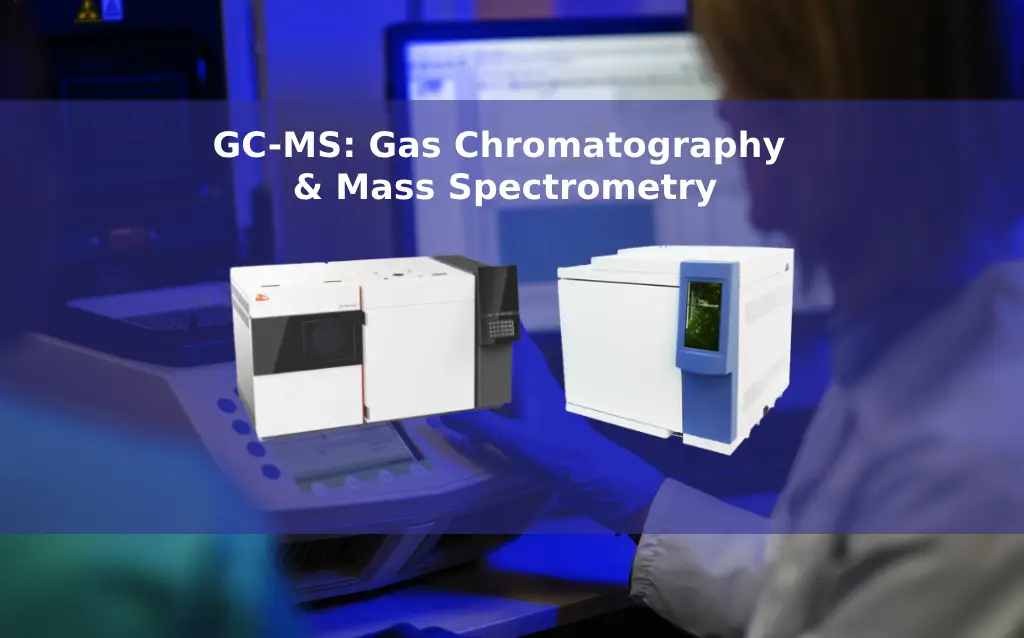
What is GC-MS (Gas Chromatograph and Mass Spectrometry)?
GC-MS, or Gas Chromatography-Mass Spectrometry, is an advanced analytical technique that scientists use to identify and quantify chemical compounds in various samples. This technique combines two powerful methods: gas chromatography (GC) and mass spectrometry (MS). By combining these methods, GC-MS allows researchers to perform a comprehensive analysis, enabling the separation, identification, and quantification of complex mixtures.
How Does GC-MS Work?
It works in two main steps:
Gas Chromatography (GC):
The sample is introduced into the gas chromatograph where it is vaporized and carried by a carrier gas through a narrow column packed with a stationary phase.
Inside the column, components of the sample separate based on their volatility and affinity for the stationary phase.
Each compound exits the column at a specific time, known as the retention time, allowing for preliminary identification.
Mass Spectrometry (MS):
The separated compounds are transferred to the mass spectrometer where they are ionized.
Ionization creates charged particles (ions), which are then separated based on their mass-to-charge ratio (m/z).
The resulting mass spectrum provides detailed information about the molecular structure and composition of the analytes.

Figure 1: GC-MS System Overview
This diagram illustrates the essential components of Gas Chromatography-Mass Spectrometry, including the carrier gas, GC column, transfer line, and mass spectrometer. Gas Chromatography-Mass Spectrometry clearly shows how the sample undergoes separation in the GC column before being analyzed by the mass spectrometer for detailed identification and quantification. As a result, Gas Chromatography-Mass Spectrometry enhances understanding of how the system works.
Key Features of Gas Chromatograph and Mass Spectrometry
Separation and Identification
GC effectively separates compounds, and then mass spectrometry confirms their identity. This dual approach ensures a high degree of accuracy in identifying even trace compounds, making it an essential tool for detailed analysis.
Quantification
By measuring the intensity of ion peaks in the mass spectrum, It enables precise quantification of each component in a sample. Consequently, it provides accurate and reliable data for complex mixtures.
High Sensitivity
It offers exceptional sensitivity, which makes it highly effective in detecting compounds at very low concentrations, even down to femtogram levels. Therefore, it is particularly useful in applications that require the detection of minute traces.
Applications of Gas Chromatograph and Mass Spectrometry
Environmental Monitoring
Used to detect pollutants in air, water, and soil samples.
Forensic Science
Helps identify drugs, toxins, and other substances in biological samples like blood and urine.
Food and Flavor Industry: Analyzes volatile compounds to detect contaminants or enhance flavors.
Pharmaceuticals
Assists in the quality control of medicines and the detection of impurities.
Toxicology and Drug Testing
It is widely used for detecting drugs and metabolites in human and animal samples, particularly in anti-doping tests.
Advantages of Gas Chromatograph and Mass Spectrometry
Precision and Accuracy
The combination of GC and MS ensures high reliability, making it a highly accurate tool for identifying compounds in complex mixtures.
Quantitative Analysis
GC-MS provides precise quantitative analysis by measuring ion intensity, allowing for accurate determination of compound concentrations.
Versatility
This technology is widely applicable across various industries, including environmental science, forensics, food safety, and pharmaceuticals, showcasing its broad scope.
Sensitivity
Due to its exceptional sensitivity, GC-MS can detect even trace amounts of substances, making it the ideal choice for trace analysis.
Quantitative Analysis
It allows for accurate quantitative analysis by measuring ion intensity.
Versatility
GC-MS provides precise quantitative analysis by measuring ion intensity, allowing for accurate determination of compound concentrations.
Sensitivity
Due to its exceptional sensitivity, GC-MS can detect even trace amounts of substances, making it the ideal choice for trace analysis.
Limitations of GC-MS
Sample Preparation
Some samples require extensive preparation, especially if they contain large matrix components that could interfere with analysis.
Volatility Limitations
GC-MS is typically limited to compounds that can be vaporized without decomposition. Non-volatile compounds may need additional preparation.
Complexity of Data Interpretation
The mass spectra generated can be complex, requiring expertise to properly identify and interpret the results.
GC-MS vs. GC-MS/MS
While GC-MS is effective for separating and identifying compounds, GC-MS/MS (tandem mass spectrometry) enhances the analysis by adding a second stage of mass spectrometry. This is particularly useful for analyzing complex samples with multiple compounds that may overlap or interfere with each other. The additional stage improves sensitivity and helps reduce interference from matrix components, making GC-MS/MS ideal for target analysis in biological and forensic testing.

Figure 2: GC-MS Setup Diagram
This diagram illustrates the components and workflow of a Gas Chromatography-Mass Spectrometry (GC-MS) system. It highlights key parts, including the carrier gas, GC column, transfer line, and mass spectrometer. The setup shows how the sample is separated in the GC column and then analyzed in the mass spectrometer.
Common Problems with Gas Chromatograph and Mass Spectrometry
Leaks: Small leaks can affect the vacuum system of the mass spectrometer, reducing sensitivity.
Contamination: Sample contaminants can interfere with results and damage sensitive components of the Gas Chromatograph and Mass Spectrometry
Column Issues: Inappropriate flow rates or degraded columns can impact the separation efficiency, leading to poor results.
Conclusion
GC-MS is an essential tool in modern analytical chemistry, offering unparalleled precision and sensitivity. By combining gas chromatography with mass spectrometry, it provides a comprehensive analysis of complex mixtures, therefore making it indispensable in fields ranging from environmental testing to drug analysis. However, despite its limitations, such as the need for extensive sample preparation and its inability to handle non-volatile compounds, Gas Chromatograph and Mass Spectrometry continues to be a cornerstone technique in many industries. This is largely due to its accuracy, versatility, and its remarkable ability to detect even trace amounts of substances.