


Introduction
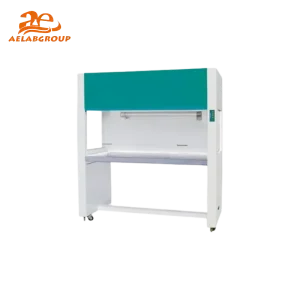
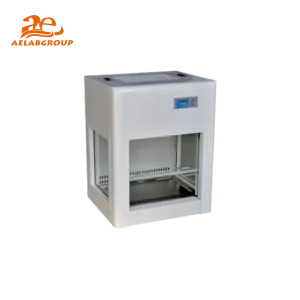
Microbiology Laminar Flow Cabinets are essential in modern laboratories where contamination control directly impacts diagnostic accuracy and research reliability. As a result, even microscopic airborne particles must be carefully controlled.
These cabinets are specifically designed to create a sterile, particle-free workspace using controlled HEPA-filtered airflow. Therefore, they protect sensitive samples and laboratory materials from environmental contamination.
In this guide, we provide a clear overview of how laminar airflow works and how different cabinet types function.
How Microbiology Laminar Flow Cabinets Use Laminar Airflow
Laminar airflow is the core operating principle behind these laboratory cabinets. It refers to a controlled air movement pattern in which air flows in parallel layers at a constant velocity without turbulence or cross-currents.
By directing HEPA-filtered air in one uniform direction across the work surface, the system significantly reduces the risk of airborne contamination. Unlike turbulent airflow — which causes chaotic particle mixing — this smooth and consistent air stream continuously sweeps contaminants away from sensitive materials.
As a result, a sterile and stable laboratory environment can be maintained for contamination-sensitive procedures.
What Are Microbiology Laminar Flow Cabinets?
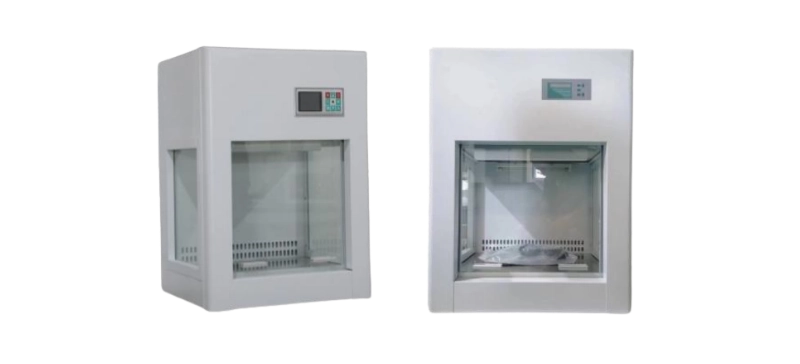
Microbiology Laminar Flow Cabinets are specialized laboratory workstations designed to create a sterile, particle-free workspace using HEPA or ULPA filtration systems. Also known as clean benches or tissue culture hoods, these cabinets deliver filtered air in a unidirectional flow across the working area.
Primary Purpose
• Protect samples and materials from airborne contamination
• Maintain sterility during laboratory procedures
• Provide a controlled environment for precision and aseptic work
Important: Microbiology Laminar Flow Cabinets are designed primarily for product protection rather than operator protection. For handling hazardous biological agents, certified biological safety cabinets should be used.
How a Laminar Flow Cabinet Works
Laminar flow cabinets operate using unidirectional, HEPA-filtered airflow to create a clean and sterile working environment. As a result, airborne particles are continuously removed from the work surface.
Step-by-Step Working Mechanism
1. Air Intake
Ambient air is drawn into the cabinet through a pre-filter, which removes large dust particles and debris.
2. HEPA / ULPA Filtration
Next, the air passes through a high-efficiency filter:
HEPA filters remove ≥99.97% (or 99.99%) of particles ≥0.3 µm
0.3 µm is known as the Most Penetrating Particle Size (MPPS)
ULPA filters provide even higher filtration efficiency
How HEPA filters capture particles:
Interception
Impaction
Diffusion (Brownian motion)
3. Laminar Airflow Creation
After filtration, the air moves at a controlled velocity (typically 0.3–0.5 m/s) in either:
Horizontal direction
Vertical downward direction
This smooth, parallel airflow minimizes turbulence.
4. Contamination Prevention
Consequently, the continuous, uniform airflow sweeps particles away from the working area, preventing them from settling on samples and maintaining sterility.
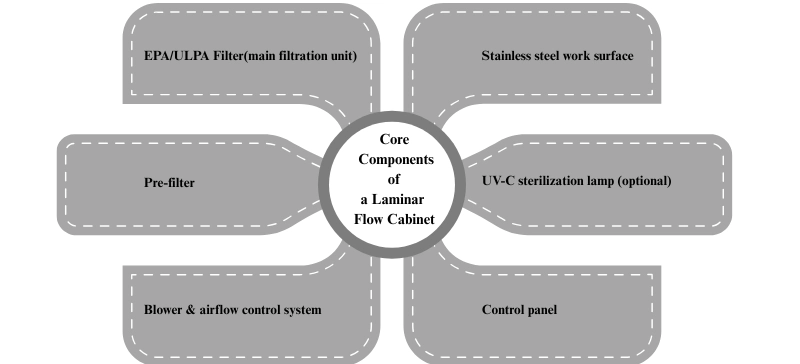
Key Components of a Laminar Flow Cabinet
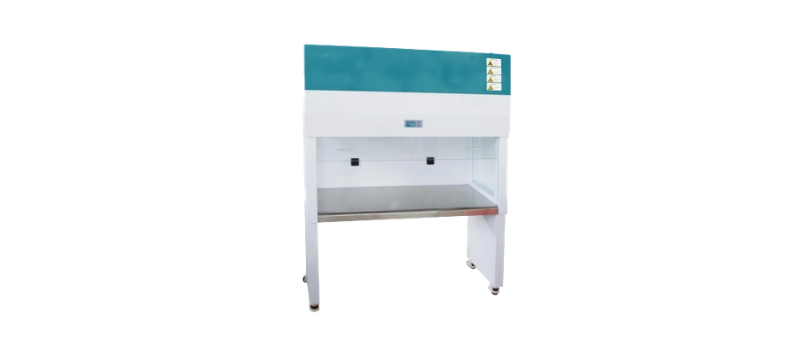
Understanding the structure helps in proper selection and maintenance.
HEPA/ULPA Filter (main filtration unit)
Pre-filter
Blower & airflow control system
Stainless steel work surface
UV-C sterilization lamp (optional)
Control panel
Types of Microbiology Laminar Flow Cabinets
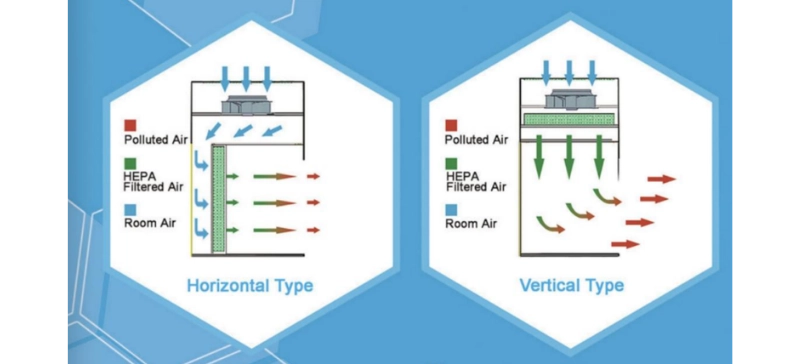
1. Horizontal Microbiology Laminar Flow Cabinets
Pattern
Air flows from the back of the cabinet toward the operator.
Advantages
Simpler design
Lower initial cost
Easy maintenance
Unobstructed workspace
Excellent product protection
Disadvantages
Air moves toward operator
No biohazard containment
Larger objects may disrupt airflow
Typical Applications
Media preparation
Agar plate pouring
Electronics assembly
Semiconductor manufacturing
Non-hazardous microorganism handling
2. Vertical Microbiology Laminar Flow Cabinets
Airflow Pattern
Air flows from top to bottom, onto the work surface.
Advantages
Reduced operator exposure
Lower internal cross-contamination risk
Suitable for sensitive procedures
More versatile
Disadvantages
Higher cost
More complex maintenance
Still not a substitute for biosafety cabinets
Typical Applications
Clinical microbiology
Sterility testing
Tissue culture
Pharmaceutical compounding
Molecular biology preparation
Horizontal vs Vertical Laminar Flow Cabinets (Quick Comparison)
| Feature | Horizontal | Vertical |
|---|---|---|
| Airflow Direction | Toward operator | Downward |
| HEPA Location | Back | Top |
| Operator Protection | Low | Moderate |
| Cross-Contamination Risk | Moderate | Lower |
| Cost | Lower | Higher |
| Primary Function | Product protection | Product protection (+ limited operator benefit) |
Applications of Microbiology Laminar Flow Cabinets
Microbiology Laminar Flow Cabinets are essential for maintaining sterile and contamination-free environments in laboratory and industrial settings. Their controlled HEPA-filtered airflow supports a wide range of critical applications.
1. Aseptic Techniques
In microbiology laboratories, these cabinets provide a sterile workspace for:
• Inoculating agar plates
• Subculturing microorganisms
• Performing culture transfers
• Conducting differential staining procedures
2. Media Preparation
In addition, they are widely used for preparing and handling sterile materials, including:
• Preparing sterile culture media
• Dispensing agar into plates and tubes
• Performing sterile filtration
• Preparing laboratory reagents
3. Molecular Diagnostics
Moreover, in molecular and clinical laboratories, they support:
• PCR preparation
• DNA and RNA sample setup
• Molecular assay workflows
• Sensitive diagnostic testing procedures
4. Pharmaceutical Applications
Similarly, in pharmaceutical environments, Microbiology Laminar Flow Cabinets assist with
• Injectable drug preparation
• Vaccine research
• Sterile compounding processes
5. Electronics and Semiconductor Industry
Beyond life sciences, they are also applied in:
• Microchip assembly
• Circuit board manufacturing
• Cleanroom-based precision operations
Benefits of Using a Laminar Flow Cabinet
• Superior Contamination Control
Removes airborne particles efficiently and maintains a sterile working environment.
• Improved Diagnostic Accuracy
Reduces environmental variables that may affect laboratory results.
• Protection of Sensitive Materials
Prevents cross-contamination during handling of samples and reagents.
• Enhanced Workflow Efficiency
Provides stable and controlled working conditions for laboratory procedures.
• Optional UV Sterilization
UV-C lamps can sterilize the chamber before operation and must be turned off during active use.
Best Practices for Safe Operation
To maintain sterility:
Allow airflow stabilization for 10–15 minutes before use
Work at least 15 cm inside cabinet
Avoid blocking front/rear grills
Minimize rapid movements
Arrange materials from clean to contaminated
Disinfect surfaces before and after use
Use PPE (gloves, lab coat, mask)
Maintenance & Certification Requirements
Proper maintenance ensures performance and regulatory compliance.
Routine Maintenance Includes:
HEPA filter integrity testing
Air velocity verification
Annual certification
Pre-filter replacement
Surface disinfection
HEPA filters typically require replacement every 1–3 years, depending on usage.
Neglecting maintenance may compromise airflow uniformity and laboratory reliability.
Laminar Flow Cabinet vs Biological Safety Cabinet vs Fume Hood
| Feature | Laminar Flow Cabinet | Biosafety Cabinet | Fume Hood |
|---|---|---|---|
| Protects Sample | Yes | Yes | No |
| Protects Operator | Limited | Yes | Yes |
| Air Pressure | Positive | Negative | Negative |
| Use with Pathogens | Not Recommended | Yes | Limited |
Quick Answer: A laminar flow cabinet protects the product, while a biosafety cabinet protects the product, operator, and environment. However, for aerosol-generating pathogens such as tuberculosis or viral cultures, a Class II Biological Safety Cabinet is mandatory.
How to Choose the Right Laminar Flow Cabinet
Before purchasing, evaluate the following:
1. Type of Application
Non-hazardous procedures → Horizontal cabinet
Sensitive procedures → Vertical cabinet
2. Laboratory Space
Ensure adequate internal workspace dimensions to support your workflow.
3. Filtration Efficiency
Evaluate HEPA versus ULPA filtration requirements based on contamination control needs.
4. Construction Material
Stainless steel interiors are preferred for durability and easy disinfection.
5. Noise and Vibration
Low noise and vibration levels are important in research environments.
6. Compliance Documentation
Verify certification standards, airflow validation reports, and regulatory compliance.
7. Long-Term Operating Cost
Consider filter replacement schedules, maintenance requirements, and service support.
Why Microbiology Laminar Flow Cabinets Are Essential in Modern Laboratories
As laboratory diagnostics, pharmaceutical production, and biotechnology research demand higher precision and contamination control, Microbiology Laminar Flow Cabinets have become indispensable in modern laboratory environments.
They help laboratories:
• Maintain sterile working conditions
• Protect product and sample integrity
• Support regulatory and quality compliance
• Enhance diagnostic reliability
• Improve overall operational efficiency
Their controlled HEPA-filtered airflow technology provides a stable and particle-free workspace, making them a foundational component in contamination-sensitive laboratory workflows.
Final Thoughts
Ultimately, Microbiology Laminar Flow Cabinets are a critical investment for clinical microbiology laboratories, pharmaceutical facilities, research centers, and contamination-sensitive environments. Their ability to generate controlled, HEPA-filtered airflow ensures sterile working conditions and protects sensitive materials from airborne contamination.
By understanding airflow principles, cabinet configurations, operational limitations, and maintenance requirements, laboratories can achieve:
• Maximum sterility
• Accurate diagnostic results
• Regulatory compliance
• Long-term operational efficiency
Selecting the appropriate horizontal or vertical model based on specific workflow needs will optimize laboratory performance, safety, and overall reliability.