

Introduction
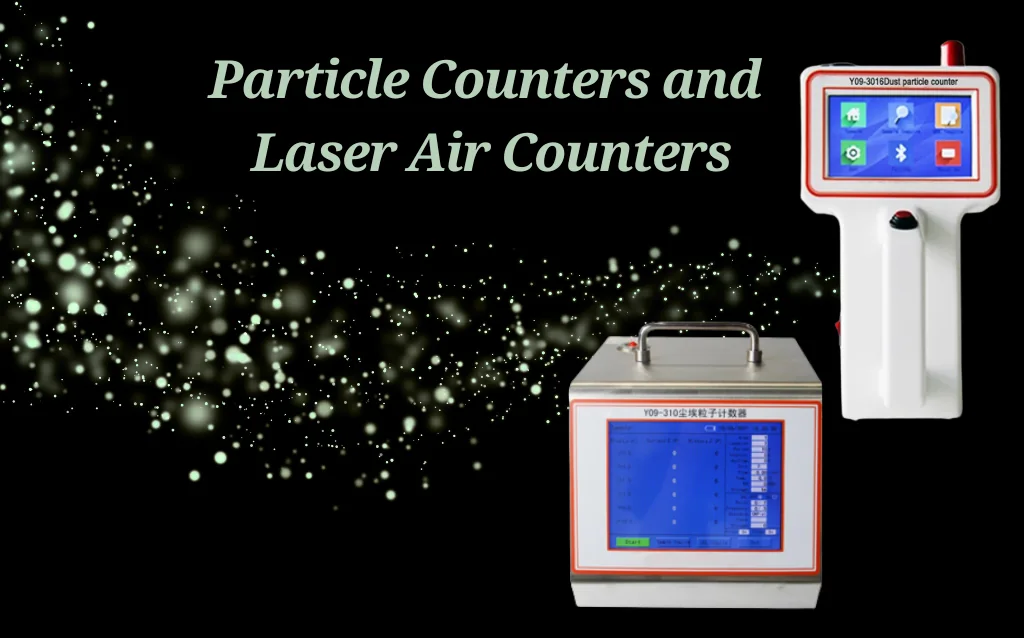
In industries where even microscopic contamination can cause serious risks, Particle Counters play an essential role in maintaining cleanroom integrity. These highly controlled environments are the foundation of pharmaceuticals, biotechnology, semiconductors, aerospace, and healthcare, where strict air purity is vital to safeguard product quality, human safety, and regulatory trust.
This guide explores what laser air particle counters are, how they work, their key benefits, and how to choose and apply them effectively.
What Is a Particle Counter?
A particle counter is a scientific instrument designed to detect and count physical particles in air, liquids, or on surfaces. In cleanroom environments, the focus is primarily on airborne particle counters (aerosol particle counters) that measure airborne contaminants and ensure compliance with ISO 14644 standards.
Main Types of Particle Counters
Aerosol (Airborne) Particle Counters – Used in cleanrooms to monitor dust, spores, and other airborne contaminants.
Liquid Particle Counters – Measure particle contamination in liquids such as water, chemicals, or pharmaceuticals.
Solid Particle Counters – Detect dry particles in industrial or environmental applications.
Among these, aerosol models are the most widely used in controlled environments.
How Do Particle Counters Work?
Particle counters rely on advanced detection methods to measure both particle size and particle concentration.
1. Optical Particle Counters (OPCs)
Based on light scattering or light blocking.
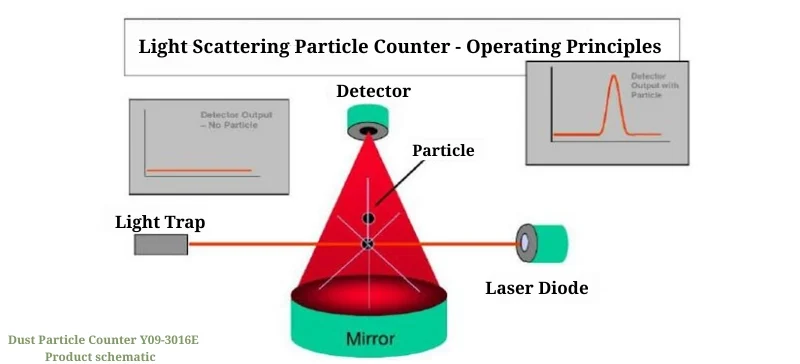
A laser diode projects light through an air sample.
As particles pass through, they scatter light.
The scattered light is detected by a photodetector, converting it into particle size and count data.
Sensitivity: as small as 0.3 µm.
2. Condensation Particle Counters (CPCs)
Use alcohol vapors (e.g., butanol, isopropyl) to enlarge ultrafine particles.
Once enlarged, these particles become detectable via light scattering.
Sensitivity: as small as 2 nanometers (0.002 µm).
Widely used in research and extreme-cleanliness environments.
What Is a Laser Air Particle Counter?
A laser air particle counter is a specialized type of optical particle counter that uses laser light scattering to provide highly accurate measurements of airborne particles.
How They Work
A laser beam illuminates the airflow sample.
Particles scatter the laser light based on size and shape.
Photodetectors measure the scattered light.
Results are reported as concentration of particles per cubic unit of air, with breakdown by size channels (e.g., ≥0.3 µm, ≥0.5 µm, ≥5 µm).
Key Features of Laser Particle Counters
High sensitivity – Detects particles as small as 0.1 µm.
Real-time monitoring – Instant results for quick corrective actions.
Data logging – Enables trend analysis and compliance reporting.
Portability & flexibility – Available as handheld, portable, and fixed systems.
Anatomy of a Particle Counter
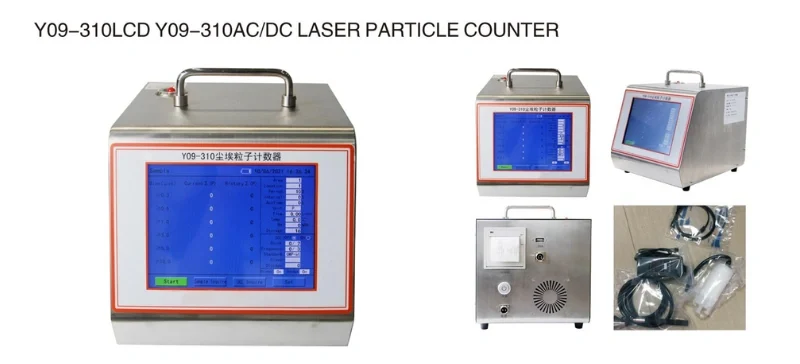
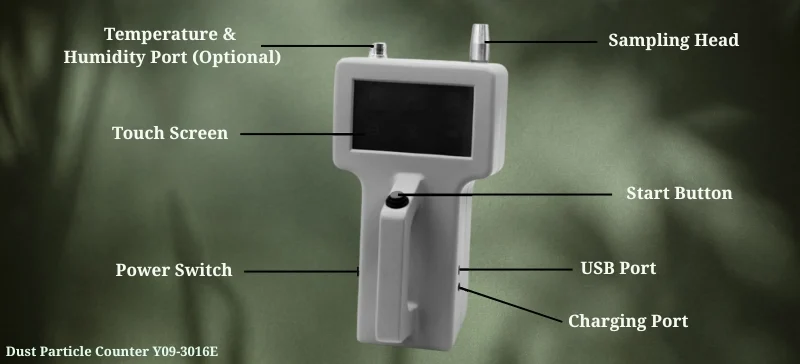
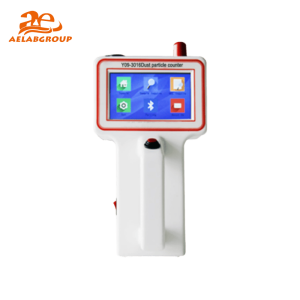
A typical AELAB laser particle counter contains:
Laser diode – Provides the light source.
Sample inlet – Draws in air.
View volume – Where particles interact with the laser.
Photodetector – Captures scattered light.
Pump & exhaust – Regulate airflow through the system.
Sources of Particles in a Cleanroom
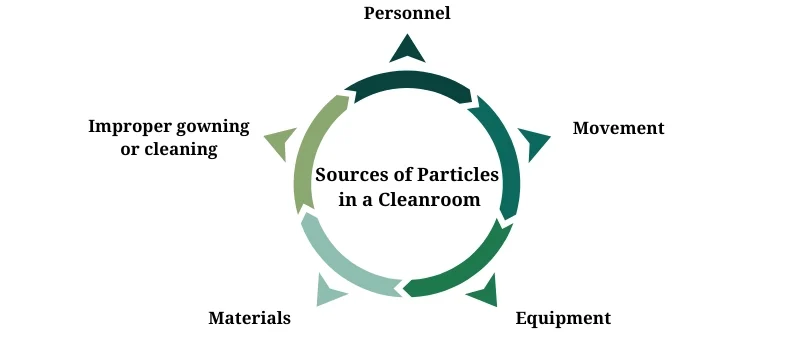
Even the most advanced cleanrooms face contamination risks:
Personnel – Account for up to 80% of contamination; human skin sheds ~40,000 cells/minute.
Movement – Increases particle generation exponentially.
Equipment – Friction and moving parts release particulates.
Materials – Raw materials and packaging carry contaminants.
Improper gowning or cleaning – Even minor mistakes compromise control.
Particle Counter vs. Laser Particle Counter
| Feature | Standard Particle Counter | Laser Air Particle Counter |
|---|---|---|
| Technology | Optical / Condensation | Laser Light Scattering |
| Accuracy | Moderate | Very High |
| Sensitivity | Larger particles only | Detects down to 0.1 µm |
| Applications | General monitoring | Cleanrooms, Pharma, Semiconductor |
All laser air particle counters are particle counters, but not all particle counters use laser technology.
Factors to Consider When Choosing a Particle Counter
When selecting a device , consider:
Particle size range – Match sensitivity to your cleanroom classification.
Flow rate – Impacts accuracy; must align with ISO standards.
Calibration – Regular calibration ensures reliability.
Data management – Advanced software simplifies compliance.
Monitoring needs – Handheld vs. fixed real-time monitoring.
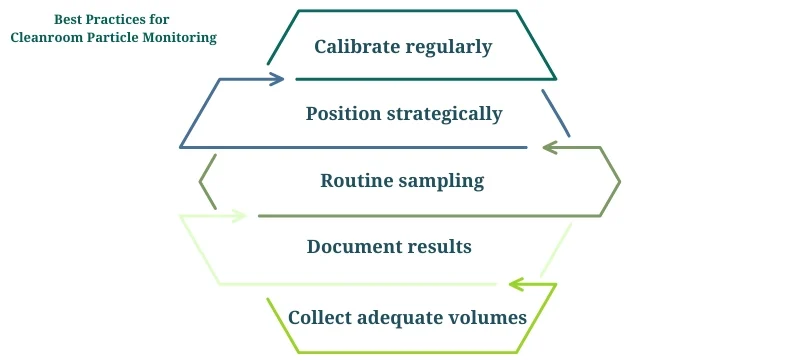
Best Practices for Cleanroom Particle Monitoring
Calibrate regularly – Follow ISO and AELAB guidelines.
Position strategically – Near HVAC outlets and critical control points.
Routine sampling – Identifies contamination trends.
Document results – Record date, time, location, and counts.
Collect adequate volumes – Ensures statistical accuracy.
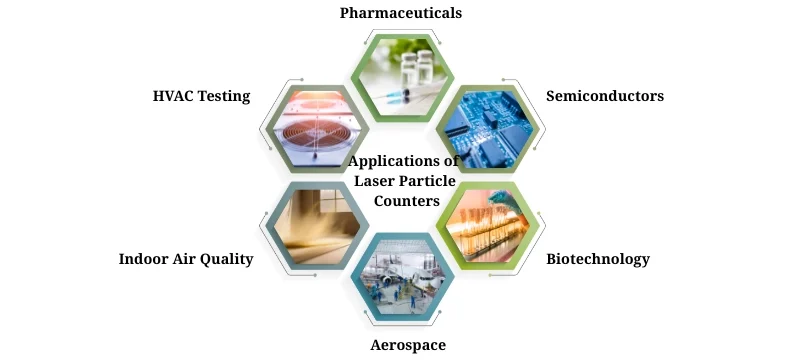
Applications of Laser Particle Counters
Pharmaceuticals – GMP compliance, sterile production.
Semiconductors – Preventing micro-defects in wafers.
Biotechnology – Contamination-free research and manufacturing.
Aerospace – Precision environments for critical components.
Indoor Air Quality – Detecting allergens, dust, mold, and VOCs.
HVAC Testing – Evaluating filter efficiency.
Common Mistakes to Avoid
Using outdated or uncalibrated counters.
Ignoring environmental factors (temperature, humidity, vibration).
Misplacing devices in non-representative areas.
Overlooking proper maintenance.
Conclusion
A particle counter is more than just a measuring device—it is a true guardian of cleanroom integrity. Among all available options, the laser air particle counter has proven to be the most accurate and reliable, delivering real-time insights with unmatched sensitivity.
From pharmaceuticals to aerospace, choosing the right AELAB laser particle counter guarantees:
Compliance with ISO, GMP, and USP standards
Consistent protection of product quality and safety
Sustainable long-term operational success
Ready to elevate your cleanroom monitoring? Discover AELAB’s advanced laser particle counters and achieve contamination-free operations today.