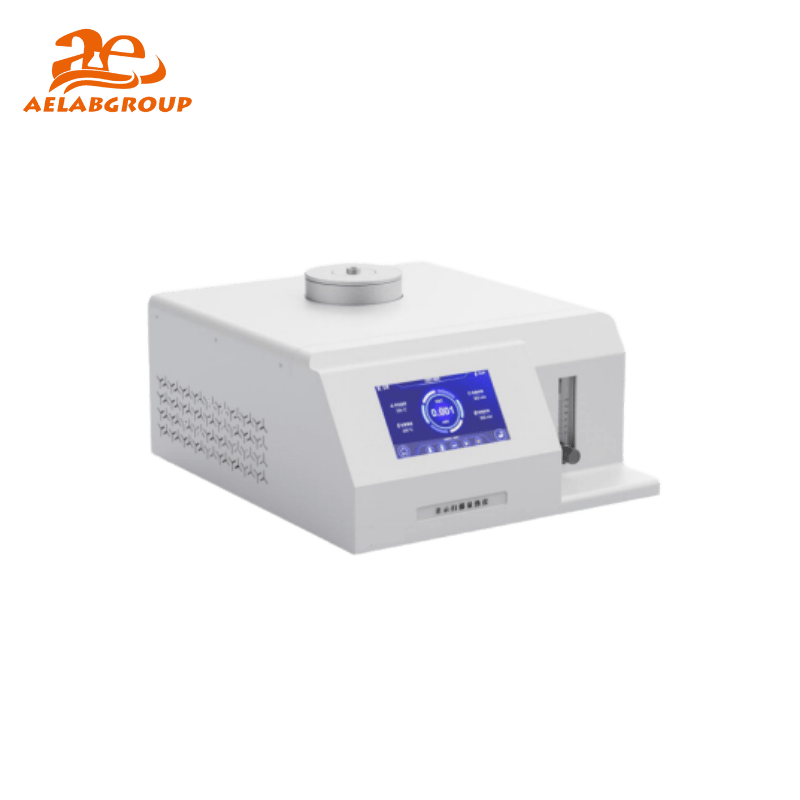
The AELAB AE-DSC600 Differential Scanning Calorimeter is engineered for precise measurement of melting behavior, crystallization, glass transition, and thermal stability. It supports a broad temperature range up to 600 °C and provides high accuracy for research, industrial quality control, and materials development.
The AE-DSC600 enables advanced thermal characterization using a 24-bit 7-inch LCD touchscreen, multi-mode temperature programming, and automatic gas switching. Users can configure temperature and enthalpy calibration independently using certified reference standards.
The AELAB AE-DSC600 integrates a precision calorimetric detection system with high-stability temperature regulation. Its measurement module achieves 0.001 °C resolution and 0.001 mW sensitivity, ensuring reliable detection of subtle thermal events. The instrument supports controlled heating, cooling, and isothermal operation through finely managed PID-based conditioning. The durable enclosure and optimized thermal pathway maintain consistent performance under continuous laboratory use.
The differential scanning calorimeter quantifies energy flow associated with phase transitions by monitoring heat difference between a sample and reference pan under programmed temperature conditions. The AE-DSC600 supports heating rates from 0.1–100 °C/min, programmable 1–10 Hz sampling, and FTC/STC experimental modes. Automatic dual-path atmosphere switching enables controlled testing under inert or oxidative environments. The high-definition touchscreen display provides real-time thermogram visualization and parameter tracking.
The AE-DSC600 includes a standard USB data interface for PC connectivity, file export, and GLP-compliant record management. Data can be transferred to laboratory information systems or external analysis software for detailed evaluation and reporting.
| Model | Specifications |
|---|---|
| AE-DSC600 | 0~±2000mW DSC range, Room temperature to 600 °C, 0.1–100 °C/min heating rate, 24-bit 7-inch LCD touchscreen, 490×390×215 mm |
The AELAB AE-DSC600 is suitable for polymer analysis, melting and crystallization studies, glass transition characterization, thermal stability testing, oxidation induction time determination, chemical reaction evaluation, curing behavior analysis, and quality control of materials in chemical, pharmaceutical, polymer, composite, and academic research laboratories.
The instrument aligns with GB/T 19466 and ISO 11357 standards for glass transition temperature, melting and crystallization temperature, thermal enthalpy, oxidation induction time (OIT), and dynamic OIT determination. All units undergo AELAB quality control, calibration verification, and GLP-aligned documentation support.
Specifications :
| No. | Technical Parameter | Value |
|---|---|---|
| 1 | DSC range | 0~±2000mW |
| 2 | Temperature range | Room temperature of ~600℃ |
| 3 | Toggle rate | 16.6Hz |
| 4 | Heating rate | 0.1~100℃/min |
| 5 | Temperature resolution | 0.001℃ |
| 6 | Temperature fluctuation | ±0.01℃ |
| 7 | DSC noise | 0.001mW |
| 8 | DSC resolution | 0.01μW |
| 9 | DSC definition | 0.001mW |
| 10 | DSC sensitivity | 0.001mW |
| 11 | Experimental mode | FTC, STC are arbitrarily set |
| 12 | Procedure temperature control | The whole stage is 12 order temperature control flexible setting |
| 13 | Temperature control method | Heat up, constant temperature, and cooling |
| 14 | Scan type | Heating up, cooling, and isothermal scanning |
| 15 | Atmosphere control | The atmosphere of the two paths can be set freely, and the instrument can automatically switch |
| 16 | Display mode | 24bit color 7-inch LCD touchscreen display |
| 17 | Data interface | Standard USB interface |
| 18 | Sampling rate | 1~10Hz programmable |
| 19 | Instrument calibration | The lower and upper computers have the multi-point temperature correction function at the same time |
| 20 | Parameter standard | With standard materials, users can correct the temperature and enthalpy by themselves |
| 21 | Instrument size | 490*390*215mm |
| No. | Technical Parameter | Value |
|---|---|---|
| 1 | DSC range | 0~±2000mW |
| 2 | Temperature range | Room temperature of ~600℃ |
| 3 | Toggle rate | 16.6Hz |
| 4 | Heating rate | 0.1~100℃/min |
| 5 | Temperature resolution | 0.001℃ |
| 6 | Temperature fluctuation | ±0.01℃ |
| 7 | DSC noise | 0.001mW |
| 8 | DSC resolution | 0.01μW |
| 9 | DSC definition | 0.001mW |
| 10 | DSC sensitivity | 0.001mW |
| 11 | Experimental mode | FTC, STC are arbitrarily set |
| 12 | Procedure temperature control | The whole stage is 12 order temperature control flexible setting |
| 13 | Temperature control method | Heat up, constant temperature, and cooling |
| 14 | Scan type | Heating up, cooling, and isothermal scanning |
| 15 | Atmosphere control | The atmosphere of the two paths can be set freely, and the instrument can automatically switch |
| 16 | Display mode | 24bit color 7-inch LCD touchscreen display |
| 17 | Data interface | Standard USB interface |
| 18 | Sampling rate | 1~10Hz programmable |
| 19 | Instrument calibration | The lower and upper computers have the multi-point temperature correction function at the same time |
| 20 | Parameter standard | With standard materials, users can correct the temperature and enthalpy by themselves |
| 21 | Instrument size | 490*390*215mm |
Download catalog for:
Looking for specific lab equipment? Fill out the form below, and our team will get back to you with detailed information and a personalized quote.



 Whatsapp