

How Do Recirculating Chillers Work in Laboratories and Industrial Applications?
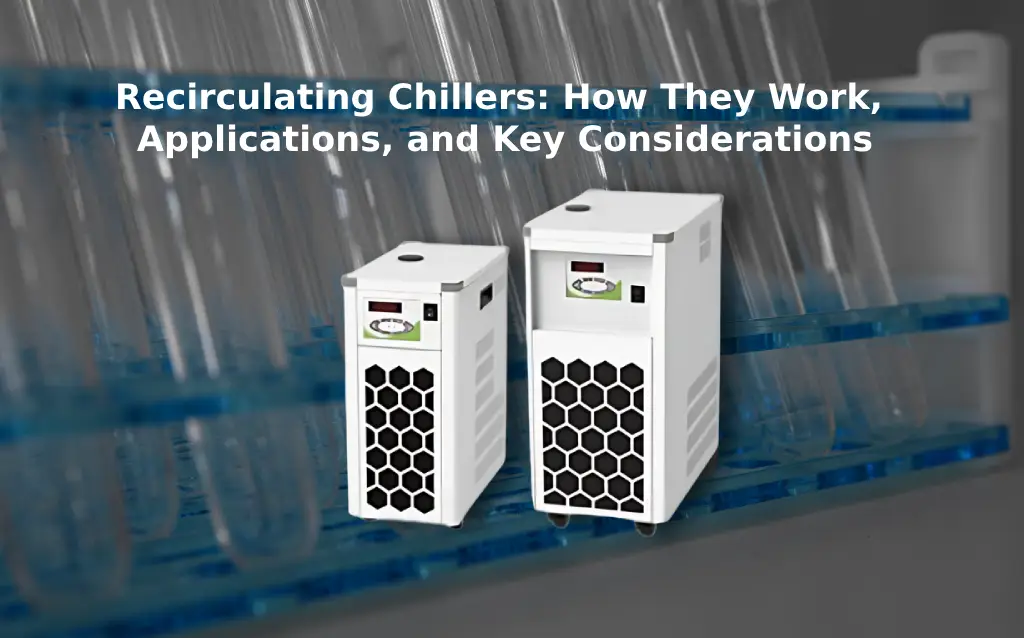
Recirculating chillers are cooling systems designed to maintain stable temperatures in laboratories, industrial settings, and medical applications. They remove heat from equipment and processes using a closed-loop system, ensuring efficiency and precision.
Cooling Cycle Overview
-
Heat Absorption
– The cooling fluid circulates through the system, absorbing heat from the equipment.
-
Heat Transfer
– The heated fluid returns to the chiller and passes through the evaporator, where refrigerant absorbs the heat.
-
Compression & Condensation
– The refrigerant, now in gas form, moves to the compressor, increasing its temperature and pressure before reaching the condenser.
-
Cooling & Expansion
– The refrigerant condenses back into a liquid, releases heat, and passes through the expansion valve for further cooling.
-
Repeat Cycle
– The cooled refrigerant re-enters the evaporator to start the process again.

Types of Recirculating Chillers
-
Air-Cooled Chillers
– Use air to dissipate heat, suitable for compact installations.
-
Water-Cooled Chillers
– Use water for cooling, more efficient in high-temperature environments.
-
Benchtop Chillers
– Small units ideal for laboratory benches.
-
Floor-Standing Chillers
– Larger models designed for high-demand applications.
Chiller vs. Circulator: What’s the Difference?
A recirculating chiller actively removes heat from a system and maintains precise temperature control by continuously cooling the fluid. In contrast, a circulator primarily moves fluid within a system but does not necessarily have active cooling capabilities. Chillers are used in applications requiring controlled cooling, while circulators are suitable for maintaining uniform temperature distribution.
Key Factors to Consider When Choosing a Recirculating Chiller
-
Cooling Capacity
– Ensure it meets the requirements of the application.
-
Temperature Range
– Choose a model that maintains the necessary stability.
-
Coolant Type – Verify compatibility with water, glycol, or other fluids.
-
Size & Footprint
– Consider available space for installation.
-
Noise Level
– Select a model suitable for the environment.
-
Energy Efficiency
– Opt for models that reduce operating costs.

Learn more : How Microwave Digestion Systems Work
Applications of Recirculating Chillers
- Laboratories – Maintains stable temperatures for analytical instruments and biological samples.
- Industrial Manufacturing – Essential for plastic molding, laser cutting, and chemical production.
- Medical Equipment – Ensures stable operation of MRI machines and diagnostic tools.
- Semiconductor Processing – Prevents overheating in microchip production.
- Food & Beverage Industry – Controls temperatures during fermentation and pasteurization.
- Power Supplies & Electronics – Protects sensitive components from overheating.
Cost Efficiency: How Recirculating Chillers Save Energy and Reduce Costs
Recirculating chillers help minimize energy consumption and operational costs by utilizing advanced cooling technologies that enhance efficiency. They incorporate closed-loop systems that significantly reduce water waste and improve long-term savings. The high search interest in cost-effective cooling solutions highlights the importance of energy-efficient models in reducing expenses while maintaining performanc
Safety, Standards, and Best Practices for Recirculating Chillers
-
Overheat Protection
– Built-in systems prevent excessive temperatures.
-
Low Coolant Alarms
– Warn users when fluid levels drop.
-
Leak Detection Systems
– Ensure safe operation.
-
Certifications
– Verify compliance with CE, ISO, UL, or FDA standards.
-
Emergency Shutdown Features
– Protect equipment in case of failure.
Installation & Maintenance Recirculating Chillers
Installation Steps
- Prepare the installation site with proper ventilation.
- Position the unit securely.
- Connect coolant lines and power supply.
- Configure settings and calibrate the system.
Routine Maintenance
- Clean filters and condenser regularly.
- Replace coolant fluid periodically.
- Inspect for leaks and performance issues.
- Schedule professional servicing.
Advances in Recirculating Chiller Technology
-
Eco-Friendly Refrigerants
– Reducing environmental impact.
-
Energy-Efficient Models
– Lower power consumption.
-
Smart Controls
– Digital monitoring and remote access.
-
Compact Designs
– Space-saving solutions for flexible installations.
-
Integration with Lab Management Systems
– Real-time monitoring and automated adjustments.
Aelab AE-IC Series: A Practical Solution
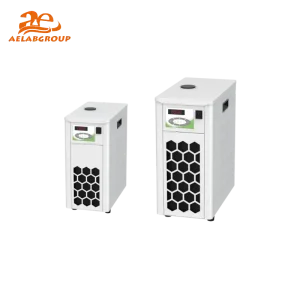
The Aelab AE-IC Series Recirculating Chillers offer precise cooling with a temperature range of -40°C to 40°C and PID control for stability (±0.3°C to ±0.5°C). These units feature compact designs for laboratory benchtops and are suitable for reactor cooling, vacuum pumps, rotary evaporators, and heat exchangers. With a powerful pump system (flow rate: 12-22 L/min) and a stainless-steel reservoir, they ensure reliable performance with low energy consumption. Their splash-proof keypad and digital display enhance usability, while built-in safety alarms prevent overheating and coolant depletion.e.
Conclusion
Recirculating chillers play a vital role in ensuring precise temperature control in laboratories, industrial facilities, and medical settings. By understanding their operation, components, and benefits, users can make informed decisions about integrating these systems into their processes for improved efficiency, reduced costs, and enhanced performance.