

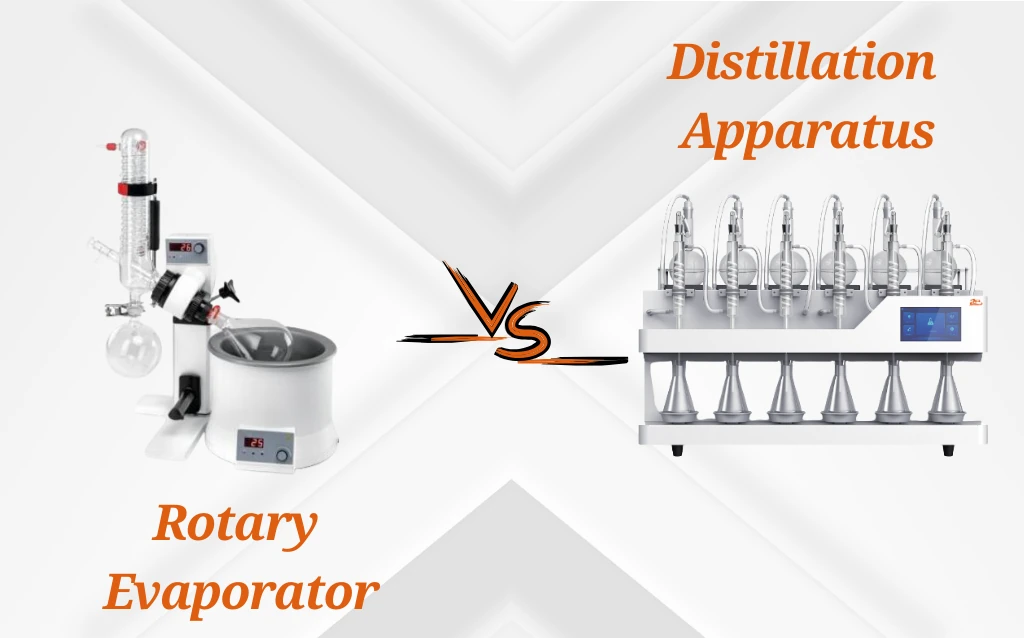
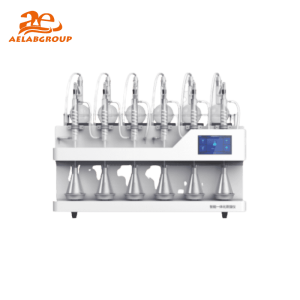
When deciding between Rotovap or Distillation Apparatus, it’s essential to understand the key differences in their operation, efficiency, and applications:
1. Operating Principle
Rotovap: Uses a combination of heat, rotation, and vacuum pressure to speed up solvent evaporation. The rotating flask increases the surface area of the liquid, enabling faster solvent removal.
Distillation Apparatus: Relies on heating a liquid mixture until its components reach their boiling point. The components then vaporize and are condensed based on their boiling points, separating them into individual fractions.
2. Temperature Control
Rotovap: Operates at lower temperatures due to reduced pressure, which is ideal for handling temperature-sensitive compounds. The low boiling point ensures that sensitive substances do not degrade.
Distillation Apparatus: Requires higher temperatu
res, which can be challenging when working with heat-sensitive compounds that could degrade under h
igh heat.
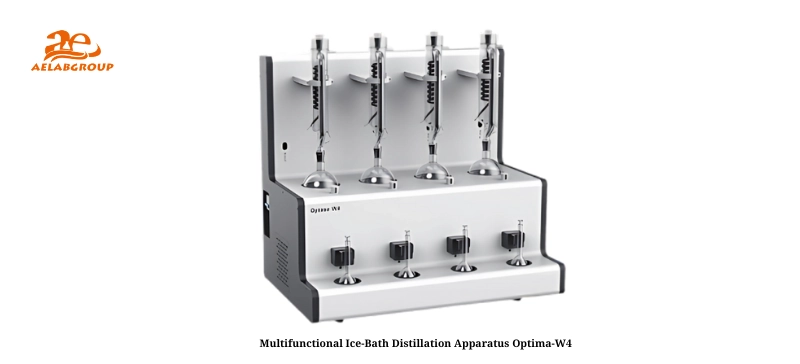
3. Speed and Efficiency
Rotovap: Known for its speed and efficiency, the Rotovap is excellent for fast solvent removal. The rotating action and reduced pressure allow for quick evaporation.
Distillation Apparatus: Typically slower due to the need to separate components individually based on their boiling points. The process can take more time, especially when the boiling point differences are minimal.
4. Energy Consumption
Rotovap: Requires up to 50% less energy compared to traditional distillation methods due to the lower operating temperatures and faster process.
Distillation Apparatus: Consumes more energy, as higher temperatures and cooling systems are necessary to separate the components.
5. Scalability
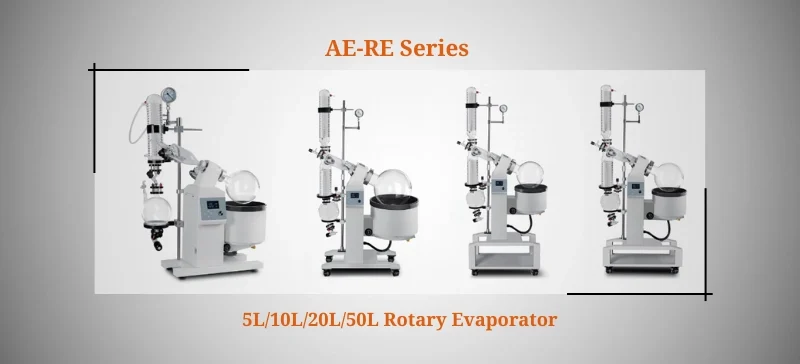
Rotovap: Ideal for small-to-medium scale operations and research labs. It is generally not suited for large-scale industrial processes, as the capacity is limited by the size of the rotating flask.
Distillation Apparatus: More scalable and can handle larger volumes of liquids. This makes it suitable for industrial-scale operations, such as petrochemical refinement or alcohol production.
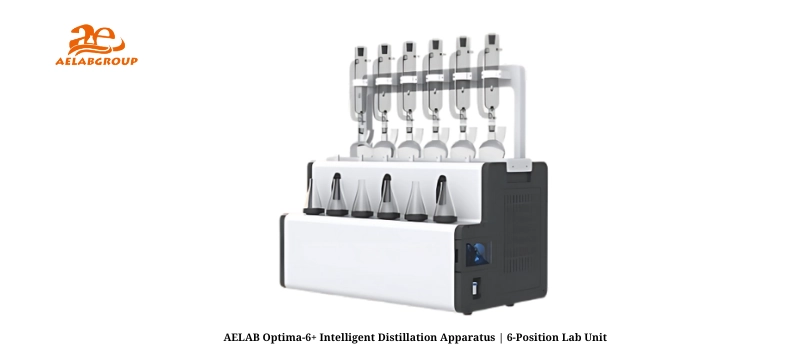
6. Application Versatility
Rotovap: Primarily used for solvent removal, concentration of samples, and recovery of solvents. It is widely used in organic chemistry, pharmaceuticals, and natural product extraction.
Distillation Apparatus: Offers greater versatility for separating complex mixtures, purifying chemicals, and handling high-boiling-point substances. It is often used in industrial applications like petrochemical processing and large-scale chemical purification.
When to Choose a Rotovap
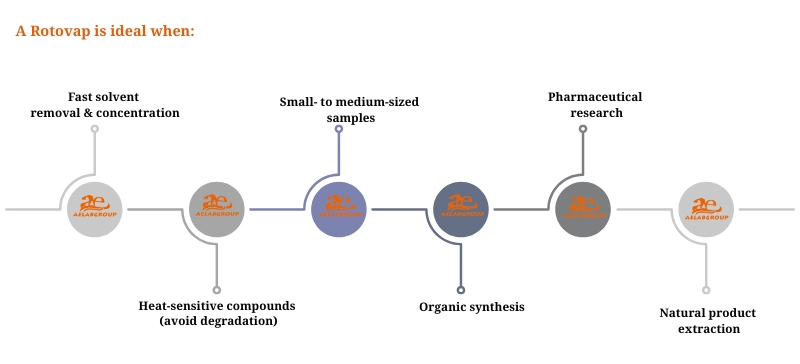
A Rotovap is ideal when:
You need fast solvent removal and concentration.
The compounds you’re working with are heat-sensitive and could degrade at higher temperatures.
You’re working with small- to medium-sized samples.
Your application involves organic synthesis, pharmaceutical research, or natural product extraction.
When to Choose a Distillation Apparatus
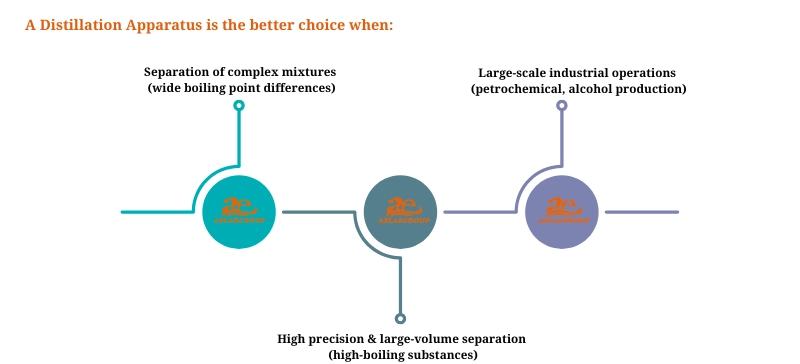
A Distillation Apparatus is the better choice when:
You need to separate complex mixtures with components that have significant differences in boiling points.
You are conducting large-scale industrial operations, such as petrochemical refining or alcohol production.
High precision and large-volume separation are required, particularly for high-boiling-point substances.