


Introduction
The field of nanotechnology has witnessed an explosion of research and development, leading to the creation of materials with unique and enhanced properties stemming from their nanoscale dimensions. Understanding the structure and composition of these nanomaterials is paramount for controlling their behavior and optimizing their performance in diverse applications, ranging from medicine and electronics to energy and catalysis.
Among the arsenal of characterization techniques available, X-ray Diffraction (XRD) holds a prominent position. Its non-destructive nature and sensitivity to the long-range order within materials make it an invaluable tool for unraveling the intricacies of their crystalline structure. In this article, we explore the types of nanomaterials analyzed by XRD, the aspects it reveals, and its broader role in material research.
Why Use XRD Analysis for Nanomaterials
XRD analysis offers a unique window into the world of nanomaterials, providing insights that are often difficult or impossible to obtain with other techniques. At its core, XRD exploits the interaction of X-rays with the electron clouds of atoms arranged in a crystalline lattice. When a beam of monochromatic X-rays strikes a crystalline material, it is diffracted by the regularly spaced atomic planes according to Bragg’s Law . The resulting diffraction pattern acts as a fingerprint of the material’s crystalline structure.
For nanomaterials, XRD is particularly crucial because their properties are often strongly dependent on their size, shape, crystal structure, and phase purity. It allows researchers to identify constituent phases, determine average crystallite size, assess crystallinity, measure lattice parameters, and investigate strain and defects. These insights are essential for correlating synthesis parameters with material performance and guiding nanomaterial design.
Types of Nanomaterials Commonly Analyzed by XRD
1. Nanoparticles
Used across catalysis, medicine, and electronics, nanoparticles are primary targets for XRD. The technique helps in:
- Phase identification and purity analysis
- Average crystallite size estimation (via the Scherrer equation)
- Crystal structure and lattice parameter determination
For example, AELAB’s gold nanoparticle studies use XRD to confirm FCC structures and size-related peak broadening.
2. Nanopowders
XRD provides bulk average structural insights:
- Crystallite size and phase composition
- Detection of amorphous content
- Thermal phase transitions (e.g., anatase to rutile in TiO2)
XRD enables researchers at AELAB to track nanopowder evolution during sintering or annealing processes.
3. Nanostructured Thin Films and Coatings
Applications in electronics and optics demand precision:
- Grazing incidence XRD (GIXRD) for surface-layer sensitivity
- Texture and epitaxy analysis
- Stress and strain assessment
At AELAB, XRD ensures quality control of TCO thin films like AZO, checking both orientation and residual stress.
4. Nanowires and Nanotubes
These 1D materials show unique orientation-dependent properties:
- Crystalline structure and preferred orientation
- Crystallite size and defect detection
AELAB researchers use aligned sample techniques for carbon nanotubes to highlight strong graphitic peak orientation.
5. Semiconductor Nanomaterials
Quantum dots, nanowires, and thin films require precise XRD analysis:
- Phase purity and lattice strain detection
- Crystallite size for quantum dots
- Interface analysis in heterostructures
AELAB’s GaN thin films on sapphire undergo XRD checks to assess hexagonal wurtzite structure and strain influence.
6. Nanocomposites
XRD helps in understanding:
- Matrix-nanofiller interactions
- Crystalline phases and new interface phases
- Nanofiller dispersion via peak intensity and width changes
In polymer-CNT systems, AELAB uses XRD to confirm graphitic fillers and composite compatibility.

Considerations for Accurate XRD Analysis
Crystallinity
High crystallinity yields sharp, well-defined peaks; amorphous content appears as broad halos. XRD allows quantification by comparing peak intensity to background.
Particle Size
As size decreases, peaks broaden. The Scherrer equation offers size estimates, though advanced analysis or complementary techniques (like TEM) are needed below ~5 nm.
Sample Preparation
Proper preparation prevents artifacts:
- Nanopowders should be uniformly ground
- Thin films must be flat and well-aligned
- Nanotubes/nanowires may require alignment fixtures

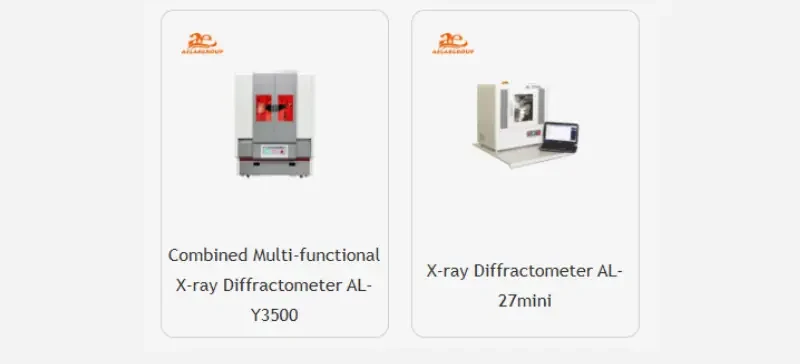
Combined Multi-functional X-ray Diffractometer AL-Y3500
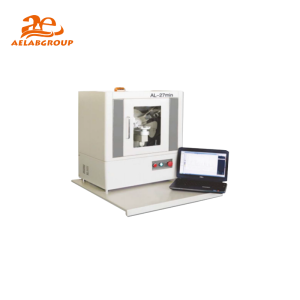
X-ray Diffractometer AL-27mini
XRD vs. Other Characterization Techniques
| Technique | Focus | Best For |
|---|---|---|
| XRD | Crystalline structure | Phase ID, crystallite size |
| TEM | Morphology | Nanoscale imaging |
| SEM | Surface features | Topography + EDS |
| AFM | Topography | Mechanical mapping |
| Raman | Molecular structure | Carbon-based materials |
| XPS | Surface chemistry | Elemental states |
Summary
XRD remains indispensable in the structural analysis of nanomaterials. From nanoparticles to composites, it offers detailed information on crystal structure, size, phase composition, and strain. At AELAB, our commitment to accurate XRD characterization ensures the success of nanomaterials in diverse applications—from electronics to energy storage.