

Polarimeters: Principles, Applications, and Importance in Measurement
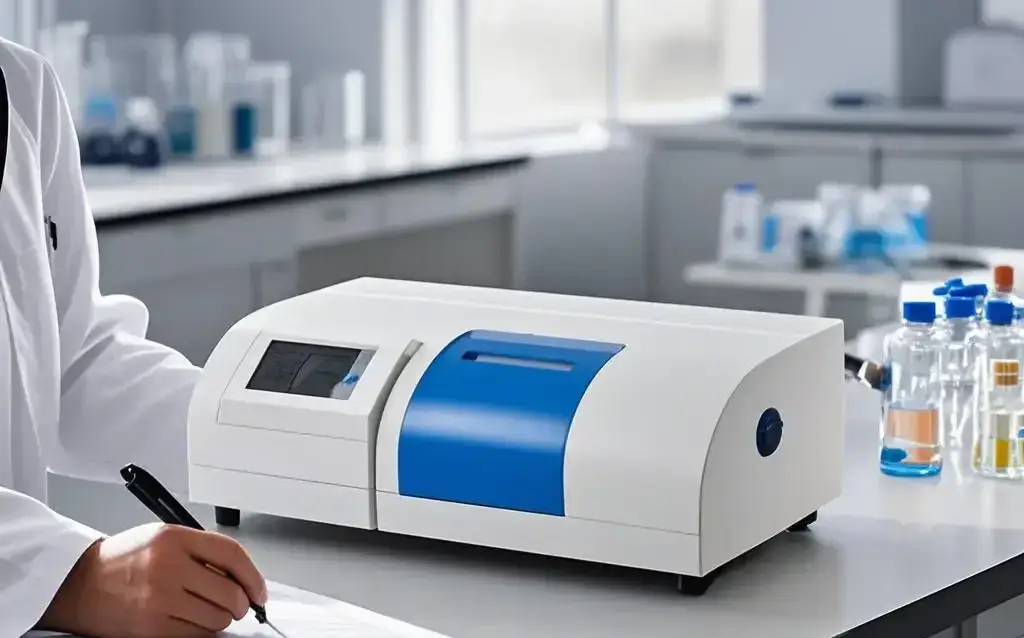
Polarimeter is sophisticated instruments used to measure the optical rotation of optically active substances. This article explores the fundamental principles, applications, and significance of polarimetry, shedding light on its importance in various industries such as pharmaceuticals, food, and chemistry.
What is a Polarimeter?
A polarimeter measures the angle by which a substance rotates the plane of polarized light. This rotation, known as optical rotation, is characteristic of chiral substances—molecules that have non-superimposable mirror images. These molecules interact with polarized light, causing it to rotate either clockwise or counterclockwise, depending on the molecule’s configuration.

How Does a Polarimeter Work?
A polarimeter works by passing monochromatic polarized light through an optically active sample. The sample rotates the plane of polarization, and the analyzer detects the angle of rotation. They adjust the analyzer until the light intensity reaches a minimum or maximum, indicating the degree of rotation. This angle, measured in degrees, represents the optical rotation of the substance.
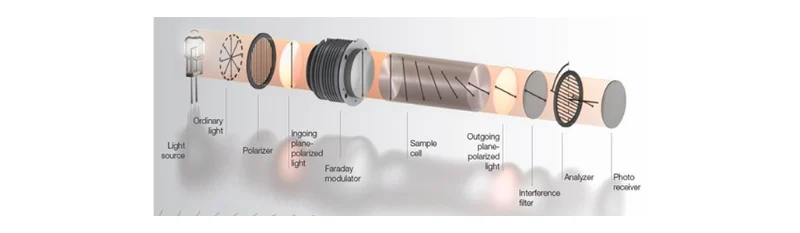
Figure 1: A schematic of the internal components of a polarimeter, which includes the light source, polarizer, sample cell, analyzer, and photo receiver. These components work together to measure the optical rotation of substances.
Key Concepts in Polarimetry
Chirality and Optical Activity
Chirality refers to the property of molecules that have a non-superimposable mirror image. These molecules are optically active, meaning they can rotate the plane of polarized light. The two enantiomers (mirror-image forms) of a chiral molecule rotate light in opposite directions—clockwise for dextrorotatory and counterclockwise for levorotatory molecules. Polarimetry helps determine the concentration and purity of these enantiomers in a sample by measuring the angle of rotation.
Specific Rotation in Polarimetry
Specific rotation is a fundamental property that describes the optical rotation of a substance at a given concentration, path length, temperature, and wavelength. Scientists use specific rotation to characterize optically active substances and calculate their concentration in solutions
Types of Polarimeters
Manual Polarimeters
Manual polarimeters require the operator to manually adjust the analyzer and visually determine the angle of rotation. These devices are often used in educational settings or basic laboratory analysis.
Semi-Automatic Polarimeters
Semi-automatic polarimeters combine manual adjustments with digital features, making them easier to use and providing more accurate results than manual models. The analyzer can be adjusted electronically, and results are displayed on a digital screen.
Fully Automatic Polarimeters
Fully automatic polarimeters offer the highest level of precision and efficiency. These instruments automatically measure the optical rotation, determine the concentration, and often come with built-in temperature controls to ensure stable results. They are commonly used in high-throughput environments like pharmaceutical production and quality control laboratories.
Applications of Polarimeters
Pharmaceutical Industry
Polarimeters measure the concentration and purity of active pharmaceutical ingredients (APIs). As many drugs are optically active, polarimetry is essential in formulating and validating new compounds, ensuring the accuracy and consistency of drug formulations, and contributing to their efficacy and safety.
Food and Beverage Industry
Polarimetry is used to measure sugar content in products like syrups, juices, and candies. By assessing optical rotation, scientists determine the concentration of sugars in solutions.
Chemical Industry
Polarimeters monitor the quality and purity of chemicals, especially organic compounds. Measuring optical rotation ensures products meet required standards and specifications.
How to Use a Polarimeter
To use a polarimeter, follow these steps:
Prepare the Sample
: Place the optically active sample in the sample cell.Pass Polarized Light
: The instrument emits polarized light that passes through the sample.Measure the Rotation
: Rotate the analyzer until the light intensity reaches a minimum or maximum, indicating the optical rotation angle.Calculate Concentration or Specific Rotation
: Use the optical rotation and known parameters (concentration, cell length) to calculate the specific rotation or concentration of the sample.
How to Calibrate a Polarimeter
Calibration of a polarimeter is essential for accurate measurements. Typically, a known substance with a specific rotation, like pure water, is used for calibration. The polarimeter should be adjusted until it gives a zero reading when the sample cell is empty.
Factors Affecting Optical Rotation
Several factors can influence optical rotation measurements:
Concentration
Higher concentrations of optically active substances result in greater optical rotation.
Path Length
The longer the path through the sample, the greater the rotation.
Temperature
Temperature affects the density and molecular structure of the substance, which in turn influences optical rotation.
Wavelength of Light
The wavelength used for measurement (commonly the sodium D-line at 589 nm) also impacts the optical rotation.

Conclusion
Polarimeters are vital tools in industries where optically active substances are prevalent. By measuring optical rotation, they enable precise determination of concentration, purity, and the specific rotation of substances. From pharmaceuticals to food and chemicals, polarimeters play a crucial role in quality control, research, and product development. With advancements in technology, fully automated polarimeters provide accurate and efficient solutions for a wide range of applications.