

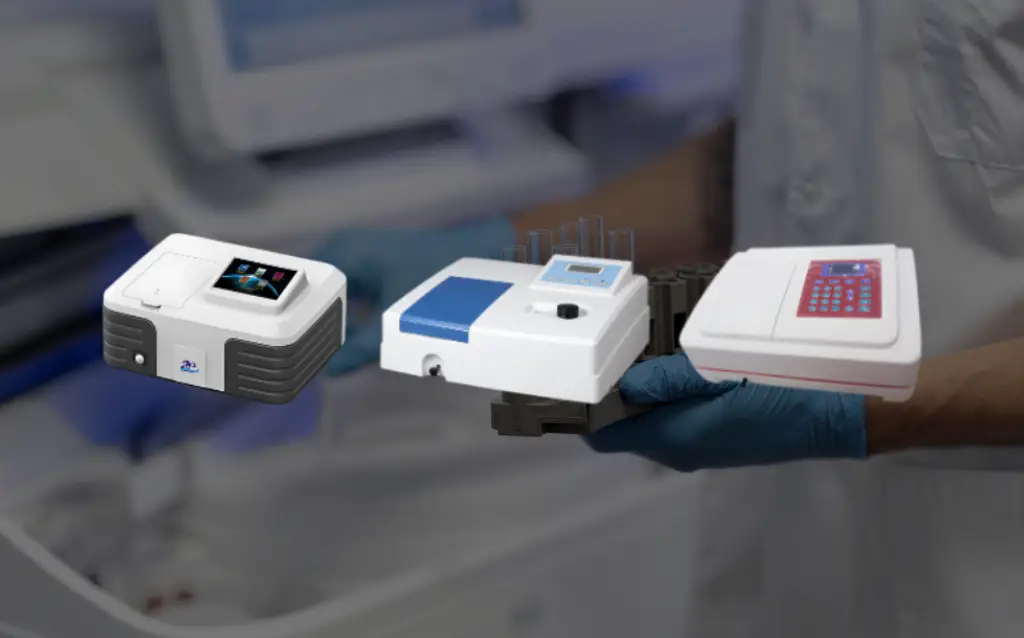
What is the function of a UV-VIS spectrophotometer?
Introduction
UV-VIS Spectrophotometer is a widely used analytical technique in various fields, including chemistry, biology, environmental science, and pharmaceuticals. This method provides valuable information about the chemical composition, concentration, and molecular structure of a wide range of substances by measuring the absorption of ultraviolet and visible light. In this article, we will explore the working principles, components, applications, and practical considerations of UV-VIS spectrophotometry, highlighting its importance in modern scientific research and industry.

Figure 1: The electromagnetic spectrum, highlighting the visible and ultraviolet (UV) light ranges used in UV-VIS spectrophotometry for analyzing molecular and chemical properties.
Working Principle of the UV-VIS Spectrophotometer
The fundamental principle behind UV-VIS spectroscopy lies in the absorption of light by molecules. When a beam of UV or visible light passes through a sample, certain wavelengths of light are absorbed by the sample’s molecules, causing electronic transitions from a lower energy state to a higher energy state. The amount of light absorbed is directly related to the concentration of the absorbing species, the path length of the sample, and the molar absorptivity (or extinction coefficient) of the substance at a given wavelength.
The relationship between absorbance and concentration is quantified by the Beer-Lambert Law, which is expressed as:
A=εcLA = \varepsilon c LA=εcL
where:
- AAA is the absorbance,
- ε\varepsilonε is the molar absorptivity (in L·mol−1^{-1}−1·cm−1^{-1}−1),
- ccc is the concentration of the analyte (in mol/L),
- LLL is the path length (in cm).
This law is commonly used to determine the concentration of unknown samples by measuring their absorbance at specific wavelengths.
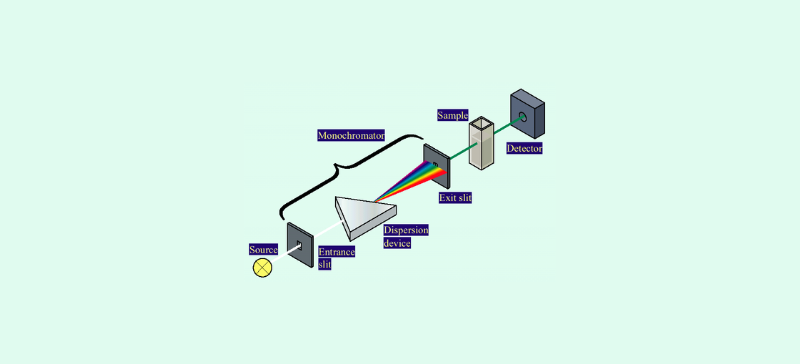
Figure 2: The diagram of a UV-VIS spectrophotometer illustrates the key components, including the monochromator, sample holder, and detector. These components, when combined, work together to measure absorbance at specific wavelengths. Consequently, they ensure the accurate analysis of the sample's properties. Additionally, the integration of these parts allows for precise measurement and reliable data collection.
Components of a UV-VIS Spectrophotometer
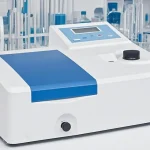
A typical UV-VIS spectrophotometer consists of the following key components:
Light Source: The light source provides the radiation necessary for the analysis. Common light sources include:
- Tungsten Lamp: Typically used for visible light (350-2500 nm).
- Deuterium Lamp: Used for ultraviolet light (190-400 nm).
- Xenon Arc Lamp: Covers a wide range of UV and visible light (160-2000 nm).
Monochromator: The monochromator is used to select a specific wavelength of light from the broad spectrum emitted by the light source. It can be a diffraction grating or a prism that separates the light into its component wavelengths.
Sample Holder (Cuvette): The cuvette holds the sample, which is typically a liquid. The path length through the sample, usually 1 cm, is a critical parameter in absorbance calculations. Cuvettes are typically made from quartz or glass, depending on the wavelength range of interest.
Detector: The detector measures the intensity of transmitted light after it passes through the sample. Common detectors include:
- Photomultiplier Tube (PMT): Converts light into an electrical signal.
- Photodiodes: Commonly used in fixed monochromator systems.
- Charge-Coupled Device (CCD): Used in array detectors to simultaneously measure multiple wavelengths.
Data Processor: This component processes the signal from the detector and converts it into absorbance or transmittance data, which can then be analyzed.

Applications of UV-VIS Spectrophotometry
Quantification of Compounds: UV-VIS spectrophotometry widely determines the concentration of absorbing species in solutions, such as:
- Pharmaceuticals: The method plays a crucial role in identifying and quantifying active pharmaceutical ingredients (APIs) and ensuring the purity of drug products.
- Environmental Monitoring: It detects and quantifies pollutants such as nitrates, phosphates, and heavy metals in water and air samples.
- Food and Beverages: UV-VIS spectroscopy measures the concentration of vitamins, sugars, and other chemical components in food and beverages.
Chemical Identification and Structural Analysis: UV-VIS spectroscopy helps identify the functional groups in a molecule by analyzing the absorption peaks at specific wavelengths, which provides insight into the molecule’s electronic structure.
Dissolution Testing in Pharmaceuticals: This technique monitors the dissolution of solid oral dosage forms, such as tablets and capsules, ensuring the correct release rate of the drug.
Impurity Detection: UV-VIS spectroscopy detects and quantifies impurities in drug ingredients or final products, ensuring compliance with pharmacopeial standards.
Thin Film Analysis: In the semiconductor and materials science industries, UV-VIS spectrophotometry measures the thickness and optical properties of thin films on substrates.
Bacterial Culture Monitoring: UV-VIS spectroscopy monitors the optical density (OD) of bacterial cultures, providing a simple and rapid way to track bacterial growth in microbiological studies.
Forensic Science: UV-VIS spectroscopy identifies dyes and pigments in samples such as fibers, paints, and glass fragments in forensic analysis.
Advantages of UV-VIS Spectrophotometry
Non-Destructive
UV-VIS spectroscopy is a non-destructive technique, meaning the sample remains intact after analysis, allowing for subsequent tests or reuse.
Ease of Use
The technique is relatively simple to use and requires minimal sample preparation.
Rapid and Cost-Effective
UV-VIS spectrophotometry is a fast, low-cost method that can provide immediate results, making it ideal for routine analysis in laboratories.
High Sensitivity
The technique can detect low concentrations of substances, particularly when using appropriate wavelengths and calibration.
Practical Considerations
Spectral Bandwidth
The spectral bandwidth of a spectrophotometer defines the range of wavelengths transmitted at one time. Narrower bandwidths offer higher resolution but require more time for measurement, while wider bandwidths enable faster scanning at the cost of accuracy.
Stray Light
Stray light refers to any unwanted light that reaches the detector and is not part of the selected wavelength. It can cause significant errors, especially at high absorbances, leading to inaccurate measurements.
Wavelength Accuracy
The accuracy of the measured wavelengths plays a critical role in ensuring precise quantification. Operators must calibrate instruments regularly to ensure that they select the correct wavelengths consistently.
Sample Preparation
The type of sample container (cuvette) and its material must be compatible with the wavelength range of the experiment. Researchers typically use quartz cuvettes for UV-Vis measurements because they transmit light across a wide range of wavelengths.
Features :
- Fully stainless steel structure
- Hand wheel type of quick-open door structure
- Door safety lock system
- LCD digital display of working status,touch of key
- Auto discharge the cool air,and steam discharging auto matically after sterilization
- Over temperature&over pressure auto-protection
- Safe protection of water lacking
- Self-inflating type seal
- Automatically shut off with beep reminding after sterilization
- With two stainless steel sterilizing baskets
- Easy to operate, safe and reliable
- The drying system is optional, which can be equipped according to the customers request
Conclusion
UV-VIS spectrophotometry is a versatile, widely used analytical tool with applications spanning pharmaceuticals, environmental science, food and beverage industries, and materials science. Its ability to provide quick, reliable, and non-destructive analysis makes it invaluable for both qualitative and quantitative purposes. Despite certain limitations, such as the impact of stray light and the need for careful calibration, UV-VIS spectroscopy remains a cornerstone technique in modern scientific research and quality control practices.
By understanding the key principles and ensuring proper experimental conditions, researchers and industries can harness the full potential of UV-VIS spectroscopy for a wide array of analytical challenges.