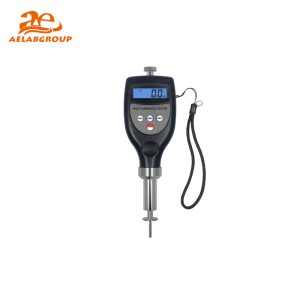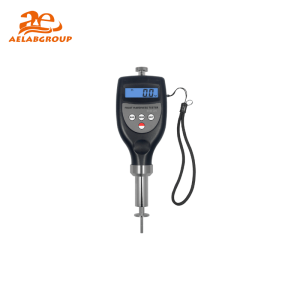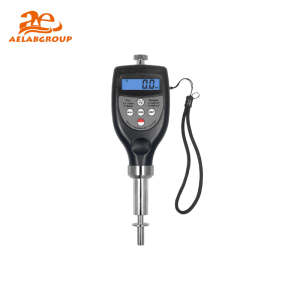
AELAB | Agricultural Testing Instruments | Fruit/Grain Hardness Meter/ Sclerometer
The Laboratory Fruit/Grain Hardness Meter (Sclerometer) provides objective firmness measurements that correlate with freshness, shelf life, and market value. Used across agricultural labs and quality control centers, it replaces subjective squeeze tests with standardized, repeatable data.
A Laboratory Fruit or Grain Hardness Meter is a precision instrument that quantifies the mechanical resistance of fruits or grains under applied force. Often referred to as a Sclerometer, it assesses ripeness, harvest readiness, varietal firmness, and resistance to mechanical damage by measuring the force needed to penetrate, compress, or fracture a sample, typically reporting results in Newtons or kg/cm².
| Feature | Details |
|---|---|
| Measurement Principle | Penetration/compression to a set depth or until fracture; force recorded via digital load cell |
| Force Units | Newtons (N) or kg/cm² |
| Operation Modes | Manual analog, digital portable, and programmable tabletop modes for various crops |
| Probes & Fixtures | Interchangeable penetration probes; sample holder/tray for fruit or grain kernels |
| Readout & Interface | Digital/analog display; advanced models include data logging and USB connectivity |
| Control of Test Rate | Controlled penetration speed for repeatable results (model-dependent) |
| Calibration | Built-in calibration/adjustment features; routine verification recommended |
| Power & Portability | Battery-powered handheld units; AC-powered tabletop systems for high-precision work |
| Aspect | Laboratory Fruit/Grain Hardness Meter | Texture Analyzer |
|---|---|---|
| Primary Purpose | Targeted firmness/hardness (penetration, crush) | Broad texture profiling (TPA, compression, shear) |
| Sample Types | Whole fruits and individual grains | Wider range: gels, baked goods, meats, produce |
| Throughput | High for routine firmness checks | Moderate; multi-parameter sequences |
| Data Complexity | Simple force-at-depth or fracture force | Rich force–time curves and multi-metric outputs |
| Cost & Portability | Lower cost; handheld and portable options | Higher cost; benchtop, less portable |
Q: What parameters does a Sclerometer report?
A: Most models report force at a defined penetration depth or at fracture, typically in Newtons or kg/cm², along with optional test speed and time stamps on advanced units.
Q: Is the test destructive?
A: Yes, penetration-based measurements are generally destructive; plan for representative sampling rather than reusing the same sample.
Q: Do I need a tabletop system or will a handheld unit suffice?
A: Handheld digital meters suit routine checks and field use; tabletop systems provide higher precision, programmable speed control, and richer data for research or tight QC.
Q: How often should I calibrate the hardness meter?
A: Follow the manufacturer’s schedule and recalibrate after transport, major temperature changes, or whenever results drift from expected values.
Looking for specific lab equipment? Fill out the form below, and our team will get back to you with detailed information and a personalized quote.