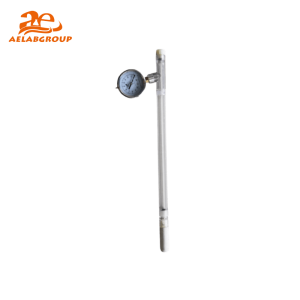
AELAB | Agricultural Testing Instruments | Soil Irromerter Tensiometer
A Soil Irrimeter Tensiometer measures soil moisture tension in real time, showing how hard roots must work to extract water. This helps growers, researchers, and gardeners optimize irrigation, protect soil health, and boost yields with data-driven decisions. The Soil Irrimeter Tensiometer is indispensable wherever precise water management matters.
A soil Irrimeter tensiometer is a water-filled instrument with a porous ceramic tip and a vacuum/pressure gauge (or digital sensor) used to measure soil water tension (matric potential). Inserted at the crop root zone, it quantifies the suction the soil exerts on water—high tension indicates drier soil, low tension indicates wetter soil—providing a direct, actionable indicator of plant-available water for irrigation scheduling and environmental monitoring.
| Feature | Details |
|---|---|
| Measurement Principle | Water-filled tube with porous ceramic cup equilibrates with soil; gauge/sensor reads soil water tension (matric potential) |
| Typical Range & Units | 0 to ~85 kPa (0–85 cbar); beyond this range cavitation may occur (model-dependent) |
| Sensor/Gauge Options | Analog vacuum gauge or digital pressure transducer with temperature compensation |
| Ceramic Tip | High-quality, saturated porous cup for rapid equilibration and minimal hysteresis |
| Installation Depths | Shallow (10–20 cm) for annuals; deeper (30–90+ cm) for trees/vines or layered soils |
| Data & Connectivity | Manual dial reading or digital logging; USB/SD/Bluetooth options for trend analysis |
| Maintenance | Periodic refilling/degassing, cup cleaning, and calibration checks |
| Durability | UV-resistant body and weatherproof seals for continuous outdoor use |
| Aspect | Soil Irrimeter Tensiometer | Soil Moisture Sensor (Capacitance/Resistance) |
|---|---|---|
| What It Measures | Soil water tension (matric potential, kPa/cbar) | Volumetric water content (VWC, %) |
| Irrigation Decision Relevance | Direct indication of plant availability | Requires crop/soil thresholds or calibration |
| Calibration Sensitivity | Low; factory gauge/sensor checks | Higher; affected by texture, salinity, temperature |
| Maintenance | Refill/degass water; keep ceramic saturated | Minimal; periodic recalibration/cleaning |
| Response Range | Best for 0–85 kPa (near field capacity to moderate dry) | Covers very wet to very dry; indirect plant availability |
| Cost | Low to moderate per point | Low to moderate; arrays scale easily |
Q: What units does a tensiometer use?
A: Soil water tension is commonly reported in kilopascals (kPa) or centibars (cbar), where 1 kPa ≈ 1 cbar.
Q: Where should I place tensiometers?
A: At the active root zone: one near the top of the roots to trigger irrigation and a deeper one to ensure water penetrates the full profile.
Q: Do tensiometers work in all soils?
A: They work best from field capacity to moderately dry conditions and across textures; extremely dry soils beyond ~85 kPa require other methods.
Q: How often should I service the device?
A: Check weekly during irrigation season for water level, bubbles, and calibration; service more frequently in hot, saline, or sandy conditions.
Looking for specific lab equipment? Fill out the form below, and our team will get back to you with detailed information and a personalized quote.