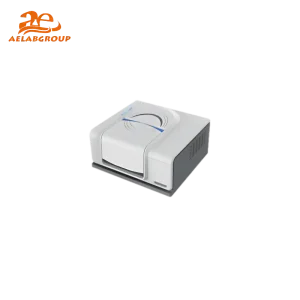
AELAB | Analytical Equipment | FT-IR Spectrometer
The FT-IR spectrometer is a critical analytical instrument used for chemical identification, material characterization, and molecular structure analysis. Modern laboratories rely on FT-IR spectroscopy for rapid, precise, and non-destructive testing. This guide explains everything you need to know about choosing, using, and understanding an FT-IR spectrometer.
An FT-IR spectrometer (Fourier Transform Infrared Spectrometer) measures molecular absorption of infrared light across different wavelengths to generate a unique chemical “fingerprint.” It is used to identify functional groups, detect contaminants, analyze organic and inorganic materials, and characterize solids, liquids, gases, and polymers with high accuracy.
| Feature | Details |
|---|---|
| Spectral Resolution | Typically 0.5–4 cm⁻¹ for detailed analysis |
| Detector Options | DTGS (general purpose) or MCT (high sensitivity) |
| Sampling Techniques | ATR, Transmission, DRIFTS |
| Interferometer Type | Michelson interferometer |
| Wavelength Range | Mid-IR to far-IR depending on model |
| Software Functions | Library search, baseline correction, peak analysis, quantification |
| Sample Compatibility | Solids, liquids, gases, powders |
| Aspect | FT-IR Spectrometer | Dispersive IR Spectrometer |
|---|---|---|
| Speed | Very fast, seconds | Slower mechanical scanning |
| Resolution | High resolution | Lower resolution |
| Sensitivity | Excellent trace detection | Moderate sensitivity |
| Moving Parts | Few mechanical components | Many mechanical components |
| Data Processing | Fourier Transform | Mechanical dispersion |
Q: Can FT-IR identify unknown materials?
A: Yes, FT-IR produces a molecular fingerprint that can be matched with spectral libraries for identification.
Q: Can FT-IR analyze solids, liquids, and powders?
A: Absolutely. ATR makes multi-state sample analysis quick and simple.
Q: How long does a typical FT-IR scan take?
A: Most scans take only 1–10 seconds depending on resolution settings.
Q: Does FT-IR require special sample preparation?
A: Minimal preparation is needed—especially when using ATR accessories. Transmission methods may require pellets or films.
Looking for specific lab equipment? Fill out the form below, and our team will get back to you with detailed information and a personalized quote.