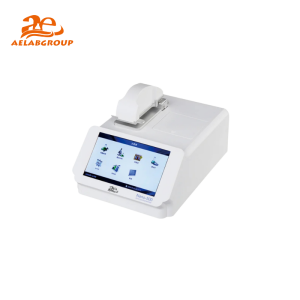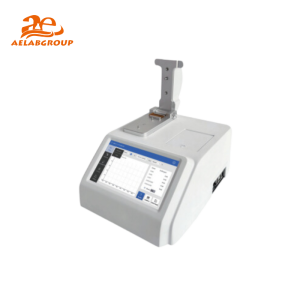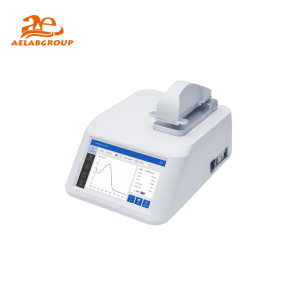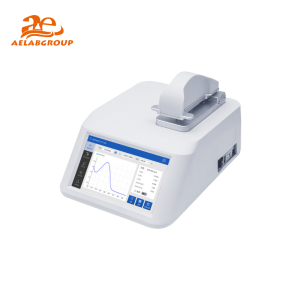
AELAB | Analytical Equipment | Micro Volume Spectrophotometer (NANO)
A Micro Volume Spectrophotometer (Nano) enables highly accurate UV-Vis measurements from ultra-small samples (≈0.5–2 µL) without cuvettes. It preserves precious DNA, RNA, and protein materials while speeding up quantification and purity checks in modern life-science workflows.
A microvolume (nano) spectrophotometer is a compact UV-Vis instrument that measures absorbance directly from a small drop placed on an optical pedestal. Light traverses a controlled micro-pathlength, absorbance is captured across ~190–850 nm, and concentration is computed via Beer–Lambert Law—ideal for nucleic acid and protein quantification without cuvettes.
| Feature | Details |
|---|---|
| Sample Volume | 0.5–2.0 µL (typical) |
| Wavelength Range | UV-Vis 190–850 nm (supports 260 nm for nucleic acids, 280 nm for proteins) |
| Detection Limits | dsDNA to ~2 ng/µL; protein sensitivity assay-dependent |
| Measurement Time | <10 seconds per sample (typical) |
| Pathlength Control | Fixed or auto-ranging micro-pathlength for extended dynamic range |
| Purity Metrics | A260/A280, A260/A230 ratios with pass/fail thresholds |
| Calibration & QA | Quick blanking; minimal calibration; supports verification standards |
| Data & Connectivity | USB/export to CSV; cloud/LIMS sync; built-in touchscreen UI (model-dependent) |
| Aspect | Micro Volume Spectrophotometer (Nano) | Traditional UV-Vis Spectrophotometer |
|---|---|---|
| Sample Volume | 0.5–2.0 µL | 500–3000 µL (cuvette) |
| Cuvettes Needed | No (pedestal measurement) | Yes |
| Throughput Speed | High (seconds/sample) | Moderate |
| Sample Preservation | Excellent | Moderate |
| Suitability for DNA/RNA | Excellent | Good; best with larger volumes |
| Cost & Consumables | Higher upfront; minimal consumables | Lower upfront; ongoing cuvette costs |
Q: What is the typical wavelength range for a Micro Volume Spectrophotometer?
A: Most nano spectrophotometers scan ~190–850 nm, covering nucleic acids at 260 nm and proteins at 280 nm.
Q: How little sample do I need?
A: Typically 0.5–2.0 µL per measurement, making it ideal for scarce or precious samples.
Q: Do I still need cuvettes?
A: No, measurements are performed directly on a pedestal; some models offer optional cuvette ports for longer pathlengths or kinetics.
Q: Can it assess sample purity?
A: Yes, common purity ratios (A260/A280, A260/A230) are calculated automatically with pass/fail guidance.
Looking for specific lab equipment? Fill out the form below, and our team will get back to you with detailed information and a personalized quote.