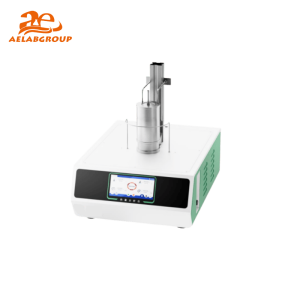
AELAB | Analytical Equipment | Thermo Gravimetric Analyzer (TGA)
A Thermo Gravimetric Analyzer (TGA) measures mass change of materials under controlled temperature and atmosphere to reveal thermal stability, composition, and decomposition behavior. This thermal analysis equipment supports research and QA by quantifying events like moisture loss, additive content, and oxidative reactions. Use a TGA instrument to optimize formulations, validate processes, and interpret TGA curves with confidence.
A Thermo Gravimetric Analyzer (TGA) continuously records a sample’s mass while it is heated, cooled, or held isothermally in a controlled gas environment (inert or oxidative). Mass losses or gains correspond to processes such as evaporation, decomposition, oxidation, and residue (ash) formation, enabling thermal stability testing, composition determination, and decomposition temperature measurement.
| Feature | Details |
|---|---|
| Temperature Range | Typically ambient to 1000–1500 °C |
| Atmospheres | Inert (N2, Ar) and oxidative (air, O2) with controlled flow |
| Balance Sensitivity / Accuracy | Microgram-level mass accuracy with stable baseline |
| Heating Rate | ~1 °C/min to 100 °C/min (programmable ramps/isotherms) |
| Sample Mass Range | Typically a few mg to tens of mg (application-dependent) |
| Crucible Options | Alumina, platinum, or disposable pans matched to chemistry |
| Data Outputs | TGA (mass vs. temp/time), DTG (derivative), onset & decomposition temperatures |
| Coupling & Integration | Optional DSC, FTIR, or MS coupling for species identification |
| Aspect | TGA | DSC |
|---|---|---|
| Measures | Mass change vs. temperature/time | Heat flow associated with transitions |
| Key Output | Decomposition temperature, mass loss steps (DTG) | Glass transition, melting/crystallization, heat capacity |
| Best For | Thermal stability, composition, moisture/ash | Thermal transitions and energetics |
| Sample Suitability | Polymers, pharmaceuticals, inorganics, biomass | Polymers, foods, pharmaceuticals (transition mapping) |
| Hybrid Options | TGA-DSC instruments combine both signals | Often integrated within simultaneous systems |
Q: What does a TGA instrument measure?
A: It measures a sample’s mass change as a function of temperature or time in a controlled atmosphere to reveal processes like moisture loss, decomposition, oxidation, and residual ash.
Q: What temperature range and heating rates are typical?
A: Most TGAs operate from ambient to roughly 1000–1500 °C with programmable heating rates around 1–100 °C/min, plus isothermal holds as needed.
Q: When should I use inert vs. oxidative atmospheres?
A: Use inert gases (N2, Ar) to study volatilization and pyrolysis without oxidation; use air or O2 to assess oxidative stability or to burn off organics for ash determination.
Q: How is TGA different from DSC?
A: TGA tracks mass change, ideal for composition and stability; DSC tracks heat flow to reveal transitions like melting, crystallization, and glass transition. Many labs use TGA-DSC hybrids for complementary data.
Q: What are common limitations of TGA?
A: It is not element-specific and may require coupling (FTIR/MS) for evolved gas identification; results are sensitive to sample size/packing and method parameters.
Looking for specific lab equipment? Fill out the form below, and our team will get back to you with detailed information and a personalized quote.