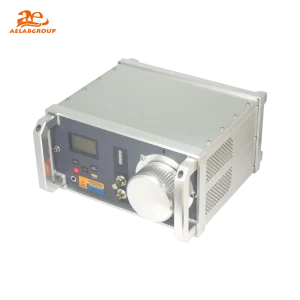
AELAB | Environmental Testing Equipment | Chilled Mirror Dew Point Instrument
A Chilled Mirror Dew Point Instrument is a primary method for measuring dew point (and frost point) with high accuracy and long-term stability. It is widely used as a reference standard for humidity and moisture measurements in gases. By directly detecting the onset of condensation on a controlled mirror surface, it provides traceable results suitable for calibration and critical process control.
A chilled mirror dew point instrument measures the dew point by cooling a polished mirror until moisture from the sample gas condenses (dew) or deposits as ice (frost) on the mirror. An optical system detects the change in reflectivity caused by condensation, while a precision temperature sensor measures the mirror temperature at equilibrium. That measured mirror temperature corresponds to the dew point (or frost point), making the technique highly accurate because it is based on a physical phase-change event rather than an inferred humidity signal.
| Feature | Details |
|---|---|
| Measurement principle | Optical detection of condensation on a temperature-controlled mirror (dew/frost point). |
| Dew/frost point range | Model-dependent; typically supports wide ranges from very dry (frost point) to near-ambient dew points. |
| Accuracy & repeatability | High accuracy and excellent repeatability; commonly used as a reference for calibration. |
| Response time | Depends on mirror cooling capacity, sample flow rate, and humidity level; optimized designs reduce stabilization time. |
| Sample gas requirements | Clean, particulate-free gas recommended; optional filtration and sample conditioning improve reliability. |
| Temperature control | Thermoelectric (Peltier) or refrigeration-based cooling with closed-loop control for stable mirror equilibrium. |
| Outputs & connectivity | Typical options include analog outputs, digital interfaces, data logging, and alarm relays for process monitoring. |
| Calibration & traceability | Suitable for traceable humidity calibration workflows; supports verification using known humidity standards. |
| Aspect | Chilled Mirror Dew Point Instrument | Capacitive Dew Point Sensor |
|---|---|---|
| Measurement basis | Direct phase-change detection (condensation/ice on mirror). | Indirect electrical response of a hygroscopic dielectric layer. |
| Accuracy & traceability | Typically used as a reference/standard with strong traceability potential. | Good for routine monitoring; traceability depends on calibration and sensor condition. |
| Long-term stability | High stability; less prone to gradual signal drift when maintained properly. | Can drift over time due to contamination, aging, and exposure history. |
| Maintenance needs | Requires mirror cleanliness and suitable sample conditioning. | Generally lower maintenance, but periodic calibration and sensor replacement may be needed. |
| Best use case | Calibration labs, audits, high-accuracy moisture control, and validation. | Cost-effective continuous monitoring in process and facility environments. |
Q: What does a chilled mirror dew point instrument measure?
A: It measures the dew point (or frost point) temperature by cooling a mirror until moisture condenses (or freezes) on the surface and then reading the mirror temperature at equilibrium.
Q: Why is chilled mirror considered a reference method?
A: Because it detects a physical phase change (condensation/ice) directly, providing high accuracy and strong long-term stability compared with many indirect humidity sensor technologies.
Q: What can cause unstable readings on a chilled mirror system?
A: Common causes include contaminated sample gas (oil/particles), insufficient sample flow control, leaks that introduce ambient moisture, and a dirty or damaged mirror surface.
Q: Can a chilled mirror instrument be used for very dry gases?
A: Yes—many systems support frost point measurements for low-moisture applications, but you should confirm that the instrument’s specified range and sample conditioning match your target dryness.
Q: How often should a chilled mirror dew point instrument be calibrated?
A: It depends on your quality requirements and usage; calibration-grade instruments are often verified on a defined schedule (e.g., quarterly or annually) and whenever performance checks indicate drift or after major maintenance.
Looking for specific lab equipment? Fill out the form below, and our team will get back to you with detailed information and a personalized quote.