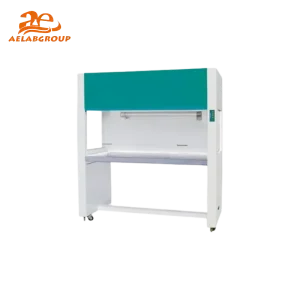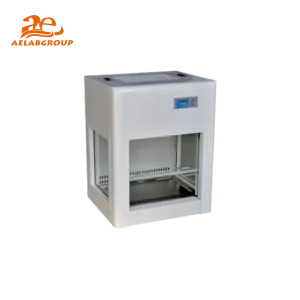
AELAB | Environmental Testing Equipment | Laminar Flow Cabinet
A Laminar Flow Cabinet delivers a continuous stream of HEPA-filtered air to create a particle-free workspace for sensitive procedures. By preventing airborne contamination from the surrounding room, a laminar flow cabinet helps laboratories maintain sterility, consistency, and higher experiment success rates.
A laminar flow cabinet (clean bench/laminar flow hood) is a ventilated workstation that directs uniform, unidirectional HEPA-filtered air across the work zone—either horizontally from rear to front or vertically from top to bottom—to protect samples from airborne contaminants. Unlike biological safety cabinets, laminar flow cabinets focus on product protection only and are intended for non-hazardous work.
| Feature | Details |
|---|---|
| Airflow Pattern | Horizontal or Vertical unidirectional flow |
| Filtration System | HEPA filter, 99.97% efficiency for ≥0.3 μm particles (optional ULPA on some models) |
| Airflow Speed | 0.3–0.5 m/s (typical setpoint range) |
| Workspace Sizes | Benchtop to large workstations (e.g., 3–6 ft widths) |
| Noise Level | ~50–60 dB for operator comfort |
| Controls | Digital display or manual speed control; filter/service reminders |
| Certification | ISO 14644-1 compliant; NSF/UL listings where applicable |
| Power Supply | 110–120 VAC or 220–240 VAC (model dependent) |
| Aspect | Laminar Flow Cabinet | Biological Safety Cabinet |
|---|---|---|
| Purpose | Protects samples from contamination | Protects samples, personnel, and environment |
| Airflow Direction | Unidirectional (horizontal or vertical) | Inward inflow + HEPA downflow; HEPA/exhausted |
| Use Cases | Non-hazardous, aseptic tasks | Hazardous/biological materials (BSL work) |
| Operator Protection | No | Yes (plus environmental) |
| Regulatory Fit | ISO 14644-1 clean benches | NSF/ANSI 49, EN 12469 for BSCs |
Q: Can a laminar flow cabinet be used with hazardous or biohazardous materials?
A: No. It protects the sample only. Use a Biological Safety Cabinet when personnel and environmental protection are required.
Q: Horizontal vs. vertical—how should I choose?
A: Select horizontal for large instruments requiring deep, unobstructed space; choose vertical for better clearance above the work and reduced airflow toward the operator.
Q: How often should filters be replaced?
A: Prefilters are typically replaced every 6–12 months depending on loading; main HEPA filters are replaced when pressure drop/airflow specs fall out of tolerance.
Q: What certifications should I look for?
A: Verify ISO 14644-1 compliance for clean benches; for biohazard work, use an NSF/ANSI 49 or EN 12469 certified Biological Safety Cabinet instead.
Looking for specific lab equipment? Fill out the form below, and our team will get back to you with detailed information and a personalized quote.