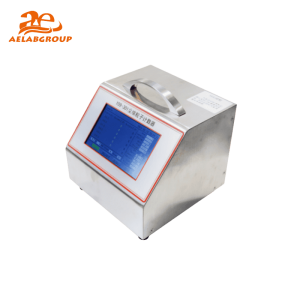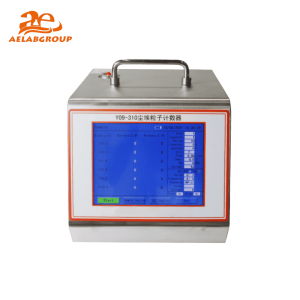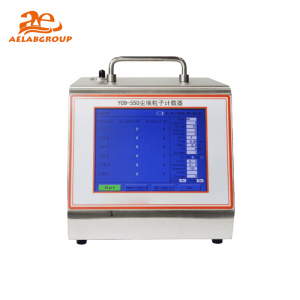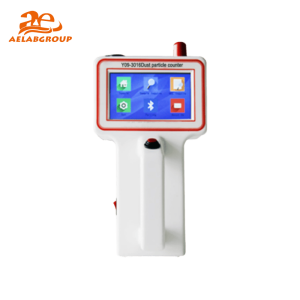
AELAB | Environmental Testing Equipment | Laser Particle Counter
A laser particle counter is a precision instrument used to detect and count airborne particles using laser light scattering, essential for cleanrooms, laboratories, and controlled environments. Monitoring airborne particles is critical to prevent contamination, maintain product quality, and ensure human health safety. This guide explains how a laser particle counter works, its key features, and best practices for deployment.
A laser particle counter is an air-monitoring device that draws in ambient air, passes the particles through a laser beam, and uses light scattering to detect, size, and count particles. These devices typically measure particles in the 0.1 µm to 10 µm range, are used in cleanrooms (ISO classes 1–9), pharmaceutical production, semiconductor manufacturing, hospitals, and other precision environments, and support regulatory compliance and contamination control.
| Feature | Details |
|---|---|
| Particle Size Range | Typically 0.1 µm to 10 µm (common bins: 0.3, 0.5, 1.0, 5.0 µm) |
| Flow Rate | Roughly 0.1 CFM to 1.0 CFM (or equivalent metric sampling volume) |
| Detection Principle | Laser diode + photodetector; light scattering; signal proportional to particle size/number |
| Display & Interface | Touchscreen or LED; real-time counts; alerts; sampling logs |
| Data Logging & Export | USB, SD card, cloud, Ethernet; supports regulatory record keeping |
| Portability | Handheld models battery-powered; fixed models for continuous monitoring |
| Compliance & Standards | Supports ISO 14644 cleanroom class verification; used in GMP environments, HEPA/ULPA filter testing |
| Limitations | Cannot determine chemical composition of particles; requires regular calibration and cleaning |
| Aspect | Laser Particle Counter | Optical Dust Sensor / General Dust Meter | Mass-based Sampler (filter + weighting) |
|---|---|---|---|
| Precision / Size range | High; covers ~0.1-10 µm and multiple channels | Moderate; often limited to >1 µm and fewer channels | Depends; good for mass concentration but slower and not real-time |
| Real-time data | Yes | Yes (often less precise) | No — post-sample analysis needed |
| Cost | Relatively high (especially for multi-channel, high-accuracy models) | Lower | Moderate; depends on sample throughput and analysis lab costs |
| Sampling speed | Fast; counts as sampling happens | Variable | Slow; needs subsequent weighing or analysis |
| Composition specificity | No — counts size & number, not chemical nature | No | No (unless further chemical analysis done) |
Q: What sizes of airborne particles can a laser particle counter detect?
A: Most can detect from ~0.1 µm (or sometimes ~0.3 µm) up to ~10 µm, often in multiple size bins (e.g. 0.3, 0.5, 1.0, 5.0 µm).
Q: Is real-time data provided by a laser particle counter useful for regulatory compliance?
A: Yes — many cleanroom and GMP requirements call for continuous or periodic airborne particle monitoring; real-time alerts help catch deviations quickly.
Q: Can a laser particle counter tell me what the particles are made of?
A: No — it counts and sizes particles, but does not identify chemical composition. Additional analysis (e.g. microscopy, spectroscopy) is needed if composition is required.
Q: How often should a laser particle counter be calibrated?
A: Calibration frequency depends on usage, environment, and regulatory requirement; typically annually or more often—recommend following manufacturer guidelines and facility protocols.
Looking for specific lab equipment? Fill out the form below, and our team will get back to you with detailed information and a personalized quote.