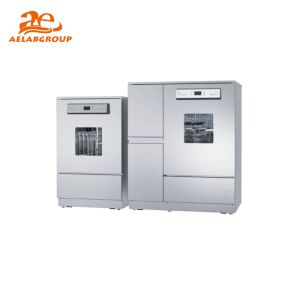
AELAB | Laboratory Equipment | Glassware Washer
A Glassware Washer automates the cleaning and disinfection of laboratory glassware, delivering repeatable, residue-free results. It boosts productivity, minimizes contamination, and supports regulatory compliance across research and quality environments.
A glassware washer is a specialized laboratory appliance engineered for scientific use that automates wash, rinse, and (often) HEPA-filtered drying cycles. Unlike household dishwashers, lab-grade systems support high-temperature disinfection, precise rinse protocols, and acid/alkaline-compatible programs tailored to delicate or complex glassware, helping labs achieve consistent cleanliness with less manual handling and risk.
| Feature | Details |
|---|---|
| Multiple Program Cycles | Customizable wash, rinse, and dry settings for varied glassware and residues |
| HEPA-Filtered Drying | Particle-controlled drying to keep items clean and ready to use |
| Chamber Construction | Stainless steel interior for durability and corrosion resistance |
| Detergent Compatibility | Supports acid, alkaline, and enzymatic cleaners |
| Thermal Disinfection | High-temperature rinse often ≥ 93 °C (200 °F) |
| Racking System | Modular racks for flasks, pipettes, cylinders, and specialized adapters |
| Water Treatment | Built-in water softener to reduce scaling and improve detergent efficacy |
| User Interface | Touchscreen controls with cycle programming and monitoring |
| Aspect | Glassware Washer | Manual Cleaning |
|---|---|---|
| Labor | Low; automated, minimal supervision | High; staff time and effort |
| Consistency | High; validated, repeatable cycles | Variable; technique-dependent |
| Contamination Risk | Low; controlled process and rinsing | Higher; residuals and handling errors |
| Chemical Exposure | Minimal; enclosed dosing | Direct; manual contact with agents |
| Glassware Damage | Reduced; gentle, secured racks | Higher; scrubbing/mishandling |
| Water/Energy Usage | Optimized for sustainability | Often inefficient |
Q: Can I use a home dishwasher for lab glassware?
A: No. Household dishwashers lack the precision, temperature control, and chemical resistance required for scientific applications.
Q: How long does a typical wash cycle take?
A: Depending on the model and program, cycles typically run 30–90 minutes, including drying.
Q: Is drying included?
A: Many lab washers include HEPA-filtered hot air drying; some offer drying as an optional module.
Q: Which detergents should I use?
A: Use lab-grade acidic, alkaline, or enzymatic detergents recommended by the manufacturer and matched to your residue type.
Looking for specific lab equipment? Fill out the form below, and our team will get back to you with detailed information and a personalized quote.