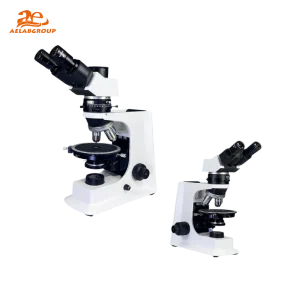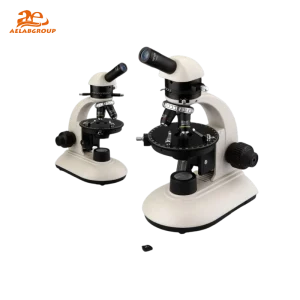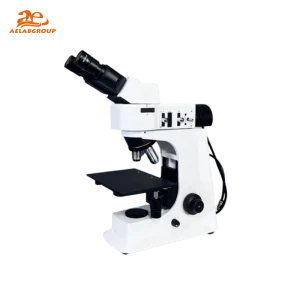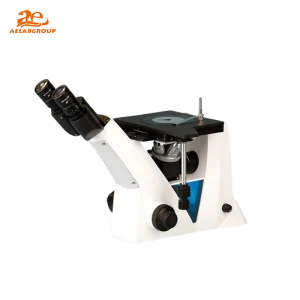
AELAB | Laboratory Equipment | Microscope | Polarizing Microscope
A laboratory polarizing microscope is a specialized optical instrument designed to analyze birefringent materials such as minerals, polymers, crystals, and biological tissues. By utilizing polarized light, it enhances contrast and reveals structural details invisible under normal light conditions. This microscope is widely used in geology, materials science, chemistry, forensics, and biomedical research for detailed optical analysis of anisotropic substances.
A polarizing microscope employs polarized light filters and optical components to study materials that exhibit birefringence — the property of splitting light into two rays. It consists of a polarizer below the specimen and an analyzer above it, which work together to detect variations in light transmission caused by anisotropic structures. The resulting interference colors and contrast patterns reveal information about composition, texture, and orientation of the sample.
| Feature | Details |
|---|---|
| Polarizers | Crossed polarizer and analyzer for controlling light polarization |
| Stage | Rotating mechanical stage with degree markings for angular analysis |
| Compensators | Retardation and wave plates to enhance interference colors |
| Objectives | High-magnification lenses optimized for polarized light imaging |
| Light Source | LED or halogen illumination with adjustable intensity |
| Analyzer Type | Fixed or rotatable analyzer for fine-tuning optical contrast |
| Imaging Integration | Digital camera and software for image capture and measurement |
| Magnification Range | Typically 40× to 1000×, depending on objectives |
| Aspect | Polarizing Microscope | Brightfield Microscope |
|---|---|---|
| Light Source | Uses polarized light with polarizer and analyzer filters | Uses unpolarized white light |
| Primary Use | Analyzing birefringent materials | General observation of stained or transparent specimens |
| Image Contrast | Enhanced by interference colors and optical effects | Contrast depends on staining or light adjustment |
| Stage Function | Rotating stage for angular measurements | Fixed or simple mechanical stage |
| Applications | Geology, materials science, forensics | Education, histology, microbiology |
Q: What is the main purpose of a polarizing microscope?
A: It is used to examine birefringent materials and determine their optical and structural properties using polarized light.
Q: What materials are best analyzed with polarizing microscopy?
A: Minerals, crystals, polymers, and biological tissues that alter light polarization are ideal for analysis.
Q: How does a polarizer differ from an analyzer?
A: The polarizer filters light into a single plane, while the analyzer detects light emerging from the specimen, revealing birefringent effects.
Q: Can a polarizing microscope be used for routine biological samples?
A: While possible, it is best suited for birefringent specimens; standard biological samples are typically analyzed using brightfield or phase-contrast microscopes.
Looking for specific lab equipment? Fill out the form below, and our team will get back to you with detailed information and a personalized quote.