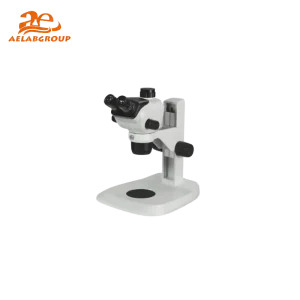
AELAB | Laboratory Equipment | Microscope | Stereo Zoom Microscope
A laboratory stereo zoom microscope is a precision optical instrument that provides three-dimensional observation of specimens with adjustable magnification. Offering a wide field of view and excellent depth perception, it is widely used in biological research, electronics inspection, quality control, and forensic analysis. Its versatility and ergonomic design make it a vital tool for both laboratory and industrial environments.
A stereo zoom microscope, also known as a dissecting microscope, utilizes two independent optical paths to produce a 3D image of the specimen. The zoom mechanism allows continuous magnification adjustments, providing smooth transitions between low and high magnification levels without changing lenses. This feature enables users to observe specimens in detail while maintaining spatial awareness and depth.
| Feature | Details |
|---|---|
| Magnification Range | Typically 7× to 45×, extendable with auxiliary lenses |
| Optical System | Two independent optical paths for 3D visualization |
| Zoom Ratio | Continuous zoom system (commonly 6.3:1 to 10:1) |
| Illumination | LED or halogen top and bottom lighting with adjustable intensity |
| Working Distance | Long working distance (up to 200 mm) for specimen handling |
| Head Type | Binocular or trinocular with ergonomic tilt adjustment |
| Digital Integration | Camera and software support for image capture and analysis |
| Stand Type | Boom, pillar, or articulated arm stand for flexible positioning |
| Aspect | Stereo Zoom Microscope | Compound Microscope |
|---|---|---|
| Image Type | 3D image with depth perception | 2D image with high magnification |
| Magnification Range | Low to medium (7×–90×) | High (40×–1000×) |
| Working Distance | Long, ideal for manipulation | Short, suited for thin sections |
| Applications | Industrial inspection, dissection, quality control | Cellular and microbiological research |
| Ease of Use | Simple zoom adjustment and ergonomic operation | Requires slide preparation and focus precision |
Q: What makes a stereo zoom microscope different from a regular microscope?
A: It provides a 3D image using two optical paths and offers adjustable zoom magnification for flexible observation.
Q: Can a stereo zoom microscope be used for biological research?
A: Yes. It is ideal for observing live specimens, insects, and plants that require three-dimensional visualization.
Q: What is the advantage of a trinocular stereo microscope?
A: It includes a third port for connecting a camera, enabling digital imaging and video documentation.
Q: Is the illumination adjustable in stereo zoom microscopes?
A: Most models feature adjustable LED or halogen lighting for optimal contrast and clarity under various conditions.
Looking for specific lab equipment? Fill out the form below, and our team will get back to you with detailed information and a personalized quote.