AELAB | Laboratory Equipment | Rotary Evaporator
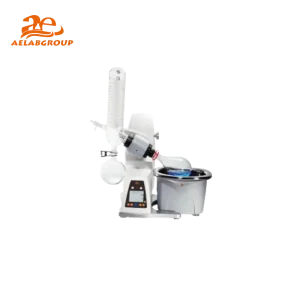
The Rotary Evaporator is a cornerstone of modern laboratories, designed for the gentle and efficient removal of solvents through evaporation. Commonly called a “rotovap,” this instrument is vital in chemistry, pharmaceutical, and food science research for concentrating and purifying samples. Its controlled temperature and vacuum operation ensure precise solvent recovery while preserving sensitive compounds.
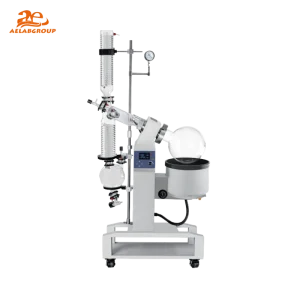
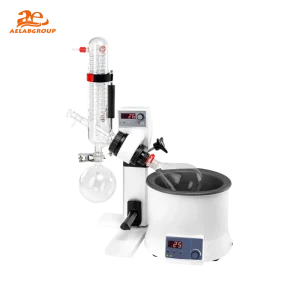
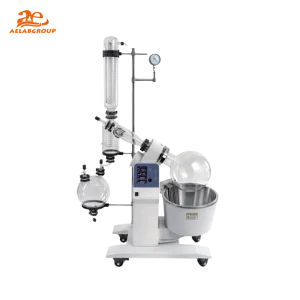
A rotary evaporator (rotovap) removes volatile solvents from samples under reduced pressure. The system combines rotation, vacuum, and controlled heating to accelerate evaporation while minimizing thermal stress on compounds. As the flask rotates in a heated bath, the solvent vaporizes, condenses on a cooling coil, and is collected in a receiving flask for reuse or analysis.
| Feature | Details |
|---|---|
| Flask Capacity | 0.5 L to 20 L (varies by model) |
| Heating Bath Temperature | Ambient to 180°C with digital control |
| Rotation Speed | 20–280 RPM adjustable |
| Vacuum Range | 1–10 mbar (depending on pump) |
| Condenser Type | Vertical or diagonal glass condenser |
| Control Interface | Digital or analog with speed/temperature settings |
| Safety Features | Over-temperature protection, dry-run prevention |
| Construction Material | Borosilicate glass and chemical-resistant materials |
| Technique | Pros | Cons |
|---|---|---|
| Rotary Evaporator | Fast, gentle, precise solvent recovery | Higher cost than basic setups |
| Vacuum Oven | Ideal for drying solids | Slower and less efficient for liquids |
| Freeze Dryer (Lyophilizer) | Excellent for biological samples | Expensive and time-consuming |
| Simple Distillation | Low-cost and easy setup | Limited control and efficiency |
Q: How does a rotary evaporator work?
A: It rotates a flask containing liquid in a heated bath under reduced pressure. The vacuum lowers the boiling point, allowing solvent evaporation and condensation into a receiving flask.
Q: What are the main components of a rotary evaporator?
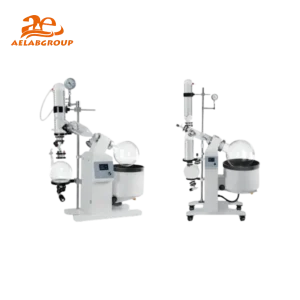
A: Key parts include a rotary motor, heating bath, vacuum pump, condenser, receiving flask, and digital control panel.
Q: What safety precautions should I follow when using a rotovap?
A: Always vent the system before opening, avoid overfilling flasks, use anti-bumping granules, and ensure seals are intact to prevent implosion.
Q: Why use a rotary evaporator instead of distillation?
A: A rotary evaporator provides faster, low-temperature evaporation, preserving sensitive compounds and offering better solvent recovery efficiency.
Looking for specific lab equipment? Fill out the form below, and our team will get back to you with detailed information and a personalized quote.