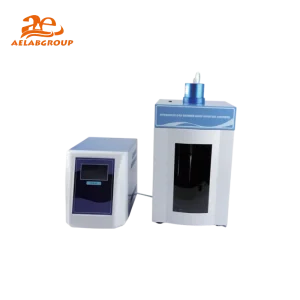
AELAB | Laboratory Equipment | Ultrasonic | Ultrasonic Cell
An Ultrasonic Cell Disruptor is a powerful laboratory device that uses high-frequency ultrasonic waves to break cell membranes and release cellular contents. This sonication-based process is widely applied in molecular biology, biochemistry, and life science research for efficient extraction of proteins, DNA, and other biomolecules.
An Ultrasonic Cell Disruptor operates by generating ultrasonic waves that create rapid pressure variations in a liquid medium. These fluctuations cause the formation and collapse of microscopic bubbles, a phenomenon known as cavitation. The resulting energy disrupts cell walls and membranes, enabling the extraction of intracellular materials such as nucleic acids, proteins, and organelles without significant thermal damage.
| Feature | Details |
|---|---|
| Frequency Range | 20–40 kHz (adjustable for different cell types) |
| Power Output | 100–1500 W, depending on model and volume |
| Cavitation Mechanism | Ultrasonic waves generate microbubbles that collapse, producing shear forces to lyse cells |
| Temperature Control | Integrated cooling or pulsed mode to minimize heat buildup |
| Timer and Pulse Settings | Programmable cycles for controlled sonication |
| Material Compatibility | Compatible with glass, plastic, and stainless-steel vessels |
| Safety Features | Overload protection, temperature monitoring, noise reduction enclosure |
| Aspect | Ultrasonic Cell Disruptor | Mechanical Homogenizer |
|---|---|---|
| Disruption Method | Ultrasonic cavitation via sound waves | Mechanical shear and grinding |
| Sample Heating | Minimal, controlled by pulsed operation | Higher due to friction |
| Efficiency | High, uniform disruption | Variable depending on sample |
| Maintenance | Low, fewer moving parts | High, mechanical wear common |
| Contamination Risk | Minimal due to closed system | Higher due to physical contact |
Q: What is sonication in cell disruption?
A: Sonication is the process of using ultrasonic waves to generate cavitation in a liquid, breaking down cell membranes and releasing intracellular contents.
Q: Can ultrasonic cell disruptors be used for all cell types?
A: Yes, they can be adapted for bacterial, yeast, plant, and mammalian cells by adjusting power, duration, and temperature settings.
Q: How do I prevent overheating during sonication?
A: Use pulsed sonication, cooling baths, or ice jackets to maintain optimal sample temperature.
Q: What volume range can ultrasonic disruptors handle?
A: Depending on the probe and model, they can process volumes from a few milliliters up to several hundred milliliters.
Looking for specific lab equipment? Fill out the form below, and our team will get back to you with detailed information and a personalized quote.