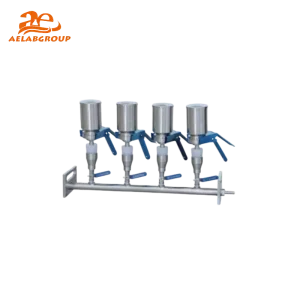
AELAB | Laboratory Equipment | Vacuum Filtration
Vacuum Filtration is a core laboratory technique for efficient separation of solids and liquids. By using reduced pressure, it speeds up the filtration process, delivering clean, dry residues ideal for chemical, pharmaceutical, and environmental analysis. Compared to gravity filtration, it’s faster, more precise, and highly reproducible.
Vacuum filtration is a technique that uses negative pressure to draw liquid through a filter paper, leaving solid residues behind. Typically performed using a Buchner funnel, filter flask, and a vacuum pump, it enhances separation speed and accuracy—making it a standard method in analytical and preparative laboratories worldwide.
| Feature | Details |
|---|---|
| Filtration Principle | Reduced pressure pulls liquid through filter paper |
| Typical Components | Buchner funnel, filter flask, vacuum pump, tubing |
| Material Compatibility | Borosilicate glass, ceramic, or PTFE |
| Pressure Range | Down to −0.09 MPa (varies by pump type) |
| Filter Paper Pore Size | 0.2 – 25 µm depending on particle size |
| Safety Features | Thick-walled flasks, vacuum traps, splash guards |
| Applications | Solid-liquid separation, purification, pollutant analysis |
| Feature | Vacuum Filtration | Gravity Filtration |
|---|---|---|
| Speed | Fast and efficient | Slow, natural flow |
| Equipment | Requires pump, funnel, flask | Basic funnel and flask |
| Precision | High, effective for fine particles | Lower, suited for coarse particles |
| Drying Capability | Excellent—removes residual solvent | Limited drying |
| Ideal Use | Analytical chemistry, synthesis, purification | Educational labs, simple separations |
Q: Can vacuum filtration be used with hot liquids?
A: Yes, but always use heat-resistant glassware and avoid rapid temperature changes to prevent breakage.
Q: What type of filter paper should I use?
A: Choose based on pore size and sample type—fine grades (5–6) for small particles, and coarse grades (1) for faster flow rates.
Q: Is vacuum filtration safe for volatile solvents?
A: Use in a fume hood with vacuum traps to prevent vapor backflow and ensure safe operation with flammable materials.
Q: Why is my vacuum filtration slow?
A: Check for air leaks, clogged filter paper, or insufficient vacuum pressure; reseal connections and replace paper if needed.
Looking for specific lab equipment? Fill out the form below, and our team will get back to you with detailed information and a personalized quote.