AELAB | Life Science Research | ATP FluorescenceDetector
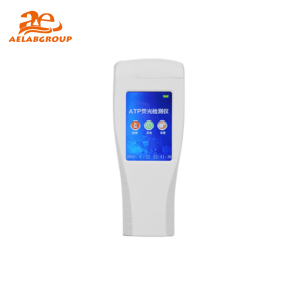
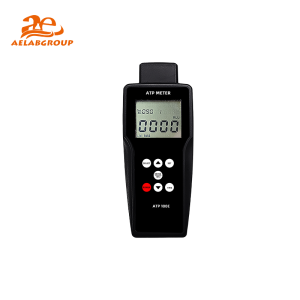
An ATP fluorescence detector enables rapid hygiene verification by quantifying adenosine triphosphate (ATP) on surfaces or in liquids. Delivering actionable results in seconds, an ATP fluorescence detector helps food, healthcare, and pharmaceutical operations minimize contamination risk and maintain regulatory compliance.
An ATP fluorescence detector is a handheld or benchtop instrument that measures ATP as a proxy for biological residue. A swabbed sample is mixed with a luciferase-based reagent; the ensuing light signal (reported as Relative Light Units, RLUs) correlates with ATP concentration—higher RLUs indicate greater contamination. Fluorescence/bioluminescence chemistry delivers near-real-time results to guide cleaning validation and corrective actions.
| Feature | Details |
|---|---|
| Detection Method | Fluorescence/bioluminescence (luciferase-luciferin reaction) |
| Measurement Unit | RLUs (Relative Light Units) |
| Detection Range | ~1 to >1,000,000 RLUs (model dependent) |
| Response Time | < 30 seconds per test |
| Sample Types | Surface swabs, rinse water, process liquids, food-contact residues |
| Power & I/O | Battery-operated or USB rechargeable; USB/Bluetooth/cloud data sync |
| Calibration/Verification | Routine instrument checks; positive/negative control swabs for validation |
| Operating Conditions | Typical 5–40 °C; protect reagents from heat/light per IFU |
| Aspect | ATP Fluorescence Detector | Bioluminescence ATP Detector |
|---|---|---|
| Sensitivity | High | Very high |
| Reagent Shelf Life | Typically longer | Typically shorter |
| Equipment Cost | Medium–High | Medium |
| Ease of Use | High (straightforward workflows) | Moderate |
| Best Fit | Broader applications; stable reagents | Focused food safety/high sensitivity use |
Q: What does an ATP fluorescence detector actually measure?
A: It quantifies ATP via light emission from a luciferase reaction; RLUs correlate with the amount of biological residue present.
Q: Can it distinguish microbial ATP from food or organic residue?
A: No—ATP assays are non-specific. Use SOPs and, when needed, microbiological tests to confirm sources.
Q: How often should I calibrate or verify the device?
A: Follow site policy; many programs verify daily or per shift with control swabs and perform periodic instrument calibration.
Q: What RLU threshold is acceptable?
A: Thresholds are application- and surface-specific. Establish baselines during validated cleaning, then set action limits accordingly.
Looking for specific lab equipment? Fill out the form below, and our team will get back to you with detailed information and a personalized quote.