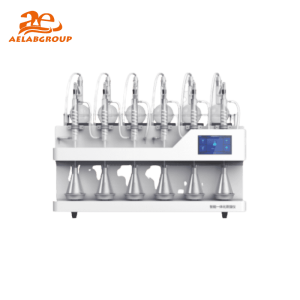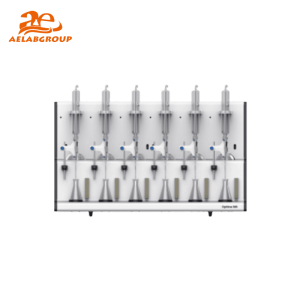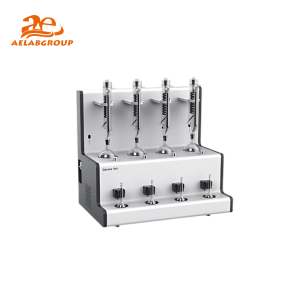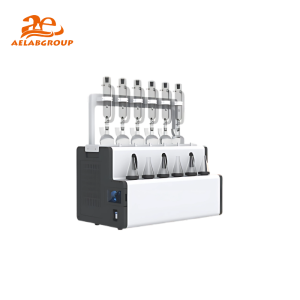
AELAB | Petroleum Testing Equipment | Distillation Tester
A Distillation Tester determines the boiling range of petroleum products under standardized conditions. It is essential for assessing volatility, performance, and compliance of fuels and solvents in quality-control labs. This guide explains what a Distillation Tester is, how it works, and how to select the right model.
A distillation tester is a laboratory instrument that simulates fractional distillation to measure initial and final boiling points and the temperatures at specified distillate volume percentages (e.g., 10%, 50%, 90%). It is widely used in refineries, fuel-testing labs, and chemical QC facilities to generate a distillation curve that reflects product composition and volatility. Results support regulatory compliance with methods such as ASTM D86 and ISO 3405.
| Feature | Details |
|---|---|
| Measurement Outputs | IBP, FBP, and temperatures at 10%, 50%, 90% distillate; total recovery and residue |
| Sample Volume | Typically 100 mL per ASTM D86 |
| Temperature Range | 0–400 °C (or higher, model-dependent) |
| Temperature Accuracy | ±0.1 °C typical |
| Automation Levels | Manual, semi-automatic, fully automatic |
| Compliance | ASTM D86, ISO 3405, EN ISO 918 |
| Cooling Method | Air-cooled or water-cooled condenser |
| Data Interface | USB, RS-232, or Ethernet; software for curve plotting and reports |
| Safety | Over-temperature cutoffs, flame protection, enclosed test area |
| Aspect | Distillation Tester | Flash Point Tester |
|---|---|---|
| Primary Measure | Boiling range/volatility (IBP, FBP, % recovery) | Lowest temp at which vapors ignite |
| Use Case | Fuel composition and performance profiling | Safety classification and handling risk |
| Standards | ASTM D86, ISO 3405 | ASTM D93, ISO 2719 |
| Automation | Manual to fully automatic systems | Manual to fully automatic (closed/open cup) |
| Outcome | Distillation curve for formulation and QC | Single flash point value for safety compliance |
Q: What does a distillation tester measure?
A: It measures the boiling range of petroleum products, including initial and final boiling points and temperatures at specified recovery percentages.
Q: Which standard applies to fuel distillation testing?
A: ASTM D86 is the most widely used method globally, with ISO 3405 providing equivalent requirements.
Q: Are automated distillation testers worth the cost?
A: For moderate to high throughput, fully automated systems improve repeatability, reduce operator time, and streamline data reporting—often offsetting the higher upfront investment.
Q: Do I need water cooling?
A: Many systems support either air- or water-cooled condensers; choose based on available utilities, expected sample volatility, and compliance with the specified method conditions.
Looking for specific lab equipment? Fill out the form below, and our team will get back to you with detailed information and a personalized quote.