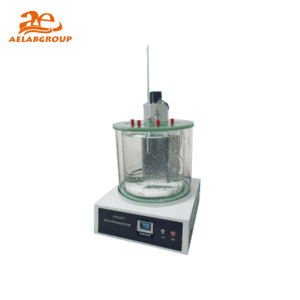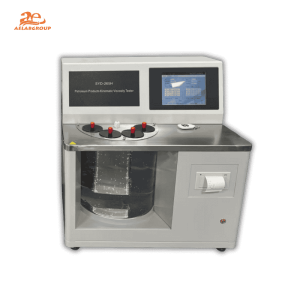
AELAB | Petroleum Testing Equipment | Kinematic Viscosity
Kinematic viscosity is a critical parameter that determines how fluids flow under the influence of gravity. It plays a vital role in the performance of lubricants, fuels, chemicals, and even food and pharmaceutical products. Understanding this property ensures optimal process efficiency, safety, and equipment longevity across scientific and industrial applications.
Kinematic viscosity is a measure of a fluid’s internal resistance to flow under gravity, defined as the ratio of dynamic viscosity to density. It is commonly expressed in centistokes (cSt). Mathematically, it is represented as:
Kinematic Viscosity (ν) = Dynamic Viscosity (μ) / Density (ρ)
Where ν is in m²/s or cSt, μ in Pa·s, and ρ in kg/m³. This property helps classify oils, fuels, and other liquids based on their flow behavior and temperature response.
| Feature | Details |
|---|---|
| Measurement Principle | Fluid flow under gravity through a calibrated capillary |
| Primary Standards | ASTM D445, ISO 3104 |
| Units | Centistokes (cSt) or mm²/s |
| Temperature Control | Typically 40°C and 100°C (±0.01°C accuracy) |
| Measurement Range | 0.3 cSt to 10,000 cSt depending on viscometer size |
| Calibration Constant | Provided with each viscometer for time–viscosity conversion |
| Sample Volume | 1–15 mL typical |
| Data Output | Manual stopwatch timing or automated digital logging |
| Feature | Kinematic Viscosity | Dynamic Viscosity |
|---|---|---|
| Symbol | ν (nu) | μ (mu) |
| Formula | μ / ρ | Force / (Area × Time) |
| Units | cSt (mm²/s) | Pa·s or N·s/m² |
| Measurement Context | Flow under gravity | Flow under applied shear force |
| Applications | Fuel, lubricant classification, quality control | Pump design, rheological modeling |
Q: What is the standard temperature for kinematic viscosity measurement?
A: Most standards specify testing at 40°C and 100°C to represent typical operational conditions for fuels and lubricants.
Q: Can dynamic viscosity be converted to kinematic viscosity?
A: Yes. Use the formula ν = μ / ρ, dividing the dynamic viscosity by the fluid density at the same temperature.
Q: Why is viscosity important in lubricants?
A: It determines the oil’s ability to form a protective film, minimizing friction and wear between engine or machinery components.
Looking for specific lab equipment? Fill out the form below, and our team will get back to you with detailed information and a personalized quote.