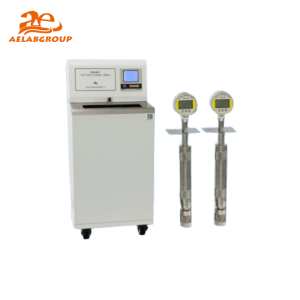
AELAB | Petroleum Testing Equipment | Vapor Pressure
Vapor pressure influences evaporation, boiling behavior, fuel volatility, and safe chemical storage. Understanding Vapor Pressure helps professionals optimize processes and reduce risk across laboratories and industry.
Vapor pressure is the pressure exerted by a vapor in equilibrium with its liquid (or solid) at a given temperature—an indicator of how readily a substance evaporates. Practically, when a liquid sits in a closed container, molecules escape to the headspace and collide with the walls, creating a measurable pressure. A higher vapor pressure means greater volatility; liquids boil when their vapor pressure equals the surrounding atmospheric pressure (e.g., water at 100 °C at 1 atm).
| Feature | Details |
|---|---|
| Definition | Equilibrium pressure of a vapor above its liquid/solid at a given temperature |
| Temperature Dependence | Increases with temperature; liquids boil when vapor pressure equals ambient pressure |
| Calculation (Antoine) | log10 P = A − B/(C + T); A, B, C are substance-specific constants (T in °C) |
| Common Units | mmHg, kPa, atm, psi |
| Measurement (Static) | Equilibrate sealed sample and read headspace pressure |
| Measurement (Dynamic) | Boil/flow methods track escaping vapor to determine pressure |
| Fuel Standard | Reid Vapor Pressure (RVP) for gasoline/volatile fuels, seasonally regulated |
| Representative Examples | Water (low), Ethanol (higher), Gasoline (very high), Mercury (low at room temp) |
| Aspect | Vapor Pressure | Partial Pressure |
|---|---|---|
| Definition | Equilibrium pressure of vapor above its own condensed phase | Pressure contribution of a gas within any gas mixture |
| Depends On | Temperature and substance properties | Mole fraction and total pressure (Dalton’s law) |
| Context | Phase equilibrium (liquid/solid ↔ vapor) | Gas mixtures (air, process streams) |
| Use Cases | Boiling, evaporation, storage limits | Breathing gas analysis, headspace composition |
| Examples | RVP of gasoline, ethanol volatility | O2 partial pressure in air |
Q: How does temperature affect vapor pressure?
A: Vapor pressure increases with temperature because more molecules have enough energy to escape the liquid; boiling occurs when vapor pressure equals ambient pressure.
Q: What is Reid Vapor Pressure (RVP)?
A: RVP is a standardized measurement of gasoline volatility used for regulatory control and seasonal fuel formulation.
Q: Which units should I report?
A: Use the unit required by your method or industry—mmHg and kPa are common; atm and psi appear in thermodynamics and U.S. pressure systems.
Q: Is vapor pressure the same as partial pressure?
A: No. Vapor pressure refers to equilibrium with its own liquid/solid; partial pressure is the contribution of any gas in a mixture, regardless of phase equilibrium.
Looking for specific lab equipment? Fill out the form below, and our team will get back to you with detailed information and a personalized quote.