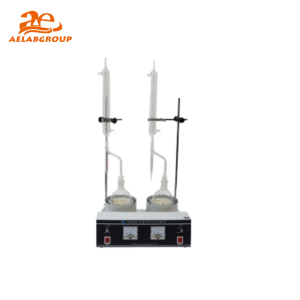
AELAB | Petroleum Testing Equipment | Water Content Tester
The Water Content Tester is an essential tool for precise moisture analysis across industries such as pharmaceuticals, food, chemicals, and construction. Accurate water content measurement ensures product quality, stability, and compliance with stringent standards. Even trace moisture can affect performance and safety, making reliable testing crucial for every laboratory and production line.
A Water Content Tester (also called a moisture analyzer or moisture meter) determines the amount of water present in solids, liquids, or gases. It operates through physical, chemical, or thermal principles to provide fast and accurate moisture readings, supporting quality control in pharmaceuticals, cosmetics, chemicals, foods, construction materials, and environmental samples.
| Feature | Details |
|---|---|
| Measurement Range | From ppm levels up to 100% moisture depending on method |
| Accuracy & Sensitivity | Down to 0.001% or 10 ppm (Karl Fischer); ±0.1% for halogen analyzers |
| Analysis Speed | Under 5 minutes (halogen) to 10–15 minutes (KF titration) |
| Display & Interface | Touchscreen, digital readout, USB/Wi-Fi connectivity |
| Sample Compatibility | Liquids, powders, solids, gases |
| Compliance Standards | USP, FDA, GLP, ISO 9001 compatible |
| Power Requirements | 100–240 V AC, 50/60 Hz |
| Aspect | Water Content Tester | Moisture Analyzer |
|---|---|---|
| Primary Measurement | Quantifies water content specifically | Measures total moisture (water + volatiles) |
| Accuracy | Very high (ppm-level with Karl Fischer) | Moderate; depends on drying temperature |
| Sample Types | Liquids, oils, gases, solids | Primarily solids and powders |
| Method Examples | Karl Fischer, LOD, titration | Halogen, infrared balance |
| Best Use Case | Trace moisture in chemicals, oils, and pharmaceuticals | Routine moisture monitoring in food and agriculture |
Q: Is a moisture analyzer the same as a water content tester?
A: Generally yes, though some analyzers may measure total volatiles, not just water.
Q: Which method is most accurate for low moisture levels?
A: Karl Fischer titration provides the highest precision for trace moisture detection down to ppm levels.
Q: How often should I calibrate my water content tester?
A: For routine use, calibration every 1–2 weeks or before critical testing is recommended.
Q: Can one tester handle all sample types?
A: No, select the instrument based on material—Karl Fischer for oils, halogen for solids, capacitance for field grains.
Looking for specific lab equipment? Fill out the form below, and our team will get back to you with detailed information and a personalized quote.