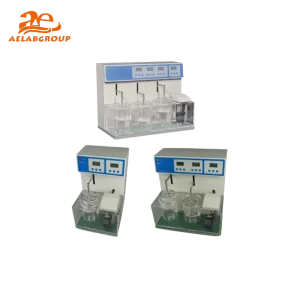
AELAB | Pharmaceutical Equipments | Disintegration Tester
A Disintegration Tester verifies that tablets and capsules break down within specified timeframes under standardized conditions. By simulating body temperature and motion, a Disintegration Tester safeguards drug safety, efficacy, and compliance for pharmaceutical manufacturers, QA teams, and regulatory labs.
Featured Snippet: A disintegration tester is a laboratory device used to determine the time it takes for tablets or capsules to break down into smaller particles under standardized conditions, typically in a liquid medium at 37 °C. The test, defined in pharmacopeial standards (USP, EP, JP), simulates in-vivo conditions to ensure dosage forms disintegrate as intended.
| Feature | Details |
|---|---|
| Number of Stations | 1–6 (choose based on throughput needs) |
| Temperature Control | 37 °C ± 2 °C water bath with heater/circulator |
| Stroke Frequency | Typically 29–32 cycles per minute (cpm) |
| Basket Rack Assembly | Tubes with mesh screens; optional discs for capsules/softgels |
| Endpoint Detection | Visual (manual) or automated sensors/camera |
| Timer Precision | High-accuracy timing per pharmacopoeial methods |
| Compliance Standards | USP <701>, EP <2.9.1>, JP, IP (model dependent) |
| Data Export | USB, Ethernet, or built-in printer; 21 CFR Part 11 options |
| Aspect | Disintegration Tester | Dissolution Tester |
|---|---|---|
| Purpose | Measures time to break down | Measures rate/extent of drug release |
| Test Medium | Water or buffer at 37 °C | Simulated gastric/intestinal fluids |
| Measurement Output | Time to disintegrate | Concentration vs. time (profiles) |
| Use Case | Early-stage QC of dosage forms | Bioavailability & performance testing |
| Complexity | Simpler setup | More advanced; requires analytics (e.g., UV/LC) |
Q: What is the typical USP limit for tablet disintegration?
A: Most immediate-release tablets should disintegrate within 30 minutes unless otherwise specified by the monograph.
Q: Can a disintegration tester handle soft gelatin capsules?
A: Yes—use appropriate discs and confirm temperature/media settings per pharmacopeial guidance.
Q: Which medium should I use?
A: Follow pharmacopeias (e.g., distilled water, 0.1 N HCl, or phosphate buffer) as defined for the dosage form.
Q: How does disintegration differ from degradation?
A: Disintegration is the physical breakup of the dosage form; degradation is chemical decomposition of ingredients.
Looking for specific lab equipment? Fill out the form below, and our team will get back to you with detailed information and a personalized quote.