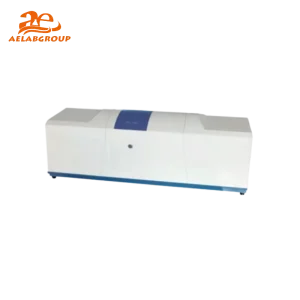
AELAB | Pharmaceutical Equipments | Laser Particle Analyzer
The Laser Particle Analyzer is a precision instrument for particle size measurement across pharmaceuticals, materials science, and food industries. By analyzing light scattering patterns, this freeze-thaw testing equipment delivers accurate size distribution data essential for R&D, formulation optimization, and quality control.
A Laser Particle Analyzer (LPA) measures the size distribution of particles suspended in liquids or gases using laser diffraction. Based on Mie or Fraunhofer scattering, it interprets how particles scatter light to calculate size ranges from nanometers to millimeters. This non-destructive technique ensures repeatable, high-accuracy results for both dry and wet samples in a matter of seconds.
| Feature | Details |
|---|---|
| Measurement Range | 0.01 µm to 3000 µm |
| Sample Types | Wet (liquid dispersion) / Dry (powders or aerosols) |
| Measurement Time | Less than 1 minute per sample |
| Accuracy | ±1–2% typical |
| Laser Source | He–Ne laser or diode laser (633 nm typical) |
| Software Features | Real-time PSD, statistical analysis, data export |
| Data Output | PSD graphs, D10, D50, D90, and span values |
| Reproducibility | High repeatability with automated calibration |
| Feature | Laser Diffraction (LPA) | DLS |
|---|---|---|
| Particle Size Range | 0.01 µm – 3000 µm | 1 nm – 1 µm |
| Sample Type | Powders, suspensions | Nanoparticles in solution |
| Speed | Fast measurement (seconds) | Moderate |
| Best Use Case | Broad particle range and industrial QC | Nanoparticles and colloids |
| Measurement Principle | Angle of scattered light | Fluctuation of scattered light intensity |
Q: Is laser particle analysis safe?
A: Yes. Most analyzers are fully enclosed and use Class 1 or 2 lasers, which are safe under normal operating conditions.
Q: What’s the difference between volume and number distributions?
A: Volume distribution highlights larger particles by volume, while number distribution treats each particle equally, ideal for nanoparticle analysis.
Q: Can dry powders be measured?
A: Yes. Many modern systems include dry dispersion modules designed for powders and aerosols.
Q: What is the typical laser lifespan?
A: Laser sources generally last 10,000–20,000 hours, depending on operating conditions and maintenance quality.
Looking for specific lab equipment? Fill out the form below, and our team will get back to you with detailed information and a personalized quote.