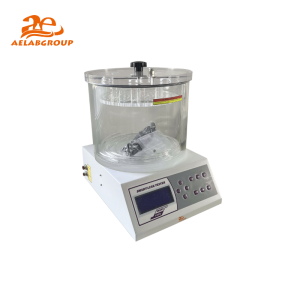
AELAB | Pharmaceutical Equipments | Leak Tester
A Leak Tester is essential for verifying the airtight or watertight integrity of components across high-stakes industries. Use a Leak Tester to detect and quantify even tiny leaks, preventing costly failures while boosting safety, performance, and compliance.
A Leak Tester is a device that identifies and measures gas or liquid escape from sealed parts and systems. It evaluates seal integrity using test methods that monitor pressure, vacuum, mass flow, or tracer gas signals to deliver quantitative leak-rate results for quality assurance and regulatory compliance.
| Feature | Details |
|---|---|
| Test Method | Pressure Decay / Vacuum Decay / Mass Flow / Tracer Gas / Bubble |
| Leak Rate Sensitivity | Up to ~1×10⁻⁶ mbar·L/s (Helium typical); specialized systems detect lower |
| Cycle Time | < 30 seconds depending on volume and method |
| Interface & Control | Touchscreen HMI; PLC/fieldbus integration for automation |
| Data Logging | Onboard storage with exportable formats; LIMS/MES connectivity |
| Compliance | Supports ISO 9001 programs; methods aligned with ASTM F2338, FDA, USP <1207> |
| Automation Support | Robotic handlers, inline fixtures, quick-connect manifolds |
| Calibration | Regular verification using certified leak standards or master parts |
| Aspect | Leak Tester | Visual Inspection |
|---|---|---|
| Detection Accuracy | High; detects micro-leaks via pressure/flow/gas signals | Low; only obvious defects visible |
| Quantitative Results | Yes; leak rate reported (e.g., mbar·L/s) | No; subjective pass/fail |
| Speed | Fast; cycle times < 30 s typical | Slow for thorough checks |
| Cost per Test | Low–Medium | Low but high labor burden |
| Automation Ready | Yes; PLC/robotic integration | No; limited automation |
| Best Use | High-volume, regulated applications needing traceable data | Quick visual scans for obvious defects |
Q: What’s the smallest leak a tester can detect?
A: High-end helium systems can detect extremely small leaks, with sensitivities commonly around 1×10⁻⁶ mbar·L/s and specialized models reaching even lower.
Q: Is leak testing destructive?
A: Most industrial methods (pressure decay, mass flow, vacuum decay) are non-destructive; bubble tests are typically non-destructive as well.
Q: Can leak testers be integrated into production lines?
A: Yes—modern systems offer PLC connectivity, robotic handling, and inline stations for automated pass/fail decisions and data capture.
Q: How often should a leak tester be calibrated?
A: Typically every 6–12 months, adjusted for usage intensity and regulatory requirements; always verify with certified leak standards.
Looking for specific lab equipment? Fill out the form below, and our team will get back to you with detailed information and a personalized quote.