AELAB | Pharmaceutical Equipments | Thawing Time Limit Tester
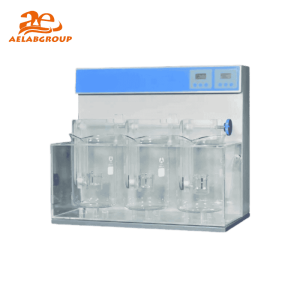
A thawing time limit tester helps food producers validate and control the duration of thawing to protect safety and quality. By automating timing, alarms, and records, a thawing time limit tester supports HACCP and regulatory compliance across meat, poultry, seafood, and food-service operations.
A Thawing Time Limit Tester is a specialized instrument that measures, monitors, and documents the time window allotted for thawing frozen food products. It tracks elapsed time (and often temperature thresholds), issues alerts when safe limits are exceeded, and logs events for HACCP, ISO, USDA/FDA audit trails—reducing human error and standardizing thawing workflows.
| Feature | Details |
|---|---|
| Real-Time Clock | Tracks elapsed thawing duration; timestamped events |
| Temperature Monitoring | Monitors defrost thresholds to avoid the 4–60 °C danger zone |
| Programmable Limits | Product-specific time windows; SOP or regulation-based presets |
| Data Logging | Automatic recording for HACCP, ISO 22000, USDA/FDA audits; exportable reports |
| Alarms | Audible/visual alerts on limit exceedance; configurable acknowledgments |
| User Interface | Touchscreen or digital display with easy program selection |
| Connectivity | USB, RS-232, LAN, or Wi-Fi; optional LIMS/FSMS integration |
| Power & Backup | Mains power with battery backup for outage protection |
| Aspect | Thawing Time Limit Tester | Manual Stopwatch / Thermometer |
|---|---|---|
| Accuracy | High—programmable and automated | Operator-dependent; prone to drift |
| Data Logging | Automatic, audit-ready logs | Manual notes; inconsistent |
| Compliance Support | Strong—HACCP/FSMS integration | Weak—harder to verify |
| Alarm Feature | Built-in audible/visual alerts | None; relies on vigilance |
| Ease of Use | Simple UI; preset programs | Training-intensive; manual timing |
Q: What does a thawing time limit tester monitor?
A: It tracks elapsed thawing time (and often temperature) against programmed limits, stores events, and triggers alarms when thresholds are exceeded.
Q: Does it replace temperature probes?
A: It complements temperature monitoring. Time control plus temperature verification provides the strongest defense against entering the danger zone.
Q: Can it integrate with HACCP or FSMS software?
A: Yes. Many models export via USB/LAN/Wi-Fi and can feed logs directly into HACCP/FSMS or LIMS for traceability.
Q: How are time limits determined?
A: Limits are set by product type, size, and regulatory/SOP guidance; presets can be configured to match USDA/FDA, ISO 22000, or internal standards.
Q: Where should the tester be installed?
A: Near thawing areas (cold rooms, prep lines, or kitchens) with clear operator access, visible/audible alarms, and protected cabling or wireless connectivity.
Looking for specific lab equipment? Fill out the form below, and our team will get back to you with detailed information and a personalized quote.