AELAB | Water Testing Equipment | Karl Fischer/Coulometric Titrator | Karl Fischer Titrator
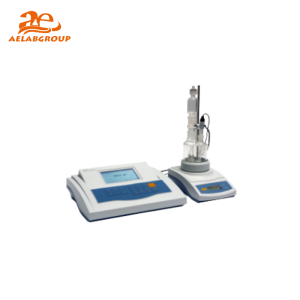
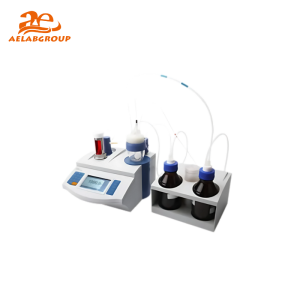
A Karl Fischer Titrator is a laboratory instrument designed to determine the water content in a wide range of samples. Using the Karl Fischer titration method, it delivers precise and reproducible moisture analysis for liquids, solids, and gases—essential in industries such as pharmaceuticals, food, chemicals, and petrochemicals for ensuring product quality and regulatory compliance.
The Karl Fischer Titrator operates based on the Karl Fischer reaction, a specific chemical reaction between iodine and water. By quantifying this reaction, the instrument measures the exact moisture content of a sample. Available in coulometric and volumetric versions, it provides flexibility for both trace and high-level moisture measurements in diverse materials.
| Feature | Details |
|---|---|
| Measurement Principle | Karl Fischer reaction between iodine and water for quantitative moisture determination |
| Titration Type | Coulometric for low moisture, volumetric for higher moisture levels |
| Measurement Range | From 1 ppm up to 100% water content |
| Accuracy | Typically ±1 µg H₂O or ±0.3% of reading |
| Sample Compatibility | Liquids, solids, and gases (with evaporation attachments) |
| Automation | Automatic reagent dosing, endpoint detection, and data processing |
| Display | Touchscreen or digital display with graphical titration curve |
| Data Interface | USB, RS-232, and LIMS connectivity for data transfer |
| Aspect | Karl Fischer Titrator | Moisture Analyzer (Gravimetric) |
|---|---|---|
| Measurement Principle | Chemical titration of water using iodine | Weight loss during controlled heating |
| Accuracy | Extremely high, specific to water | Moderate, affected by volatile compounds |
| Detection Range | 1 ppm to 100% | Usually >0.1% |
| Sample Type | Liquids, solids, gases | Mostly solids and powders |
| Specificity | Specific only to water molecules | Non-specific to water; includes volatiles |
Q: What is the principle behind a Karl Fischer Titrator?
A: It’s based on the reaction of iodine with water, allowing direct quantitative determination of moisture in a sample.
Q: What’s the difference between coulometric and volumetric titration?
A: Coulometric titration is for low water levels and generates iodine electrochemically, while volumetric titration uses added reagent for higher moisture content.
Q: Can the Karl Fischer Titrator analyze solid samples?
A: Yes, with the use of an oven or vaporizer attachment that transfers moisture into the titration cell.
Q: Why is Karl Fischer titration preferred over drying methods?
A: It is more specific, faster, and accurate—detecting only water molecules, unlike gravimetric methods that include volatiles.
Looking for specific lab equipment? Fill out the form below, and our team will get back to you with detailed information and a personalized quote.