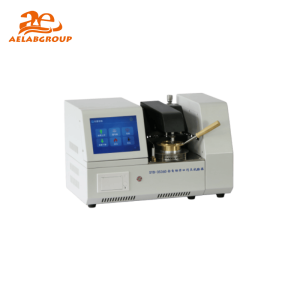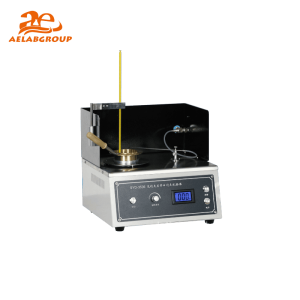
AELAB | Petroleum Testing Equipment | Flash Point Tester
A Flash Point Tester is a vital laboratory instrument used to determine the lowest temperature at which a liquid emits vapors that can ignite. Accurate flash point measurement ensures safe handling of fuels, oils, paints, and chemicals while meeting safety and transportation regulations.
A Flash Point Tester measures the minimum temperature at which a volatile liquid produces enough vapor to ignite when exposed to an ignition source. This parameter defines the flammability and volatility of materials, supporting hazard classification, quality control, and compliance with ASTM and ISO standards.
| Feature | Details |
|---|---|
| Temperature Range | Ambient to 400 °C or higher |
| Ignition Source | Flame, electric spark, or hot wire |
| Heating Rate | Programmable, per ASTM/ISO method |
| Automation Level | Manual, semi-automatic, or fully automatic |
| Sample Volume | Typically 50–100 mL |
| Compliance Standards | ASTM D93, D92; ISO 2719; EN ISO 3679/3680 |
| User Interface | Touchscreen with USB or Ethernet data export |
| Safety Features | Over-temperature protection and flame enclosure |
| Feature | Flash Point Tester | Dropping Point Tester | Melting Point Apparatus |
|---|---|---|---|
| Measures | Ignition temperature of vapors | Flow temperature of grease | Melting temperature of solids |
| Key Application | Fire safety and volatility assessment | Lubricating grease behavior | Purity and composition analysis |
| Common Standards | ASTM D93, D92, ISO 2719 | ASTM D566, D2265 | USP, ISO, ASTM D127 |
| Typical Materials | Fuels, solvents, coatings | Greases and lubricants | Waxes, drugs, crystals |
Q: What is the flash point of a liquid?
A: The flash point is the lowest temperature at which a liquid releases enough vapor to ignite momentarily when exposed to a flame or spark.
Q: How is the flash point determined?
A: A sample is gradually heated under controlled conditions, and an ignition source is introduced at intervals. The temperature at which ignition occurs is recorded as the flash point.
Q: Which method is better—closed cup or open cup?
A: Closed cup methods, such as ASTM D93, are preferred for safety-critical materials as they better simulate enclosed storage and yield lower, more conservative values.
Q: What factors can affect flash point results?
A: Contamination, sample volume, heating rate, and atmospheric pressure can all influence the measured flash point temperature.
Looking for specific lab equipment? Fill out the form below, and our team will get back to you with detailed information and a personalized quote.